
Pulp Fiction, 1922 · page 171 of 204
Adventure Magazine Cover — page 171: what you’re looking at
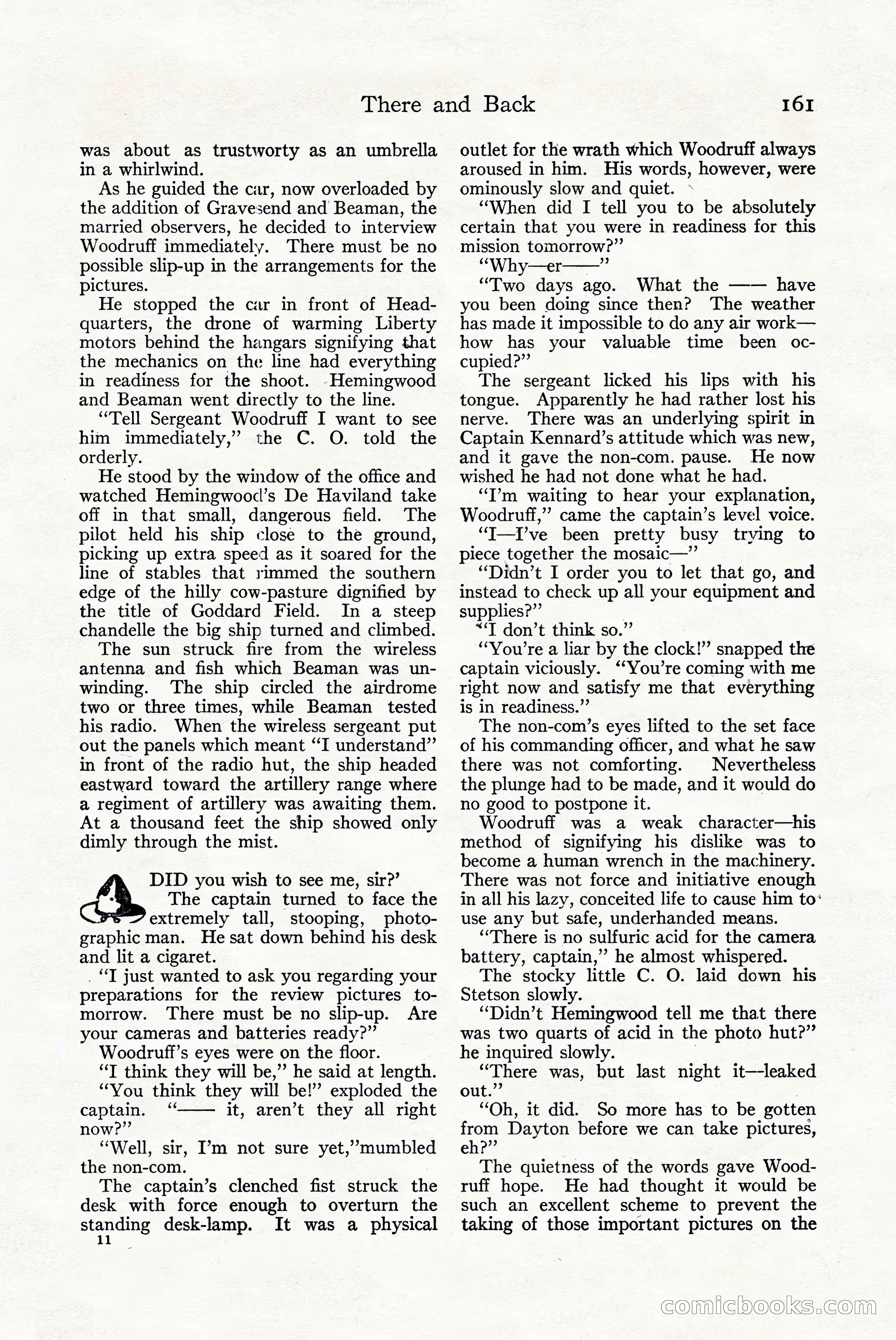
A restored page from Pulp Fiction, 1922. Page through the whole issue in the reader above.
📄 Transcribed text from this page (OCR, searchable)
Machine-transcribed from the original scan — historical spelling and the odd misread are preserved.
There and Back was about as trustworty as an umbrella In a whirlwind. As he guided the car, now overloaded by the addition of Gravesend and Beaman, the married observers, he decided to interview Woodruff immediately. There must be no possible slip-up in the arrangements for the pictures. He stopped the car in front of Head- quarters, the drone of warming Liberty motors behind the hangars signifying that the mechanics on the line had everything in readiness for the shoot. -Hemingwood and Beaman went directly to the line. “Tell Sergeant Woodruff I want to see him immediately,” the C. O. told the orderly. He stood by the window of the office and watched Hemingwoocl’s De Haviland take off in that small, dangerous field. The pilot held his ship close to the ground, picking up extra speed as it soared for the line of stables that rimmed the southern edge of the hilly cow-pasture dignified by the title of Goddard Field. In a steep chandelle the big ship turned and climbed. The sun struck fire from the wireless antenna and fish which Beaman was un- winding. The ship circled the airdrome two or three times, while Beaman _ tested his radio. When the wireless sergeant put out the panels which meant “TI understand”’ in front of the radio hut, the ship headed eastward toward the artillery range where a regiment of artillery was awaiting them. At a thousand feet the ship showed only dimly through the mist. raX The captain turned to face the extremely tall, stooping, photo- graphic man. He sat down behind his desk and lit a cigaret. _“T just wanted to ask you regarding your preparations for the review pictures to- morrow. ‘There must be no slip-up. Are your cameras and batteries ready?” Woodruff’s eyes were on the floor. “T think they will be,” he said at length. “You think they will be!” exploded the captain. ‘ it, aren’t they all right now?” “Well, sir, I’m not sure yet,’”’mumbled the non-com. The captain’s clenched fist struck the desk with force enough to overturn the standing desk-lamp. It was a physical DID you wish to see me, sir?’ 161 outlet for the wrath which Woodruff always aroused in him. His words, however, were ominously slow and quiet. ‘“‘When did I tell you to be absolutely certain that you were in readiness for this mission tomorrow?” “Why—er “Two days ago. What the —— have you been doing since then? The weather has made it impossible to do any air work— how has your valuable time been oc- cupied?”’ The sergeant licked his lips with his tongue. Apparently he had rather lost his nerve. There was an underlying spirit in Captain Kennard’s attitude which was new, and it gave the non-com. pause. He now wished he had not done what he had. “I’m waiting to hear your explanation, Woodruff,” came the captain’s level voice. “TI—I’ve been pretty busy trying to piece together the mosaic—”’ “Didn’t I order you to let that go, and instead to check up all your equipment and supplies?”’ “‘T don’t think so.’ “Vou’re a liar by the clock!” snapped the captain viciously. “‘You’re coming with me right now and satisfy me that everything is in readiness.”’ The non-com’s eyes lifted to the set face of his commanding officer, and what he saw there was not comforting. Nevertheless the plunge had to be made, and it would do no good to postpone it. Woodruff was a weak character—his method of signifying his dislike was to become a human wrench in the machinery. There was not force and initiative enough in all his lazy, conceited life to cause him to‘ use any but safe, underhanded means. ‘There is no sulfuric acid for the camera battery, captain,” he almost whispered. The stocky little C. O. laid down his Stetson slowly. “Didn’t Hemingwood tell me that there was two quarts of acid in the photo hut?” he inquired slowly. “There was, but last night it—-leaked out.” “Oh, it did. So more has to be gotten from Dayton before we can take pictures, eh?”’ The quietness of the words gave Wood- ruff hope. He had thought it would be such an excellent scheme to prevent the taking of those important pictures on the MICLOOOK C©