
Pulp Fiction, 1922 · page 151 of 204
Adventure Magazine Cover — page 151: what you’re looking at
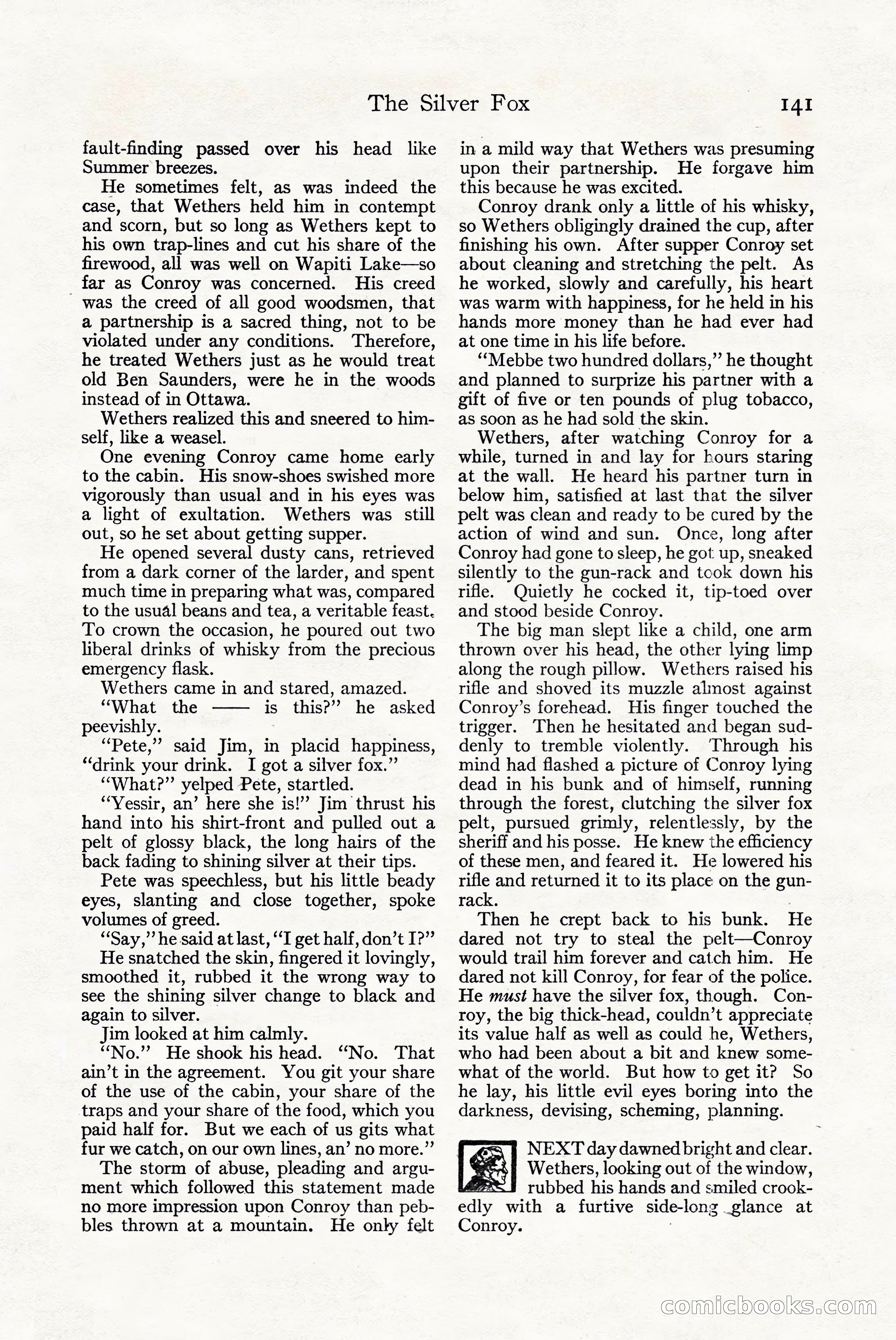
A restored page from Pulp Fiction, 1922. Page through the whole issue in the reader above.
📄 Transcribed text from this page (OCR, searchable)
Machine-transcribed from the original scan — historical spelling and the odd misread are preserved.
The Silver Fox fault-finding passed over his head like Summer breezes. He sometimes felt, as was indeed the case, that Wethers held him in contempt and scorn, but so long as Wethers kept to his own trap-lines and cut his share of the firewood, all was well on Wapiti Lake—so _far as Conroy was concerned. His creed was the creed of all good woodsmen, that a partnership is a sacred thing, not to be violated under any conditions. Therefore, he treated Wethers just as he would treat old Ben Saunders, were he in the woods instead of in Ottawa. Wethers realized this and sneered to him- self, like a weasel. One evening Conroy came home early to the cabin. His snow-shoes swished more vigorously than usual and in his eyes was a light of exultation. Wethers was still out, so he set about getting supper. He opened several dusty cans, retrieved from a dark corner of the larder, and spent much time in preparing what was, compared to the usual beans and tea, a veritable feast. To crown the occasion, he poured out two liberal drinks of whisky from the precious emergency flask. Wethers came in and stared, amazed. “What the is this?” he asked peevishly. “Pete,” said Jim, in placid happiness, “drink your drink. I got a silver fox.” ‘““‘What?”’ yelped Pete, startled. ‘“Yessir, an’ here she is!’ Jim thrust his hand into his shirt-front and pulled out a pelt of glossy black, the long hairs of the back fading to shining silver at their tips. Pete was speechless, but his little beady eyes, slanting and close together, spoke volumes of greed. “Say,” he said at last, “I get half, don’t I?” He snatched the skin, fingered it lovingly, smoothed it, rubbed it the wrong way to see the shining silver change to black and again to silver. Jim looked at him calmly. “‘No.”’ He shook his head. “No. That ain’t in the agreement. You git your share of the use of the cabin, your share of the traps and your share of the food, which you paid half for. But we each of us gits what fur we catch, on our own lines, an’ no more.”’ The storm of abuse, pleading and argu- ment which followed this statement made no more impression upon Conroy than peb- bles thrown at a mountain. He only felt I4I in a mild way that Wethers was presuming upon their partnership. He forgave him this because he was excited. Conroy drank only a little of his whisky, so Wethers obligingly drained the cup, after finishing his own. After supper Conroy set about cleaning and stretching the pelt. As he worked, slowly and carefully, his heart was warm with happiness, for he held in his hands more money than he had ever had at one time in his life before. ““Mebbe two hundred dollars,”’ he thought and planned to surprize his partner with a gift of five or ten pounds of plug tobacco, as soon as he had sold the skin. Wethers, after watching Conroy for a while, turned in and lay for hours staring at the wall. He heard his partner turn in below him, satisfied at last that the silver pelt was clean and ready to be cured by the action of wind and sun. Once, long after Conroy had gone to sleep, he got up, sneaked silently to the gun-rack and took down his rifle. Quietly he cocked it, tip-toed over and stood beside Conroy. The big man slept like a child, one arm thrown over his head, the other lying limp along the rough pillow. Wethers raised his rifle and shoved its muzzle almost against Conroy’s forehead. His finger touched the trigger. Then he hesitated and began sud- denly to tremble violently. ‘Through his mind had flashed a picture of Conroy lying dead in his bunk and of himself, running through the forest, clutching the silver fox pelt, pursued grimly, relentlessly, by the sheriff and his posse. He knew the efficiency of these men, and feared it. He lowered his rifle and returned it to its place on the gun- rack. Then he crept back to his bunk. He dared not try to steal the pelt—Conroy would trail him forever and catch him. He dared not kill Conroy, for fear of the police. He must have the silver fox, though. Con- roy, the big thick-head, couldn’t appreciate its value half as well as could he, Wethers, who had been about a bit and knew some- what of the world. But how to get it? So he lay, his little evil eyes boring into the darkness, devising, scheming, planning. Wethers, looking out of the window, oP rubbed his hands and smiled crook- aly with a furtive side-long glance at Conroy. DOOK NEXT day dawned bright and clear. (C@