
Pulp Fiction, 1922 · page 138 of 204
Adventure Magazine Cover — page 138: what you’re looking at
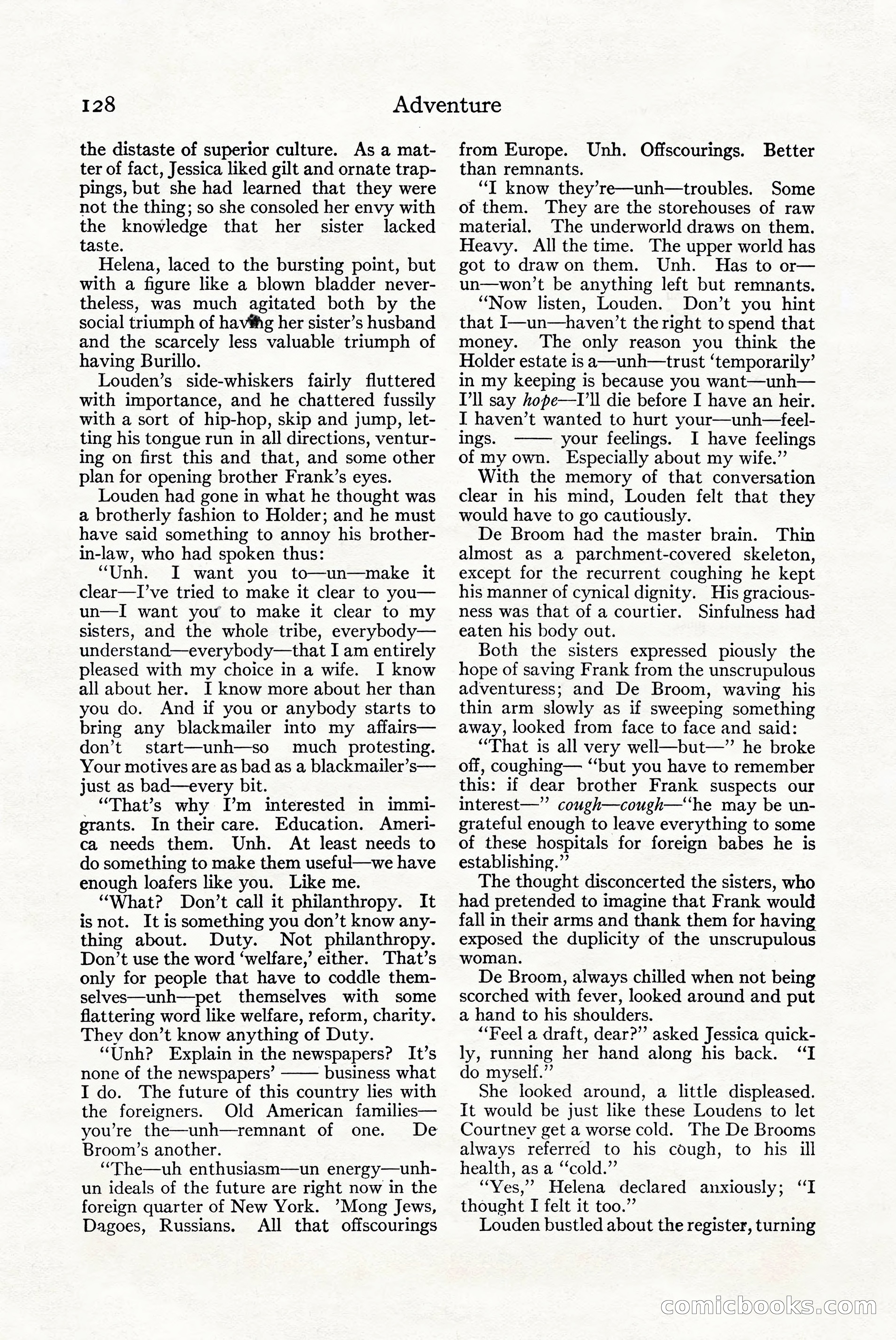
A restored page from Pulp Fiction, 1922. Page through the whole issue in the reader above.
📄 Transcribed text from this page (OCR, searchable)
Machine-transcribed from the original scan — historical spelling and the odd misread are preserved.
128 the distaste of superior culture. As a mat- ter of fact, Jessica liked gilt and ornate trap- pings, but she had learned that they were not the thing; so she consoled her envy with the knowledge that her sister lacked taste. Helena, laced to the bursting point, but with a figure like a blown bladder never- theless, was much agitated both by the social triumph of hav#hg her sister’s husband and the scarcely less valuable triumph of having Burillo. Louden’s side-whiskers fairly fluttered with importance, and he chattered fussily with a sort of hip-hop, skip and jump, let- ting his tongue run in all directions, ventur- Ing on first this and that, and some other plan for opening brother Frank’s eyes. Louden had gone in what he thought was a brotherly fashion to Holder; and he must have said something to annoy his brother- in-law, who had spoken thus: “Unh. I want you to—un—make it clear—I’ve tried to make it clear to you— un—I want you to make it clear to my sisters, and the whole tribe, everybody— understand—everybody—that I am entirely pleased with my choice in a wife. I know all about her. I know more about her than you do. And if you or anybody starts to bring any blackmailer into my affairs— don’t start—unh—so much protesting. Your motives are as bad as a blackmailer’s— just as bad—every bit. _“That’s why I’m interested in immi- grants. In their care. Education. Ameri- ca needs them. Unh. At least needs to do something to make them useful—we have enough loafers like you. Like me. “What? Don’t call it philanthropy. It isnot. It is something you don’t know any- thing about. Duty. Not philanthropy. Don’t use the word ‘welfare,’ either. That’s only for people that have to coddle them- selves—unh—pet themselves with some flattering word like welfare, reform, charity. They don’t know anything of Duty. “Unh? Explain in the newspapers? It’s none of the newspapers’ business what I do. The future of this country lies with the foreigners. Old American families— you’re the—unh—remnant of one. De Broom’s another. ‘“The—uh enthusiasm—un energy—unh- un ideals of the future are right now in the foreign quarter of New York. ’Mong Jews, Dagoes, Russians. All that offscourings Adventure from Europe. Unh. Offscourings. Better than remnants. “I know they’re—unh—troubles. Some of them. They are the storehouses of raw material. The underworld draws on them. Heavy. All the time. The upper world has got to drawon them. Unh. Has to or— un—won’t be anything left but remnants. “Now listen, Louden. Don’t you hint that I—un—haven’t the right to spend that money. The only reason you think the Holder estate is a—unh—trust ‘temporarily’ in my keeping is because you want—unh— I'll say hope—I'll die before I have an heir. I haven’t wanted to hurt your—unh—feel- ings. your feelings. I have feelings of my own. Especially about my wife.” With the memory of that conversation clear in his mind, Louden felt that they would have to go cautiously. De Broom had the master brain. Thin almost as a parchment-covered skeleton, except for the recurrent coughing he kept his manner of cynical dignity. His gracious- ness was that of a courtier. Sinfulness had eaten his body out. Both the sisters expressed piously the hope of saving Frank from the unscrupulous adventuress; and De Broom, waving his thin arm slowly as if sweeping something away, looked from face to face and said: “That is all very well—but—” he broke off, coughing— “‘but you have to remember this: if dear brother Frank suspects our interest—”’ cough—cough—‘‘he may be un- grateful enough to leave everything to some of these hospitals for foreign babes he is establishing.” The thought disconcerted the sisters, who had pretended to imagine that Frank would fall in their arms and thank them for having exposed the duplicity of the unscrupulous woman. : De Broom, always chilled when not being scorched with fever, looked around and put a hand to his shoulders. “Feel a draft, dear?’ asked Jessica quick- ly, running her hand along his back. “I do myself.” She looked around, a little displeased. It would be just like these Loudens to let Courtnev get a worse cold. The De Brooms always referred to his cough, to his ill health, as a “‘cold.” “Yes,” Helena declared anxiously; “I thought I felt it too.” Louden bustled about the register, turning MICLOOOK (C©