
Pulp Fiction, 1922 · page 134 of 204
Adventure Magazine Cover — page 134: what you’re looking at
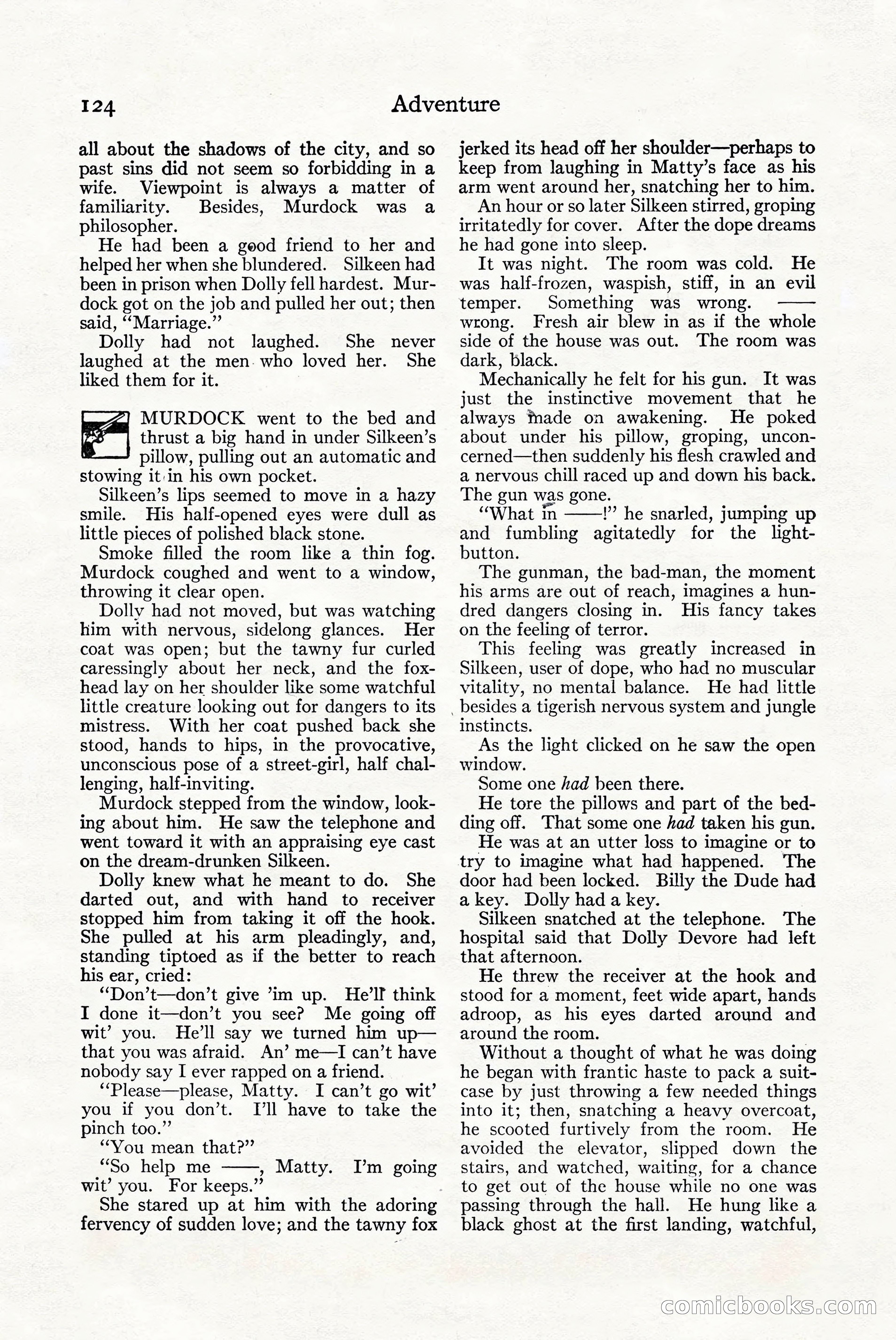
A restored page from Pulp Fiction, 1922. Page through the whole issue in the reader above.
📄 Transcribed text from this page (OCR, searchable)
Machine-transcribed from the original scan — historical spelling and the odd misread are preserved.
124 all about the shadows of the city, and so past sins did not seem so forbidding in a wife. Viewpoint is always a matter of familiarity. Besides, Murdock was a philosopher. He had been a good friend to her and helped her when she blundered. Silkeen had been in prison when Dolly fell hardest. Mur- dock got on the job and pulled her out; then said, “‘Marriage.”’ Dolly had not laughed. laughed at the men. who loved her. liked them for it. She never She ee MURDOCK went to the bed and thrust a big hand in under Silkeen’s pillow, pulling out an automatic and stowing it In his own pocket. Silkeen’s lips seemed to move in a hazy smile. His half-opened eyes were dull as little pieces of polished black stone. Smoke filled the room like a thin fog. Murdock coughed and went to a window, throwing it clear open. Dolly had not moved, but was watching him with nervous, sidelong glances. Her coat was open; but the tawny fur curled caressingly about her neck, and the fox- head lay on her shoulder like some watchful little creature looking out for dangers to its mistress. With her coat pushed back she stood, hands to hips, in the provocative, unconscious pose of a street-girl, half chal- lenging, half-inviting. Murdock stepped from the window, look- ing about him. He saw the telephone and went toward it with an appraising eye cast on the dream-drunken Silkeen. Dolly knew what he meant to do. She darted out, and with hand to receiver stopped him from taking it off the hook. She pulled at his arm pleadingly, and, standing tiptoed as if the better to reach his ear, cried: ‘“‘Don’t—don’t give ’im up. He'll think I done it—don’t you see? Me going off wit’ you. He’ll say we turned him up— that you was afraid. An’ me—I can’t have nobody say I ever rapped on a friend. ‘‘Please—please, Matty. I can’t go wit’ you if you don’t. Ill have to take the pinch too.” “You mean that?” “So help me , Matty. wit’ you. For keeps.” She stared up at him with the adoring fervency of sudden love; and the tawny fox I’m going Adventure jerked its head off her shoulder—perhaps to keep from laughing in Matty’s face as his arm went around her, snatching her to him. An hour or so later Silkeen stirred, groping irritatedly for cover. After the dope dreams he had gone into sleep. It was night. The room was cold. He was half-frozen, waspish, stiff, in an evil temper. Something was wrong. wrong. Fresh air blew in as if the whole side of the house was out. The room was dark, black. Mechanically he felt for his gun. It was just the instinctive movement that he always made on awakening. He poked about under his pillow, groping, uncon- cerned—then suddenly his flesh crawled and a nervous chill raced up and down his back. The gun was gone. “What in !? he snarled, jumping up and fumbling agitatedly for the light- button. The gunman, the bad-man, the moment his arms are out of reach, imagines a hun- dred dangers closing in. His fancy takes on the feeling of terror. This feeling was greatly increased in Silkeen, user of dope, who had no muscular vitality, no mental balance. He had little _ besides a tigerish nervous system and jungle instincts. As the light clicked on he saw the open window. Some one fad been there. He tore the pillows and part of the bed- ding off. That some one had taken his gun. He was at an utter loss to imagine or to try to imagine what had happened. The door had been locked. Billy the Dude had akey. Dolly had a key. Silkeen snatched at the telephone. The hospital said that Dolly Devore had left that afternoon. He threw the receiver at the hook and stood for a moment, feet wide apart, hands adroop, as his eyes darted around and around the room. Without a thought of what he was doing he began with frantic haste to pack a suit- case by just throwing a few needed things into it; then, snatching a heavy overcoat, he scooted furtively from the room. He avoided the elevator, slipped down the stairs, and watched, waiting, for a chance to get out of the house while no one was passing through the hall. He hung like a black ghost at the first landing, watchful, NOOK (C©