
Pulp Fiction, 1922 · page 113 of 204
Adventure Magazine Cover — page 113: what you’re looking at
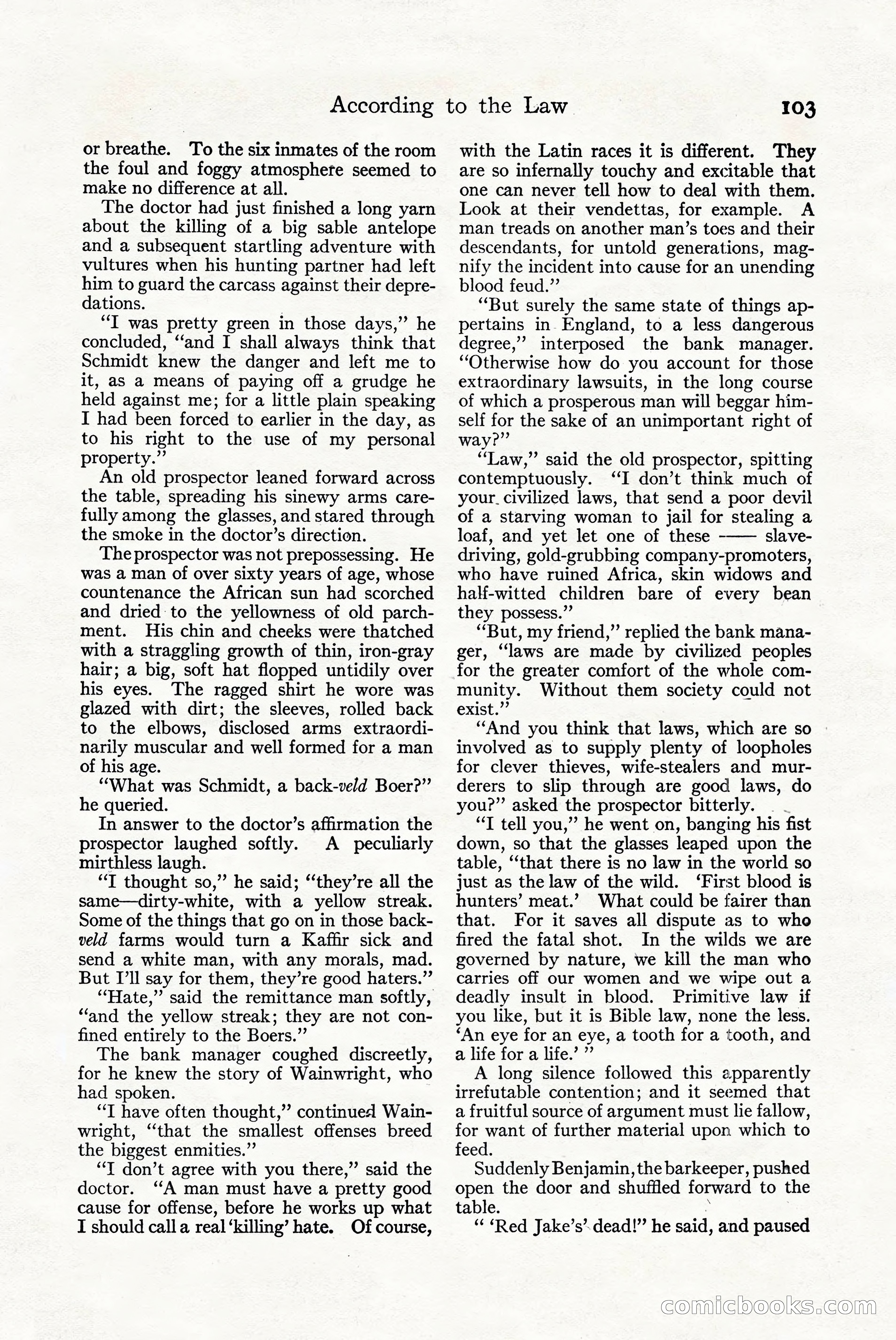
A restored page from Pulp Fiction, 1922. Page through the whole issue in the reader above.
📄 Transcribed text from this page (OCR, searchable)
Machine-transcribed from the original scan — historical spelling and the odd misread are preserved.
According to the Law or breathe. To the six inmates of the room the foul and foggy atmosphere seemed to make no difference at all. The doctor had just finished a long yarn about the killing of a big sable antelope and a subsequent startling adventure with vultures when his hunting partner had left him to guard the carcass against their depre- dations. “I was pretty green in those days,” he concluded, ‘‘and I shall always think that Schmidt knew the danger and left me to it, as a means of paying off a grudge he held against me; for a little plain speaking I had been forced to earlier in the day, as to his right to the use of my personal property.” An old prospector leaned forward across the table, spreading his sinewy arms care- fully among the glasses, and stared through the smoke in the doctor’s direction. The prospector was not prepossessing. He was a man of over sixty years of age, whose countenance the African sun had scorched and dried to the yellowness of old parch- ment. His chin and cheeks were thatched with a straggling growth of thin, iron-gray hair; a big, soft hat flopped untidily over his eyes. The ragged shirt he wore was glazed with dirt; the sleeves, rolled back to the elbows, disclosed arms extraordi- narily muscular and well formed for a man of his age. ‘What was Schmidt, a back-veld Boer?” he queried. In answer to the doctor’s affirmation the prospector laughed softly. A peculiarly mirthless laugh. “T thought so,”’ he said; “‘they’re all the same—dirty-white, with a yellow streak. Some of the things that go on in those back- veld farms would turn a Kaffr sick and send a white man, with any morals, mad. But I’ll say for them, they’re good haters.”’ “Hate,” said the remittance man softly, “and the yellow streak; they are not con- fined entirely to the Boers.”’ The bank manager coughed discreetly, for he knew the story of Wainwright, who had spoken. “T have often thought,” continued Wain- wright, “‘that the smallest offenses breed the biggest enmities.”’ “T don’t agree with you there,” said the doctor. “A man must have a pretty good cause for offense, before he works up what I should call a real ‘killing’ hate. Of course, 103 with the Latin races it is different. They are so infernally touchy and excitable that one can never tell how to deal with them. Look at their vendettas, for example. A man treads on another man’s toes and their descendants, for untold generations, mag- nify the incident into cause for an unending blood feud.”’ ““But surely the same state of things ap- pertains in England, to a less dangerous degree,” interposed the bank manager. “Otherwise how do you account for those extraordinary lawsuits, in the long course of which a prosperous man will beggar him- self for the sake of an unimportant right of way?” “‘Law,” said the old prospector, spitting contemptuously. “I don’t think much of your. civilized laws, that send a poor devil of a starving woman to jail for stealing a loaf, and yet let one of these -—— slave- driving, gold-grubbing company-promoters, who have ruined Africa, skin widows and half-witted children bare of every bean they possess.” “But, my friend,” replied the bank mana- ger, “laws are made by civilized peoples for the greater comfort of the whole com- munity. Without them society could not exist.” “And you think that laws, which are so involved as to supply plenty of loopholes for clever thieves, wife-stealers and mur- derers to slip through are good laws, do you?” asked the prospector bitterly. “T tell you,” he went on, banging his fist down, so that the glasses leaped upon the table, “‘that there is no law in the world so just as the law of the wild. ‘First blood is hunters’ meat.’ What could be fairer than that. For it saves all dispute as to who fired the fatal shot. In the wilds we are governed by nature, we kill the man who carries off our women and we wipe out a deadly insult in blood. Primitive law if you like, but it is Bible law, none the less. ‘An eye for an eye, a tooth for a tooth, and a life for a life.’ ”’ A long silence followed this apparently irrefutable contention; and it seemed that a fruitful source of argument must lie fallow, for want of further material upon which to feed. Suddenly Benjamin, the barkeeper, pushed open the door and shuffled forward to the table. ““ “Red Jake’s’ dead!’”’ he said, and paused NOOK C©@