
Pulp Fiction, 1922 · page 107 of 204
Adventure Magazine Cover — page 107: what you’re looking at
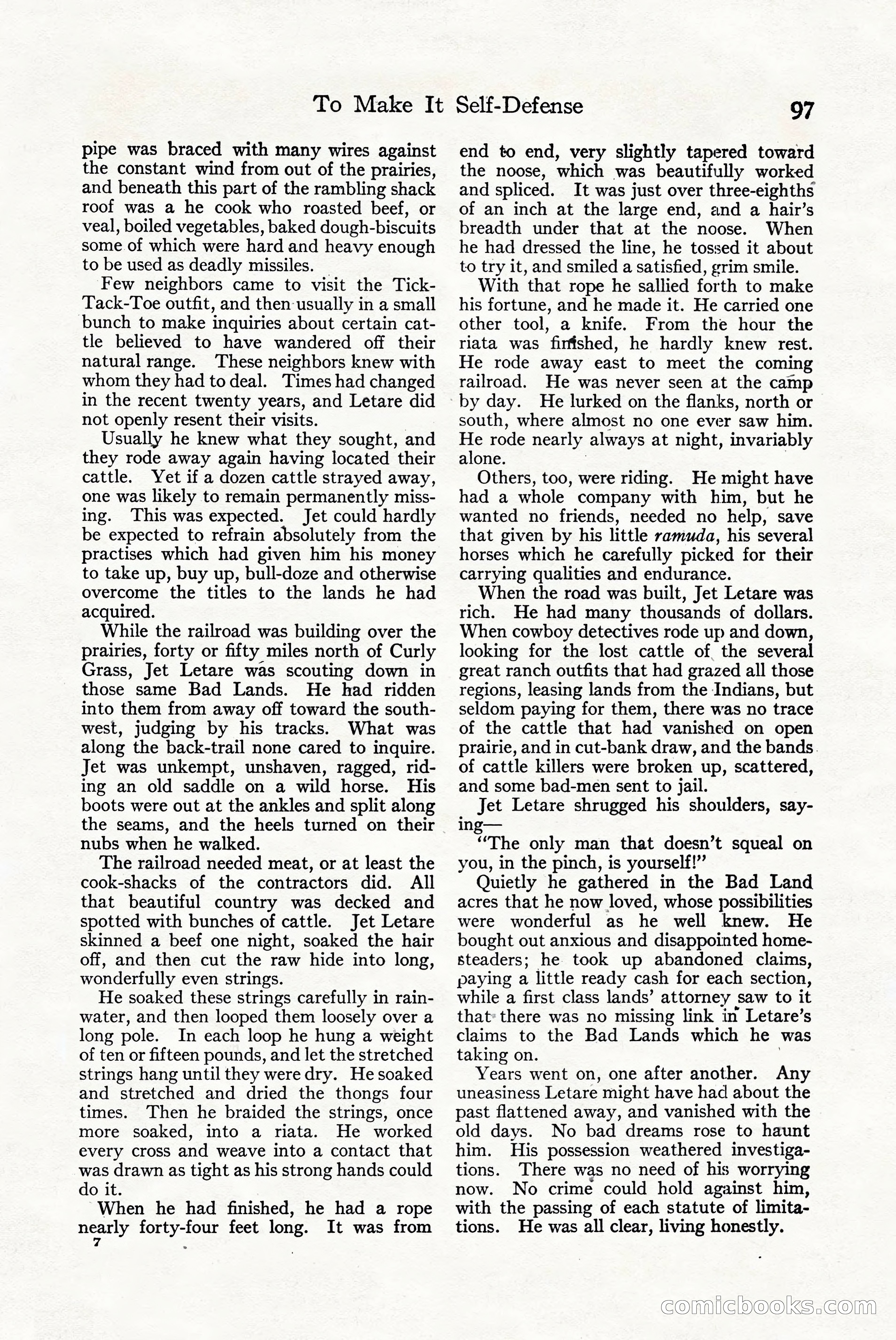
A restored page from Pulp Fiction, 1922. Page through the whole issue in the reader above.
📄 Transcribed text from this page (OCR, searchable)
Machine-transcribed from the original scan — historical spelling and the odd misread are preserved.
To Make It Self-Defense pipe was braced with many wires against the constant wind from out of the prairies, and beneath this part of the rambling shack roof was a he cook who roasted beef, or veal, boiled vegetables, baked dough- biscuits some. of which were hard and heavy enough to be used as deadly missiles. _ Few neighbors came to visit the Tick- Tack-Toe outfit, and then usually in a small bunch to make inquiries about certain cat- tle believed to have wandered off their natural range. These neighbors knew with whom they had to deal. Times had changed in the recent twenty years, and Letare did not openly resent their visits. | Usually he knew what they sought, and they rode away again having located their cattle. Yet if a dozen cattle strayed away, one was likely to remain permanently miss- ing. ‘This was expected. Jet could hardly be expected to refrain absolutely from the practises which had given him his money to take up, buy up, bull-doze and otherwise overcome the titles to the lands he had acquired. While the railroad was building over the prairies, forty or fifty miles north of Curly Grass, Jet Letare was scouting down in those same Bad Lands. He had ridden into them from away off toward the south- west, judging by his tracks. What was along the back-trail none cared to inquire. Jet was unkempt, unshaven, ragged, rid- ing an old saddle on a wild horse. His boots were out at the ankles and split along the seams, and the heels turned on their nubs when he walked. The railroad needed meat, or at least the cook-shacks of the contractors did. All that beautiful country was decked and spotted with bunches of cattle. Jet Letare skinned a beef one night, soaked the hair off, and then cut the raw hide into long, wonderfully even strings. He soaked these strings carefully in rain- water, and then looped them loosely over a long pole. In each loop he hung a weight of ten or fifteen pounds, and let the stretched strings hang until they were dry. He soaked and stretched and dried the thongs four times. Then he braided the strings, once more soaked, into a riata. He worked every cross and weave into a contact that was drawn as tight as his strong hands could do it. When he had finished, he had a rope nearly OLE Our feet long. It was from 97 end to end, very slightly tapered toward the noose, which was beautifully worked and spliced. It was just over three-eighths of an inch at the large end, and a hair’s breadth under that at the noose. When he had dressed the line, he tossed it about to try it, and smiled a satisfied, grim smile. With that rope he sallied forth to make his fortune, and he made it. He carried one other tool, a knife. From the hour the riata was firfished, he hardly knew rest. He rode away east to meet the coming railroad. He was never seen at the camp by day. He lurked on the flanks, north or south, where almost no one ever saw him. He rode nearly always at night, invariably alone. Others, too, were riding. He might have had a whole company with him, but he wanted no friends, needed no help, save that given by his little ramuda, his several horses which he carefully picked for their carrying qualities and endurance. When the road was built, Jet Letare was rich. He had many thousands of dollars. When cowboy detectives rode up and down, looking for the lost cattle of, the several great ranch outfits that had grazed all those regions, leasing lands from the Indians, but seldom paying for them, there was no trace of the cattle that had vanished on open prairie, and in cut-bank draw, and the bands. of cattle killers were broken up, scattered, and some bad-men sent to jail. Jet Letare shrugged his shoulders, say- ing— “The only man that doesn’t squeal on you, in the pinch, is yourself!”’ Quietly he gathered in the Bad Land acres that he now loved, whose possibilities were wonderful as he well knew. He bought out anxious and disappointed home- steaders; he took up abandoned claims, paying a little ready cash for each section, while a first class lands’ attorney saw to it that: there was no missing link in Letare’s claims to the Bad Lands which he was taking on. Years went on, one after another. Any uneasiness Letare might have had about the past flattened away, and vanished with the old days. No bad dreams rose to haunt him. His possession weathered investiga- tions. There was no need of his worrying now. No crime could hold against him, with the passing of each statute of limita- tions. He was all clear, living honestly. DOOLK C@