
Pulp Fiction, 1921 · page 88 of 204
Adventure Magazine Cover, June 18, 1921 — page 88: what you’re looking at
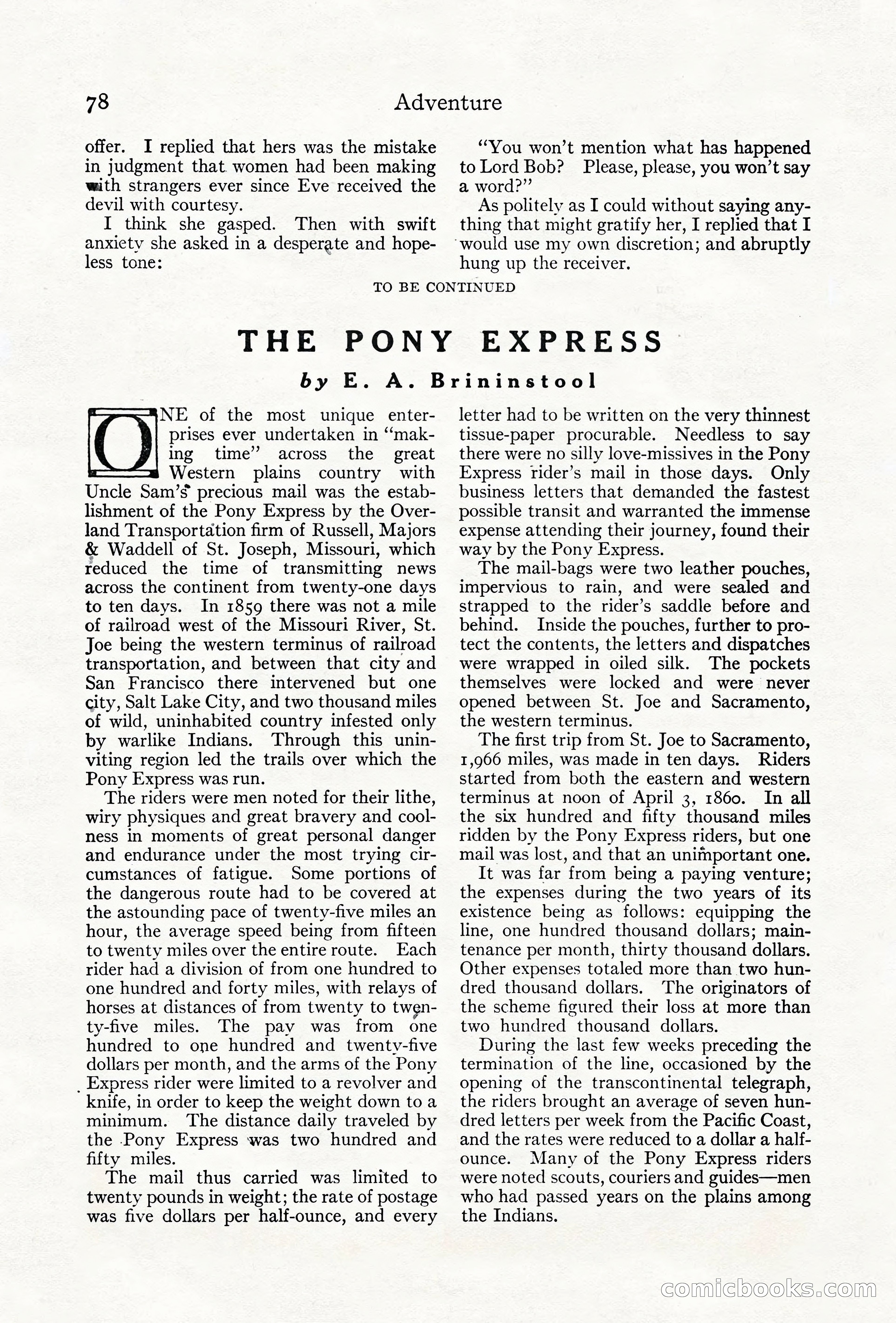
A restored page from Pulp Fiction, 1921. Page through the whole issue in the reader above.
📄 Transcribed text from this page (OCR, searchable)
Machine-transcribed from the original scan — historical spelling and the odd misread are preserved.
78 offer. I replied that hers was the mistake in judgment that. women had been making with strangers ever since Eve received the devil with courtesy. I think she gasped. Then with swift anxiety she asked in a desperate and hope- less tone: Adventure “You won’t mention what has happened to Lord Bob? Please, please, you won’t say a word?” As politely as I could without saying any- thing that might gratify her, I replied that I “would use my own discretion; and abruptly hung up the receiver. TO BE CONTINUED THE PON Y-EAPRESS by E. A. Brininstool NE of the most unique enter- prises ever undertaken in ‘‘mak- ing time’ across the great Western plains country with Uncle Sam’s precious mail was the estab- lishment of the Pony Express by the Over- land Transportation firm of Russell, Majors & Waddell of St. Joseph, Missouri, which reduced the time of transmitting news across the continent from twenty-one days to ten days. In 1859 there was not a mile of railroad west of the Missouri River, St. Joe being the western terminus of railroad transportation, and between that city and San Francisco there intervened but one city, Salt Lake City, and two thousand miles of wild, uninhabited country infested only by warlike Indians. Through this unin- viting region led the trails over which the Pony Express was run. The riders were men noted for their lithe, wiry physiques and great bravery and cool- ness in moments of great personal danger and endurance under the most trying cir- cumstances of fatigue. Some portions of the dangerous route had to be covered at the astounding pace of twenty-five miles an hour, the average speed being from fifteen to twenty miles over the entire route. Each rider had a division of from one hundred to one hundred and forty miles, with relays of horses at distances of from twenty to twen- ty-five miles. The pay was from one hundred to one hundred and twenty-five dollars per month, and the arms of the Pony _ Express rider were limited to a revolver and knife, in order to keep the weight down toa minimum. The distance daily traveled by the Pony Express was two hundred and fifty miles. The mail thus carried was limited to twenty pounds in weight; the rate of postage was five dollars per half-ounce, and every letter had to be written on the very thinnest tissue-paper procurable. Needless to say there were no silly love-missives in the Pony Express rider’s mail in those days. Only business letters that demanded the fastest possible transit and warranted the immense expense attending their journey, found their way by the Pony Express. The mail-bags were two leather pouches, impervious to rain, and were sealed and strapped to the rider’s saddle before and behind. Inside the pouches, further to pro- tect the contents, the letters and dispatches were wrapped in oiled silk. The pockets themselves were locked and were never opened between St. Joe and Sacramento, the western terminus. The first trip from St. Joe to Sacramento, 1,966 miles, was made in ten days. Riders started from both the eastern and western terminus at noon of April 3, 1860. In all the six hundred and fifty thousand miles ridden by the Pony Express riders, but one mail was lost, and that an unimportant one. It was far from being a paying venture; the expenses during the two years of its existence being as follows: equipping the line, one hundred thousand dollars; main- tenance per month, thirty thousand dollars. Other expenses totaled more than two hun- dred thousand dollars. The originators of the scheme figured their loss at more than two hundred thousand dollars. During the last few weeks preceding the termination of the line, occasioned by the opening of the transcontinental telegraph, the riders brought an average of seven hun- dred letters per week from the Pacific Coast, and the rates were reduced to a dollar a half- ounce. Many of the Pony Express riders were noted scouts, couriers and guides—men who had passed years on the plains among the Indians. COmiclboo CN Vp) C©