
Pulp Fiction, 1921 · page 73 of 204
Adventure Magazine Cover, June 18, 1921 — page 73: what you’re looking at
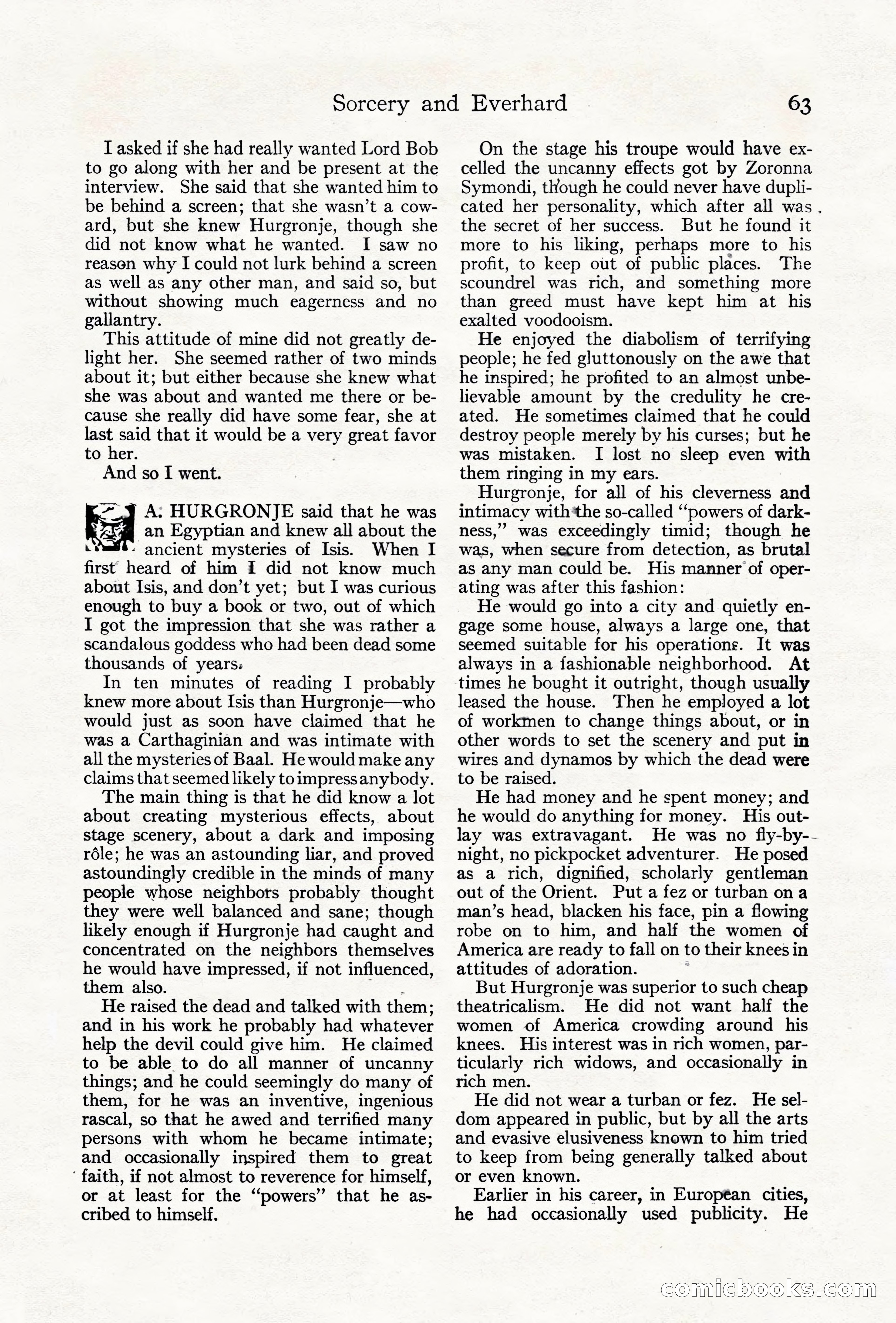
A restored page from Pulp Fiction, 1921. Page through the whole issue in the reader above.
📄 Transcribed text from this page (OCR, searchable)
Machine-transcribed from the original scan — historical spelling and the odd misread are preserved.
Sorcery and Everhard I asked if she had really wanted Lord Bob to go along with her and be present at the interview. She said that she wanted him to be behind a screen; that she wasn’t a cow- ard, but she knew Hurgronje, though she did not know what he wanted. I saw no reason why I could not lurk behind a screen as well as any other man, and said so, but without showing much eagerness and no gallantry. This attitude of mine did not greatly de- light her. She seemed rather of two minds about it; but either because she knew what she was about and wanted me there or be- cause she really did have some fear, she at last said that it would be a very y great favor to her. And so I went. ka ie a A: HURGRONIJE said that he was an Egyptian and knew all about the ancient mysteries of Isis. When I first heard of him i did not know much about Isis, and don’t yet; but I was curious enough to buy a book or two, out of which I got the impression that she was rather a scandalous goddess who had been dead some thousands of years: In ten minutes of reading I probably knew more about Isis than Hurgronje—who would just as soon have claimed that he was a Carthaginian and was intimate with all the mysteries of Baal. He would make any claims that seemed likely toimpressanybody. The main thing is that he did know a lot about creating mysterious effects, about stage scenery, about a dark and imposing role; he was an astounding liar, and proved astoundingly credible in the minds of many people whose neighbors probably thought they were well balanced and sane; though likely enough if Hurgronje had caught and concentrated on the neighbors themselves he would have impressed, if not influenced, them also. He raised the dead and talked with them; and in his work he probably had whatever help the devil could give him. He claimed to be able to do all manner of uncanny things; and he could seemingly do many of them, for he was an inventive, ingenious rascal, so that he awed and terrified many persons with whom he became intimate; and occasionally inspired them to great ‘ faith, if not almost to reverence for himself, or at least for the “‘powers” that he as- cribed to himself. 63 On the stage his troupe would have ex- celled the uncanny effects got by Zoronna Symondi, though he could never have dupli- cated her personality, which after all was. the secret of her success. But he found it more to his liking, perhaps more to his profit, to keep out of public places. The scoundrel was rich, and something more than greed must have kept him at his exalted voodooism. He enjoyed the diabolism of terrifying people; he fed gluttonously on the awe that he inspired; he profited to an almost unbe- lievable amount by the credulity he cre- ated. He sometimes claimed that he could destroy people merely by his curses; but he was mistaken. I lost no sleep even with them ringing in my ears. Hurgronje, for all of his cleverness and intimacy with ‘the so-called ‘powers of dark- ness,” was exceedingly timid; though he was, when secure from detection, as brutal as any man could be. His manner of oper- ating was after this fashion: He would go into a city and quietly en- gage some house, always a large one, that seemed suitable for his operations. It was always in a fashionable neighborhood. At times he bought it outright, though usually leased the house. Then he employed a lot of workmen to change things about, or in other words to set the scenery and put in wires and dynamos by which the dead were to be raised. He had money and he spent money; and he would do anything for money. His out- lay was extravagant. night, no pickpocket adventurer. He posed as a rich, dignified, scholarly gentleman out of the Orient. Put a fez or turban ona man’s head, blacken his face, pin a flowing robe on to him, and half the women of America are ready to fall on to their knees in attitudes of adoration. But Hurgronje was superior to such cheap theatricalism. He did not want half the women of America crowding around his knees. His interest was in rich women, par- ticularly rich widows, and occasionally in rich men. He did not wear a turban or fez. He sel- dom appeared in public, but by all the arts and evasive elusiveness known to him tried to keep from being generally talked about or even known. Earlier in his career, in Européan cities, he had occasionally used publicity. He COmicloo He was no fly-by-- ZN UM) ©