
Pulp Fiction, 1921 · page 68 of 204
Adventure Magazine Cover, June 18, 1921 — page 68: what you’re looking at
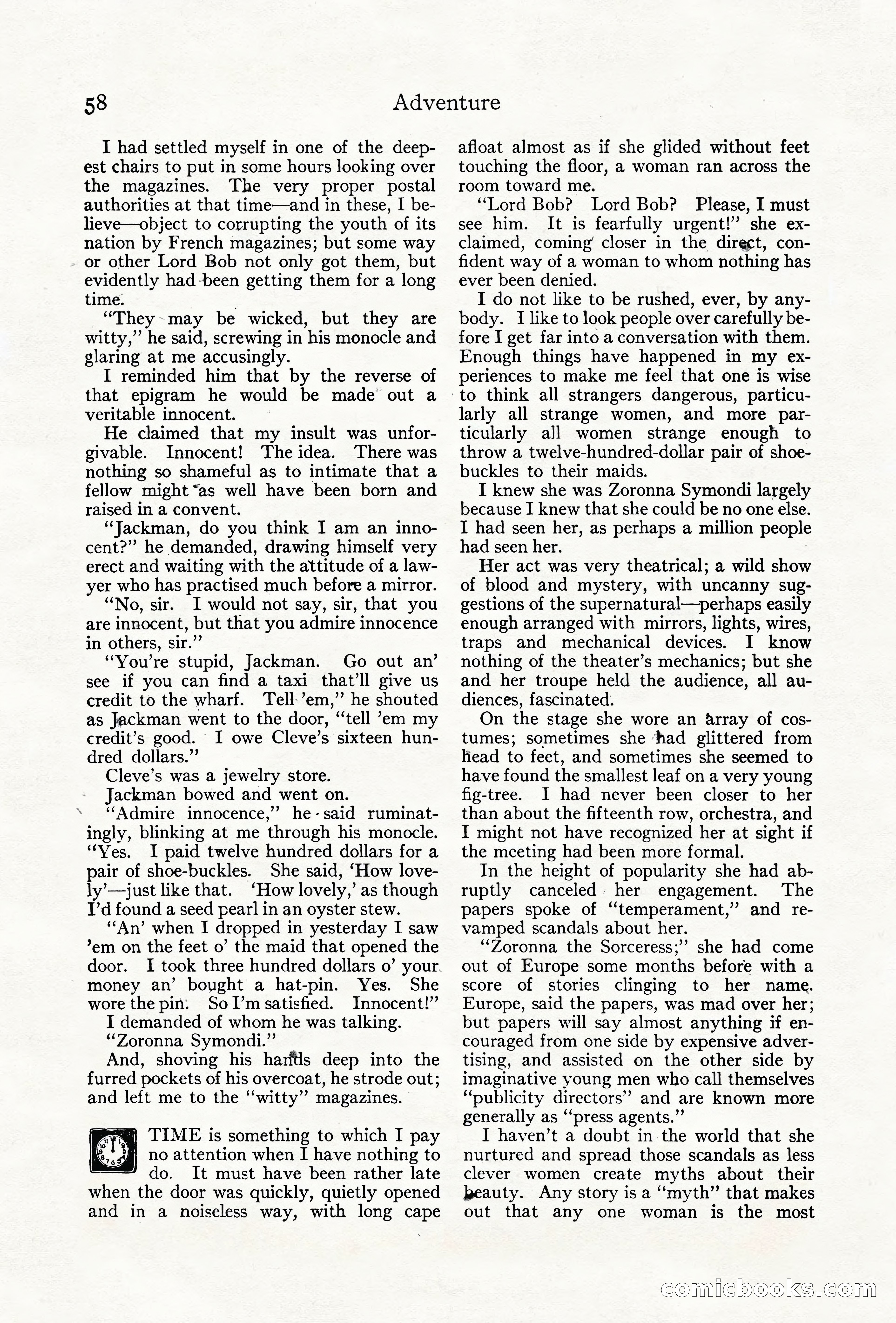
A restored page from Pulp Fiction, 1921. Page through the whole issue in the reader above.
📄 Transcribed text from this page (OCR, searchable)
Machine-transcribed from the original scan — historical spelling and the odd misread are preserved.
58 I had settled myself in one of the deep- est chairs to put in some hours looking over the magazines. The very proper postal authorities at that time—and in these, I be- lieve—object to corrupting the youth of its nation by French magazines; but some way or other Lord Bob not only got them, but evidently had-been getting them for a long time. ‘“They~may be wicked, but they are witty,” he said, screwing in his monocle and glaring at me accusingly. I reminded him that by the reverse of that epigram he would be made out a veritable innocent. He claimed that my insult was unfor- givable. Innocent! Theidea. There was nothing so shameful as to intimate that a fellow might “as well have been born and raised in a convent. “Jackman, do you think I am an inno- cent?” he demanded, drawing himself very erect and waiting with the attitude of a law- yer who has practised much before a mirror. “No, sir. I would not say, sir, that you are innocent, but that you admire innocence in others, sir.”’ “Vou’re stupid, Jackman. Go out an’ see if you can find a taxi that’ll give us credit to the wharf. Tell-’em,” he shouted as Jackman went to the door, “tell em my credit’s good. I owe Cleve’s sixteen hun- dred dollars.” Cleve’s was a jewelry store. Jackman bowed and went on. ‘Admire innocence,” he-said ruminat- ingly, blinking at me through his monocle. “Yes. I paid twelve hundred dollars for a pair of shoe-buckles. She said, ‘How love- ly’—just like that. ‘How lovely,’ as though I’d found a seed pearl in an oyster stew. ‘An’ when I dropped in yesterday I saw ?em on the feet o’ the maid that opened the door. money an’ bought a hat-pin. Yes. She wore the pin: SolT’msatisfied. Innocent!” I demanded of whom he was talking. *“Zoronna Symondi.” And, shoving his harfds deep into the furred pockets of his overcoat, he strode out; and left me to the “witty” magazines. | Pea) TIME is something to which I pay 7 7 no attention when I have nothing to do. It must have been rather late when the door was quickly, quietly opened and in a noiseless way, with long cape I took three hundred dollars o’ your. Adventure afloat almost as if she glided without feet touching the floor, a woman ran across the room toward me. “Lord Bob? Lord Bob? Please, I must see him. It is fearfully urgent!” she ex- claimed, coming closer in the direct, con- fident way of a woman to whom nothing has ever been denied. I do not like to be rushed, ever, by any- body. I like to look people over carefully be- fore I get far into a conversation with them. Enough things have happened in my ex- periences to make me feel that one is wise ‘to think all strangers dangerous, particu- larly all strange women, and more par- ticularly all women strange enough to throw a twelve-hundred-dollar pair of shoe- buckles to their maids. I knew she was Zoronna Symondi largely because I knew that she could be no one else. I had seen her, as perhaps a million people had seen her. Her act was very theatrical; a wild show of blood and mystery, with uncanny sug- gestions of the supernatural—perhaps easily enough arranged with mirrors, lights, wires, traps and mechanical devices. I know nothing of the theater’s mechanics; but she and her troupe held the audience, all au- diences, fascinated. On the stage she wore an 4rray of cos- tumes; sometimes she ‘had glittered from head to feet, and sometimes she seemed to have found the smallest leaf on a very young fig-tree. JI had never been closer to her than about the fifteenth row, orchestra, and I might not have recognized her at sight if the meeting had been more formal. In the height of popularity she had ab- ruptly canceled: her engagement. The papers spoke of “temperament,” and re- vamped scandals about her. ‘“‘Zoronna the Sorceress;”? she had come out of Europe some months before with a score of stories clinging to her name. Europe, said the papers, was mad over her; but papers will say almost anything if en- couraged from one side by expensive adver- tising, and assisted on the other side by imaginative young men who call themselves “publicity directors” and are known more generally as “press agents.”’ I haven’t a doubt in the world that she nurtured and spread those scandals as less clever women create myths about their beauty. Any story is a “myth” that makes out that any one woman is the most COmiclboo oN ) CO