
Pulp Fiction, 1921 · page 61 of 204
Adventure Magazine Cover, June 18, 1921 — page 61: what you’re looking at
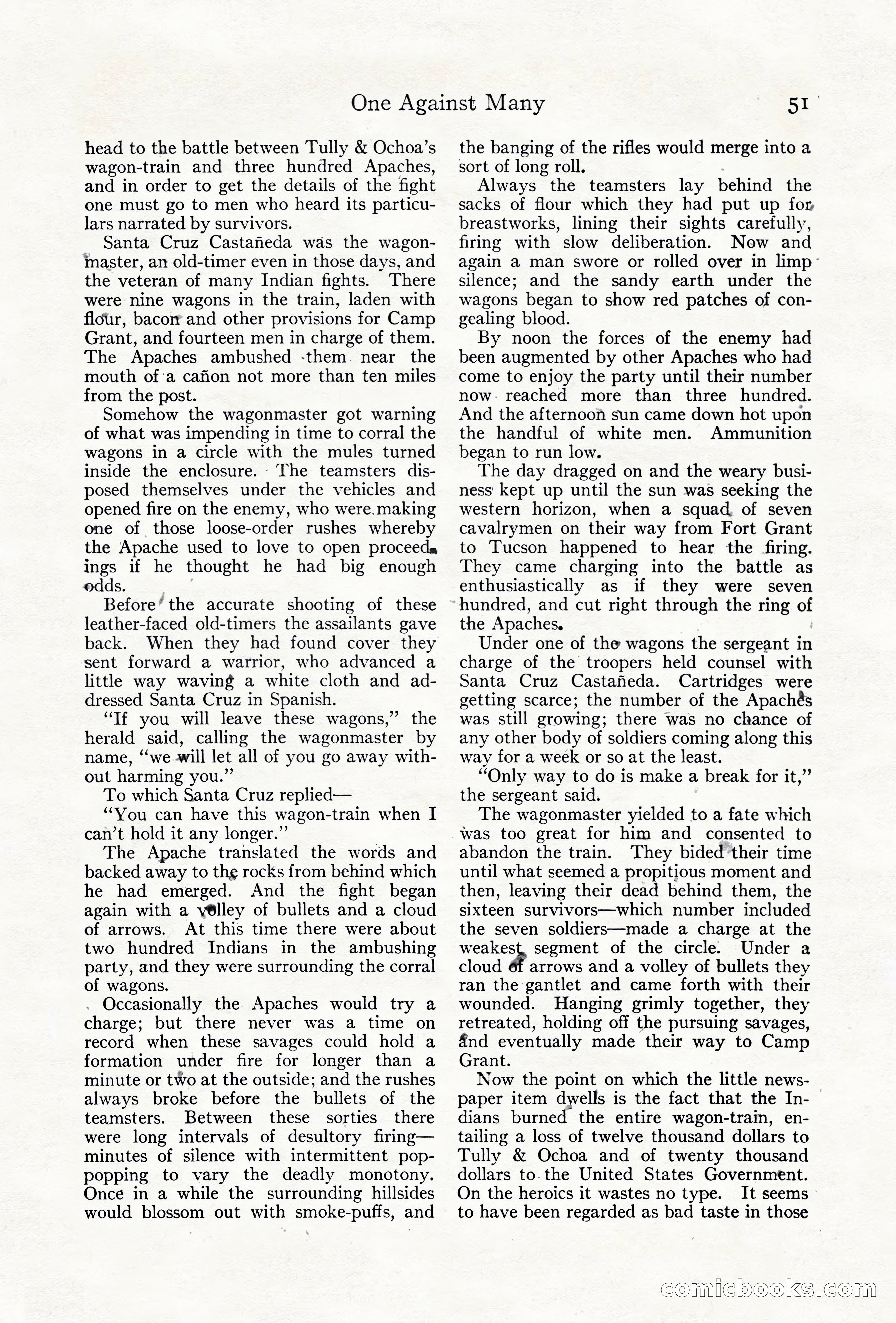
A restored page from Pulp Fiction, 1921. Page through the whole issue in the reader above.
📄 Transcribed text from this page (OCR, searchable)
Machine-transcribed from the original scan — historical spelling and the odd misread are preserved.
One Against Many head to the battle between Tully & Ochoa’s wagon-train and three hundred Apaches, and in order to get the details of the fight one must go to men who heard its particu- lars narrated by survivors. Santa Cruz Castaneda was the wagon- master, an old-timer even in those days, and the veteran of many Indian fights. There were nine wagons in the train, laden with flour, bacorr and other provisions for Camp Grant, and fourteen men in charge of them. The Apaches ambushed -them. near the mouth of'a cafion not more than ten miles from the post. Somehow the wagonmaster got warning of what was impending in time to corral the wagons in a circle with the mules turned inside the enclosure. The teamsters dis- posed themselves under the vehicles and opened fire on the enemy, who were.making one of those loose-order rushes whereby the Apache used to love to open proceeda ings if he thought he had big enough odds. i Before’ the accurate shooting of these leather-faced old-timers the assailants gave back. When they had found cover they sent forward a warrior, who advanced a little way waving a white cloth and ad- dressed Santa Cruz in Spanish. “Tf you will leave these wagons,” the herald said, calling the wagonmaster by name, ‘“‘we will let all of you go away with- out harming you.” To which Santa Cruz replied— “You can have this wagon-train when I can’t hold it any longer.” The Apache translated the words and backed away to the rocks from behind which he had emerged. And the fight began again with a y@lley of bullets and a cloud of arrows. At this time there were about two hundred Indians in the ambushing party, and they were surrounding the corral of wagons. . Occasionally the Apaches would try a charge; but there never was a time on record when these savages could hold a formation under fire for longer than a minute or two at the outside; and the rushes always broke before the bullets of the teamsters. Between these sorties there were long intervals of desultory firing— minutes of silence with intermittent pop- popping to vary the deadly monotony. Once in a while the surrounding hillsides would blossom out with smoke-puffs, and the banging of the rifles would merge into a sort of long roll. Always the teamsters lay behind the sacks of flour which they had put up for breastworks, lining their sights carefully, firing with slow deliberation. Now and again a man swore or rolled over in limp~ silence; and the sandy earth under the wagons began to show red patches of con- gealing blood. By noon the forces of the enemy had been augmented by other Apaches who had come to enjoy the party until their number now. reached more than three hundred. And the afternoon sun came down hot upon the handful of white men. Ammunition began to run low. The day dragged on and the weary busi- ness kept up until the sun was seeking the western horizon, when a squad of seven cavalrymen on their way from Fort Grant to Tucson happened to hear the firing. They came charging into the battle as enthusiastically as if they were seven hundred, and cut right through the ring of the Apaches. Under one of the wagons the sergeant in charge of the troopers held counsel with Santa Cruz Castafieda. Cartridges were getting scarce; the number of the Apachés was still growing; there was no chance of any other body of soldiers coming along this way for a week or so at the least. “Only way to do is make a break for it,” the sergeant said. The wagonmaster yielded to a fate which was too great for him and consented to abandon the train. They bided ‘their time until what seemed a propitious moment and then, leaving their dead behind them, the sixteen survivors—which number included the seven soldiers—made a charge at the weakest, segment of the circle. Under a cloud 6f arrows and a volley of bullets they ran the gantlet and came forth with their wounded. Hanging grimly together, they retreated, holding off the pursuing savages, fnd eventually made their way to Camp Grant. Now the point on which the little news- paper item dwells is the fact that the In- dians burned the entire wagon-train, en- tailing a loss of twelve thousand dollars to Tully & Ochoa and of twenty thousand dollars to.the United States Government. On the heroics it wastes no type. It seems to have been regarded as bad taste in those COmiclboo CN Vp) St CO