
Pulp Fiction, 1921 · page 54 of 204
Adventure Magazine Cover, June 18, 1921 — page 54: what you’re looking at
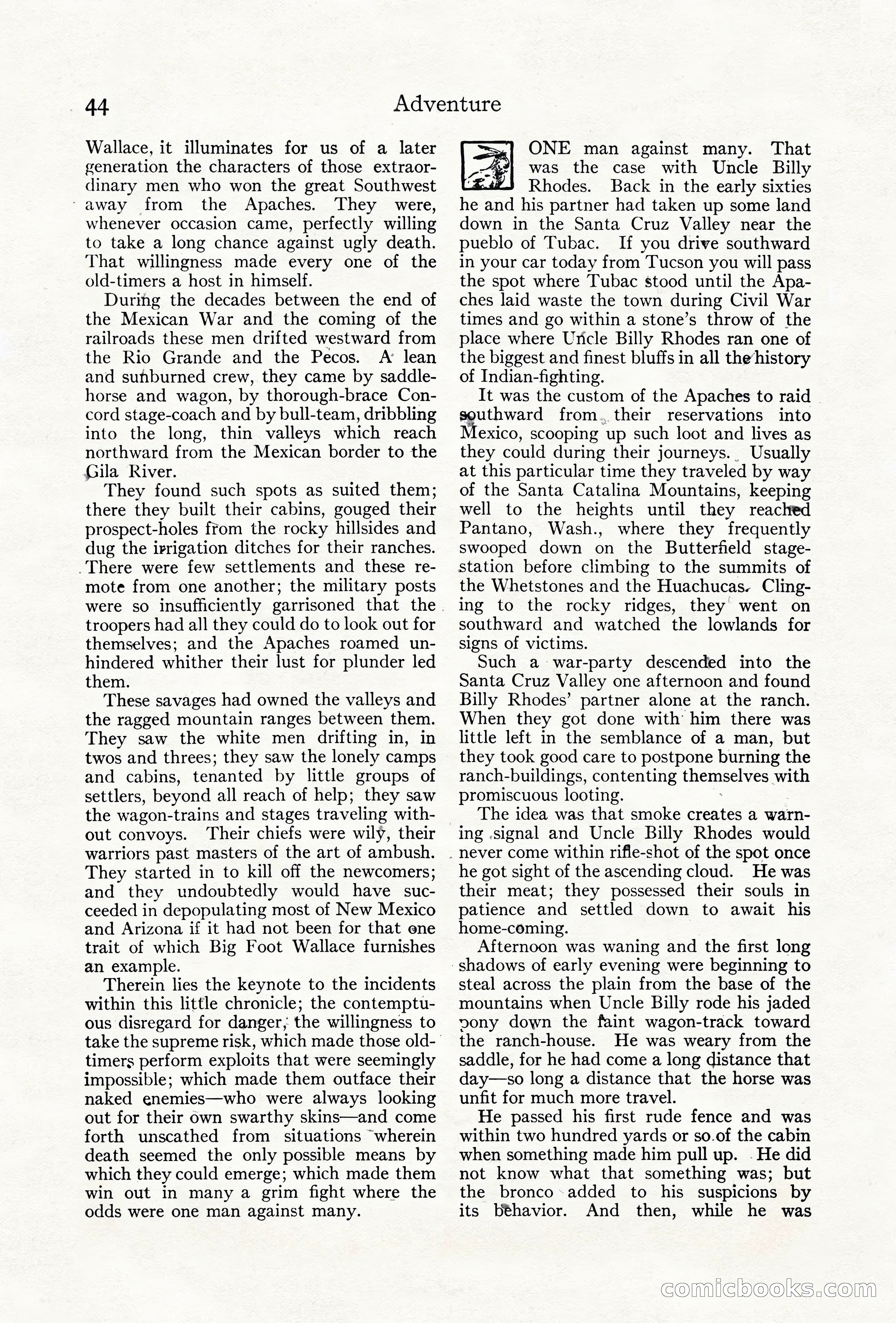
A restored page from Pulp Fiction, 1921. Page through the whole issue in the reader above.
📄 Transcribed text from this page (OCR, searchable)
Machine-transcribed from the original scan — historical spelling and the odd misread are preserved.
44 Wallace, it illuminates for us of a later generation the characters of those extraor- dinary men who won the great Southwest ‘away from the Apaches. They were, whenever occasion came, perfectly willing to take a long chance against ugly death. That willingness made every one of the old-timers a host in himself. During the decades between the end of the Mexican War and the coming of the railroads these men drifted westward from the Rio Grande and the Pecos. A’ lean and sunburned crew, they came by saddle- horse and wagon, by thorough-brace Con- cord stage-coach and by bull-team, dribbling into the long, thin valleys which reach northward from the Mexican border to the Gila River. They found such spots as suited them; there they built their cabins, gouged their prospect-holes from the rocky hillsides and dug the irrigation ditches for their ranches. .There were few settlements and these re- mote from one another; the military posts were so insufficiently garrisoned that the. troopers had all they could do to look out for themselves; and the Apaches roamed un- hindered whither their lust for plunder led them. These savages had owned the valleys and the ragged mountain ranges between them. They saw the white men drifting in, in twos and threes; they saw the lonely camps and cabins, tenanted by little groups of settlers, beyond all reach of help; they saw the wagon-trains and stages traveling with- out convoys. ‘Their chiefs were wily, their warriors past masters of the art of ambush. They started in to kill off the newcomers; and they undoubtedly would have suc- ceeded in depopulating most of New Mexico and Arizona if it had not been for that ene trait of which Big Foot Wallace furnishes an example. Therein lies the keynote to the incidents within this little chronicle; the contemptu- ous disregard for danger, the willingness to take the supreme risk, which made those old-_ timers perform exploits that were seemingly impossible; which made them outface their naked enemies—who were always looking out for their own swarthy skins—and come forth unscathed from situations wherein death seemed the only possible means by which they could emerge; which made them win out in many a grim fight where the odds were one man against many. Adventure ONE man against many. That was the case with Uncle Billy J Rhodes. Back in the early sixties he and his partner had taken up some land down in the Santa Cruz Valley near the pueblo of Tubac. If you drive southward in your car today from Tucson you will pass the spot where Tubac stood until the Apa- ches laid waste the town during Civil War times and go within a stone’s throw of the place where Unicle Billy Rhodes ran one of the biggest and finest bluffs in all the/history of Indian-fighting. It was the custom of the Apaches to raid © southward from. their reservations into Mexico, scooping up such loot and lives as they could during their journeys.. Usually at this particular time they traveled by way of the Santa Catalina Mountains, keeping well to the heights until they reached Pantano, Wash., where they frequently swooped down on the Butterfield stage- station before climbing to the summits of the Whetstones and the Huachucas. Cling- ing to the rocky ridges, they went on southward and watched the lowlands for signs of victims. Such a -war-party descended into the Santa Cruz Valley one afternoon and found Billy Rhodes’ partner alone at the ranch. When they got done with him there was little left in the semblance of a man, but they took good care to postpone burning the ranch-buildings, contenting poe with promiscuous looting. The idea was that smoke creates a warn- ing signal and Uncle Billy Rhodes would _ never come within rifle-shot of the spot once he got sight of the ascending cloud. He was their meat; they possessed their souls in patience and settled down to await his home-coming. Afternoon was waning and the first long shadows of early evening were beginning to steal across the plain from the base of the mountains when Uncle Billy rode his jaded sony down the faint wagon-track toward the ranch-house. He was weary from the saddle, for he had come a long distance that day—so long a distance that the horse was unfit for much more travel. He passed his first rude fence and was within two hundred yards or so.of the cabin when something made him pull up. - He did not know what that something was; but the bronco~added to his suspicions by its behavior. And then, while he was COmiclboo oN ) ©