
Pulp Fiction, 1921 · page 196 of 204
Adventure Magazine Cover, June 18, 1921 — page 196: what you’re looking at
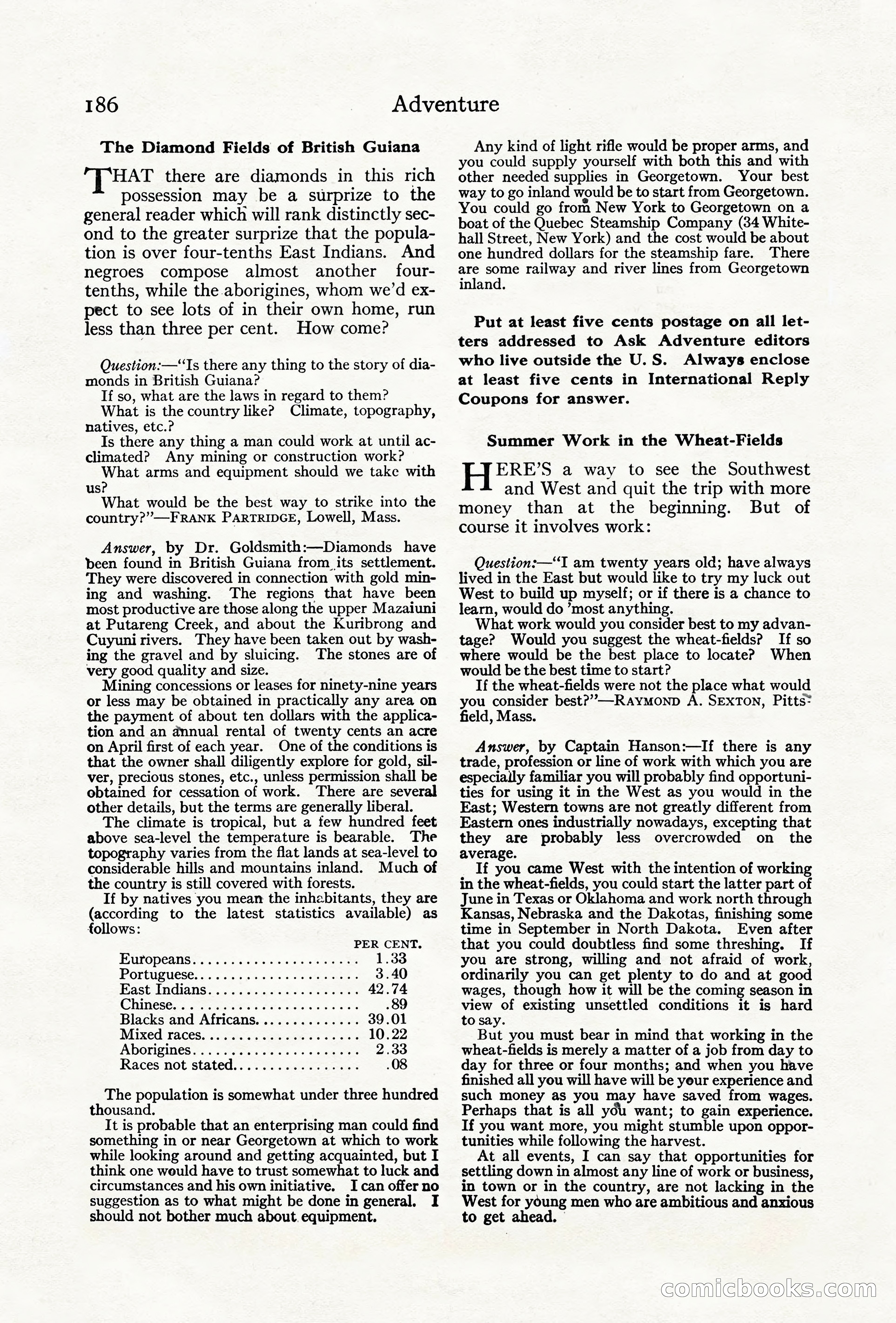
A restored page from Pulp Fiction, 1921. Page through the whole issue in the reader above.
📄 Transcribed text from this page (OCR, searchable)
Machine-transcribed from the original scan — historical spelling and the odd misread are preserved.
186 The Diamond Fields of British Guiana "THAT there are diamonds in this rich possession may be a surprize to the general reader which will rank distinctly sec- ond to the greater surprize that the popula- tion is over four-tenths East Indians. And negroes compose almost another four- tenths, while the aborigines, whom we'd ex- pect to see lots of in their own home, run less than three per cent. How come? Question: —“Is there any thing to the story of dia- monds in British Guiana? If so, what are the laws in regard to them? What is the country like? Climate, topography, natives, etc.? Is there any thing a man could work at until ac- climated? Any mining or construction work? What arms and equipment should we take with us? What would be the best way to strike into the country?”—FRANK PARTRIDGE, Lowell, Mass. Answer, by Dr. Goldsmith:—Diamonds have been found in British Guiana from_its settlement. They were discovered in connection with gold min- ing and washing. The regions that have been most productive are those along the upper Mazaiuni at Putareng Creek, and about the Kuribrong and Cuyuni rivers. They have been taken out by wash- ing the gravel and by sluicing. The stones are of very good quality and size. Mining concessions or leases for ninety-nine years or less may be obtained in practically any area on the payment of about ten dollars with the applica- tion and an dnnual rental of twenty cents an acre on April first of each year. One of the conditions is that the owner shall diligently explore for gold, sil- ver, precious stones, etc., unless permission shall be obtained for cessation of work. There are several other details, but the terms are generally liberal. The climate is tropical, but a few hundred feet above sea-level the temperature is bearable. The topography varies from the flat lands at sea-level to considerable hills and mountains inland. Much of the country is still covered with forests. If by natives you mean the inhabitants, they are (according to the latest statistics available) as follows: PER CENT. EUEODEaANG y < . Die es camces aoe ee SS 1.33 POrtiguese on. pian « antiweens 3.40 Bast Endians$, ..+ iseweia sss Casa te 42.74 CAINGSC. 2G ek Aero eas ss os .89 Blacks and Africans.............. 39.01 Mixed races: coast wes s os cas 10.22 ADOPIQINES . : . Sones tes «4 peers 2.33 Races not stated..............06- .08 The population is somewhat under three hundred thousand. It is probable that an enterprising man could find something in or near Georgetown at which to work while looking around and getting acquainted, but I think one weuld have to trust somewhat to luck and circumstances and his own initiative. I can offer no suggestion as to what might be done in general. I should not bother much about. equipment. Adventure Any kind of light rifle would be proper arms, and you could supply yourself with both this and with other needed supplies in Georgetown. Your best way to go inland would be to start from Georgetown. You could go from New York to Georgetown on a boat of the Quebec Steamship Company (34 White- hall Street, New York) and the cost would be about one hundred dollars for the steamship fare. There are eo railway and river lines from Georgetown inland. Put at least five cents postage on all let- ters addressed to Ask Adventure editors who live outside the U. S. Always enclose at least five cents in International Reply Coupons for answer. Summer Work in the Wheat-Fields ERE’S a way to see the Southwest and West and quit the trip with more money than at the beginning. But of course it involves work: Question:—“I am twenty years old; have always lived in the East but would like to try my luck out West to build up myself; or if there is a chance to learn, would do ’most anything. What work would you consider best to my advan- tage? Would you suggest the wheat-fields? If so where would be the best place to locate? When would be the best time to start? If the wheat-fields were not the place what would you consider best?”—RayMonp A. SExTON, Pitts= field, Mass. Answer, by Captain Hanson:—TIf there is any trade, profession or line of work with which you are especiaily familiar you will probably find opportuni- ties for using it in the West as you would in the East; Western towns are not greatly different from Eastern ones industrially nowadays, excepting that they are probably less overcrowded on _ the average. If you came West with the intention of working in the wheat-fields, you could start the latter part of June in Texas or Oklahoma and work north through Kansas, Nebraska and the Dakotas, finishing some time in September in North Dakota. Even after that you could doubtless find some threshing. If you are strong, willing and not afraid of work, ordinarily you can get plenty to do and at good wages, though how it will be the coming season in view of existing unsettled conditions it is hard to say. But you must bear in mind that working in the wheat-fields is merely a matter of a job from day to day for three or four months; and when you have finished all you will have will be your experience and such money as you may have saved from wages. Perhaps that is all you want; to gain experience. If you want more, you might stumble upon oppor- tunities while following the harvest. At all events, I can say that opportunities for settling down in almost any line of work or business, in town or in the country, are not lacking in the West for young men who are ambitious and anxious to get ahead. COmicloo ©