
Pulp Fiction, 1921 · page 187 of 204
Adventure Magazine Cover, June 18, 1921 — page 187: what you’re looking at
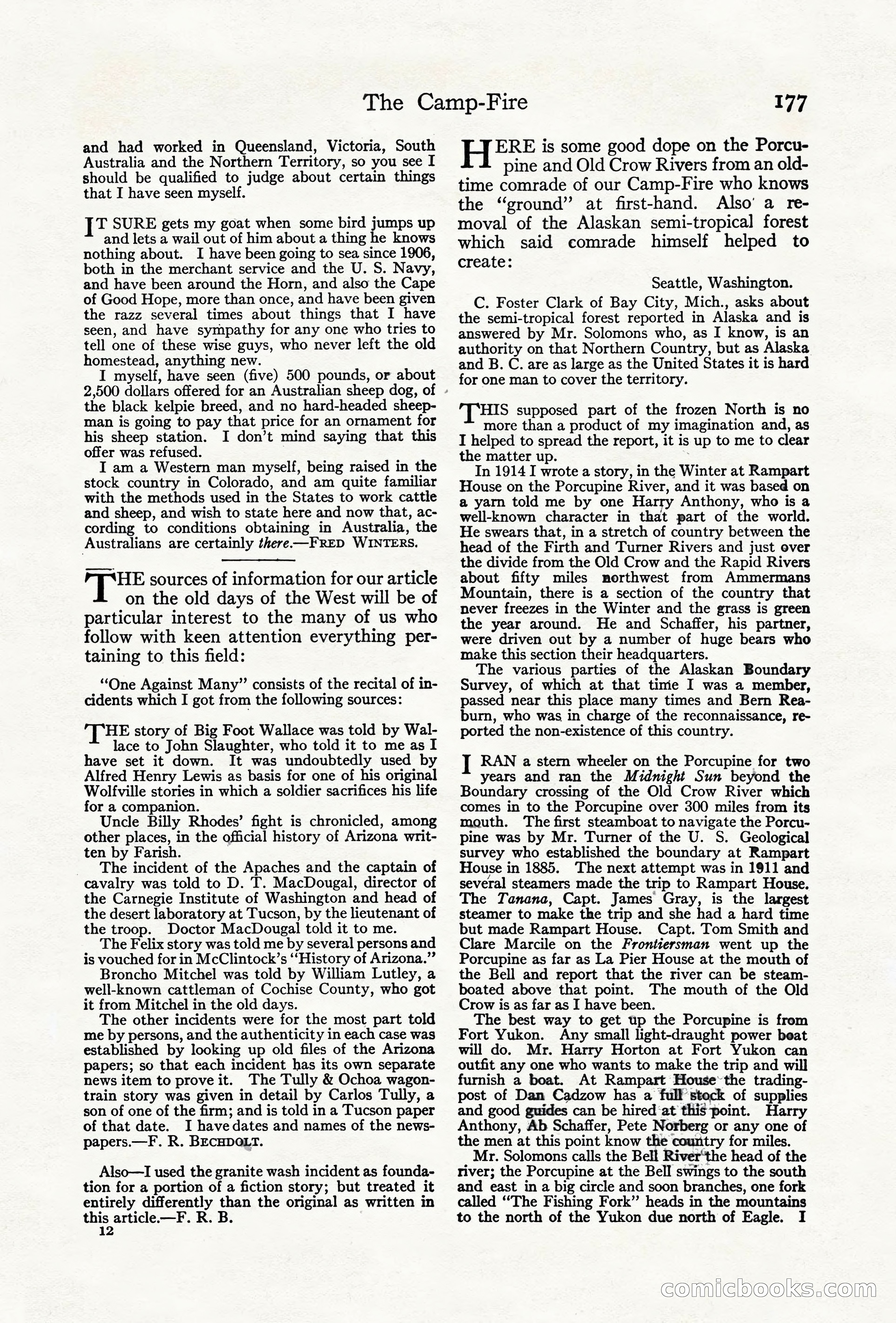
A restored page from Pulp Fiction, 1921. Page through the whole issue in the reader above.
📄 Transcribed text from this page (OCR, searchable)
Machine-transcribed from the original scan — historical spelling and the odd misread are preserved.
The Camp-Fuire and had worked in Queensland, Victoria, South Australia and the Northern Territory, so you see I should be qualified to judge about certain things that I have seen myself. T SURE gets my goat when some bird jumps up and lets a wail out of him about a thing he knows nothing about. I have been going to sea since 1906, both in the merchant service and the U. S. Navy, and have been around the Horn, and also the Cape of Good Hope, more than once, and have been given the razz several times about things that I have seen, and have sympathy for any one who tries to tell one of these wise guys, who never left the old homestead, anything new. I myself, have seen (five) 500 pounds, or about 2,500 dollars offered for an Australian sheep dog, of - the black kelpie breed, and no hard-headed sheep- man is going to pay that price for an ornament for his sheep station. I don’t mind saying that this offer was refused. I am a Western man myself, being raised in the stock country in Colorado, and am quite familiar with the methods used in the States to work cattle and sheep, and wish to state here and now that, ac- cording to conditions obtaining in Australia, the Australians are certainly there—FRED WINTERS. HE sources of information for our article on the old days of the West will be of particular interest to the many of us who follow with keen attention everything per- taining to this field: “One Against Many’”’ consists of the recital of in- cidents which I got from the following sources: ‘THE story of Big Foot Wallace was told by Wal- lace to John Slaughter, who told it to me as I have set it down. It was undoubtedly used by Alfred Henry Lewis as basis for one of his original Wolfville stories in which a soldier sacrifices his life for a companion. Uncle Billy Rhodes’ fight is chronicled, among other places, in the official history of Arizona writ- ten by Farish. The incident of the Apaches and the captain of cavalry was told to D. T. MacDougal, director of the Carnegie Institute of Washington and head of the desert laboratory at Tucson, by the lieutenant of the troop. Doctor MacDougal told it to me. The Felix story was told me by several persons and is vouched for in McClintock’s “‘History of Arizona.” Broncho Mitchel was told by William Lutley, a well-known cattleman of Cochise County, who got it from Mitchel in the old days. The other incidents were for the most part told me by persons, and the authenticity in each case was established by looking up old files of the Arizona papers; so that each incident has its own separate news item to prove it. The Tully & Ochoa wagon- train story was given in detail by Carlos Tully, a son of one of the firm; and is told in a Tucson paper of that date. I havedates and names of the news- papers.—F. R. BECHDOLT. Also—I used the granite wash incident as founda- tion for a portion of a fiction story; but treated it entirely differently than the original as written in this article.—F. R. B. 12 177 HE is some good dope on the Porcu- pine and Old Crow Rivers from an old- time comrade of our Camp-Fire who knows the “ground” at first-hand. Also’ a re- moval of the Alaskan semi-tropical forest which said comrade himself helped to create: Seattle, Washington. C. Foster Clark of Bay City, Mich., asks about the semi-tropical forest reported in Alaska and is answered by Mr. Solomons who, as I know, is an authority on that Northern Country, but as Alaska and B. C. are as large as the United States it is hard for one man to cover the territory. ‘THIS supposed part of the frozen North is no more than a product of my imagination and, as I helped to spread the report, it is up to me to clear the matter up. ; In 1914 I wrote a story, in the Winter at Rampart House on the Porcupine River, and it was based on a yarn told me by one Harry Anthony, who is a well-known character in that part of the world. He swears that, in a stretch of country between the head of the Firth and Turner Rivers and just over the divide from the Old Crow and the Rapid Rivers about fifty miles northwest from Ammermans Mountain, there is a section of the country that never freezes in the Winter and the grass is green the year around. He and Schaffer, his partner, were driven out by a number of huge bears who make this section their headquarters. The various parties of the Alaskan Boundary Survey, of which at that tinie I was a member, passed near this place many times and Bern Rea- burn, who was in charge of the reconnaissance, re- ported the non-existence of this country. RAN a stern wheeler on the Porcupine for two years and ran the Midnight Sun beyond the Boundary crossing of the Old Crow River which comes in to the Porcupine over 300 miles from its mouth. The first steamboat to navigate the Porcu- pine was by Mr. Turner of the U. S. Geological survey who established the boundary at Rampart House in 1885. The next attempt was in 1911 and several steamers made the trip to Rampart House. The Tanana, Capt. James Gray, is the largest steamer to make the trip and she had a hard time but made Rampart House. Capt. Tom Smith and Clare Marcile on the Frontiersman went up the Porcupine as far as La Pier House at the mouth of the Bell and report that the river can be steam- boated above that point. The mouth of the Old Crow is as far as I have been. The best way to get up the Porcupine is from Fort Yukon. Any small light-draught power beat will do. Mr. Harry Horton at Fort Yukon can outfit any one who wants to make the trip and will furnish a boat. At Rampart House’ the trading- post of Dan Cadzow has a full’ stock of supplies and good guides can be hired at this-point. Harry Anthony, Ab Schaffer, Pete Norberg or any one of the men at this point know the country for miles. Mr. Solomons calls the Bell River‘the head of the river; the Porcupine at the Bell swings to the south and east in a big circle and soon branches, one fork called ‘‘The Fishing Fork” heads in the mountains to the north of the Yukon due north of Eagle. I COmicloo S|