
Pulp Fiction, 1921 · page 173 of 204
Adventure Magazine Cover, June 18, 1921 — page 173: what you’re looking at
A restored page from Pulp Fiction, 1921. Page through the whole issue in the reader above.
📄 Transcribed text from this page (OCR, searchable)
Machine-transcribed from the original scan — historical spelling and the odd misread are preserved.
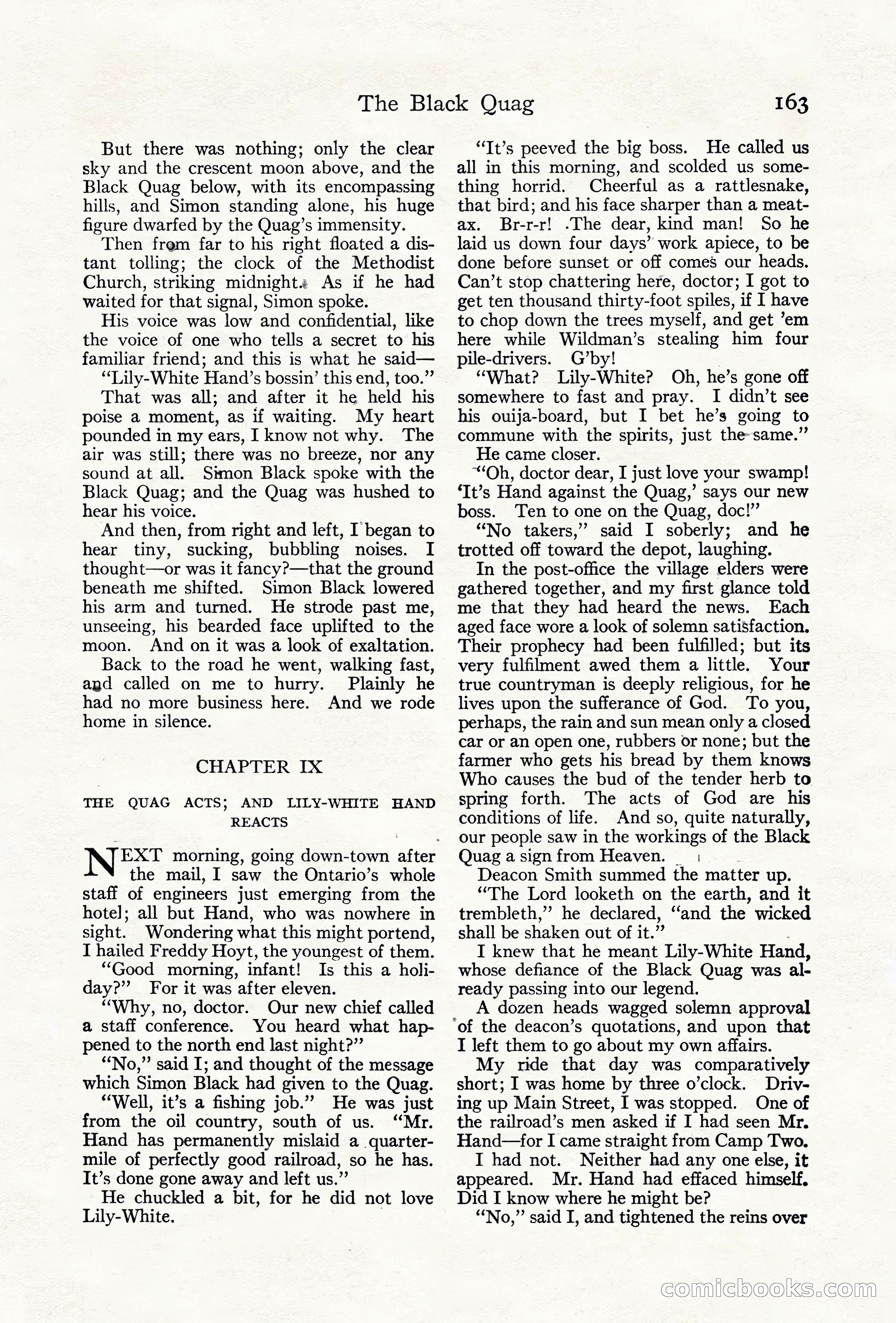
The Black Quag But there was nothing; only the clear sky and the crescent moon above, and the Black Quag below, with its encompassing hills, and Simon standing alone, his huge figure dwarfed by the Quag’s immensity. Then frem far to his right floated a dis- tant tolling; the clock of the Methodist Church, striking midnighta As if he had waited for that signal, Simon spoke. His voice was low and confidential, like the voice of one who tells a secret to his familiar friend; and this is what he said— “Lily-White Hand’s bossin’ this end, too.” That was all; and after it he held his poise a moment, as if waiting. My heart pounded in my ears, I know not why. The air was still; there was no breeze, nor any sound at all. Simon Black spoke with the Black Quag; and the Quag was hushed to hear his voice. And then, from right and left, I began to hear tiny, sucking, bubbling noises. I thought—or was it fancy?—that the ground beneath me shifted. Simon Black lowered his arm and turned. He strode past me, unseeing, his bearded face uplifted to the moon. And on it was a look of exaltation. Back to the road he went, walking fast, apd called on me to hurry. Plainly he had no more business here. And we rode home in silence. CHAPTER IX THE QUAG ACTS; AND LILY-WHITE HAND REACTS NEX? morning, going down-town after the mail, I saw the Ontario’s whole staff of engineers just emerging from the hotel; all but Hand, who was nowhere in sight. Wondering what this might portend, I hailed Freddy Hoyt, the youngest of them. “Good morning, infant! Is this a holi- day?” For it was after eleven. “‘Why, no, doctor. Our new chief called a staff conference. You heard what hap- pened to the north end last night?” “No,” said I; and thought of the message which Simon Black had given to the Quag. “Well, it’s a fishing job.”” He was just from the oil country, south of us. “Mr. Hand has permanently mislaid a quarter- mile of perfectly good railroad, so he has. It’s done gone away and left us.”’ He chuckled a bit, for he did not love Lily-White. 163 “Tt’s peeved the big boss. He called us all in this morning, and scolded us some- thing horrid. Cheerful as a rattlesnake, that bird; and his face sharper than a meat- ax. Br-r-r! .The dear, kind man! So he laid us down four days’ work apiece, to be done before sunset or off comes our heads. Can’t stop chattering here, doctor; I got to get ten thousand thirty-foot spiles, if I have to chop down the trees myself, and get ’em here while Wildman’s stealing him four pile-drivers. G’by! “What? Lily-White? Oh, he’s gone off somewhere to fast and pray. I didn’t see his ouija-board, but I bet he’s going to commune with the spirits, just the-same.” He came closer. “Oh, doctor dear, I just love your swamp! ‘It’s Hand against the Quag,’ says our new boss. Ten to one on the Quag, doc!” “No takers,” said I soberly; and he trotted off toward the depot, laughing. In the post-office the village elders were gathered together, and my first glance told me that they had heard the news. Each aged face wore a look of solemn satisfaction. Their prophecy had been fulfilled; but its very fulfilment awed them a little. Your true countryman is deeply religious, for he lives upon the sufferance of God. To you, perhaps, the rain and sun mean only a closed car or an open one, rubbers or none; but the farmer who gets his bread by them knows Who causes the bud of the tender herb to spring forth. The acts of God are his conditions of life. And so, quite naturally, our people saw in the workings of the Black Quag asignfrom Heaven. | Deacon Smith summed the matter up. “The Lord looketh on the earth, and it trembleth,”’ he declared, “and the wicked shall be shaken out of it.” I knew that he meant Lily-White Hand, whose defiance of the Black Quag was al- ready passing into our legend. A dozen heads wagged solemn approval ‘of the deacon’s quotations, and upon that I left them to go about my own affairs. My ride that day was comparatively short; I was home by three o’clock. Driv- ing up Main Street, I was stopped. One of the railroad’s men asked if I had seen Mr. Hand—for I came straight from Camp Two. I had not. Neither had any one else, it appeared. Mr. Hand had effaced himself. Did I know where he might be? “No,” said I, and tightened the reins over COmicloo ZA ) CO