
Pulp Fiction, 1921 · page 171 of 204
Adventure Magazine Cover, June 18, 1921 — page 171: what you’re looking at
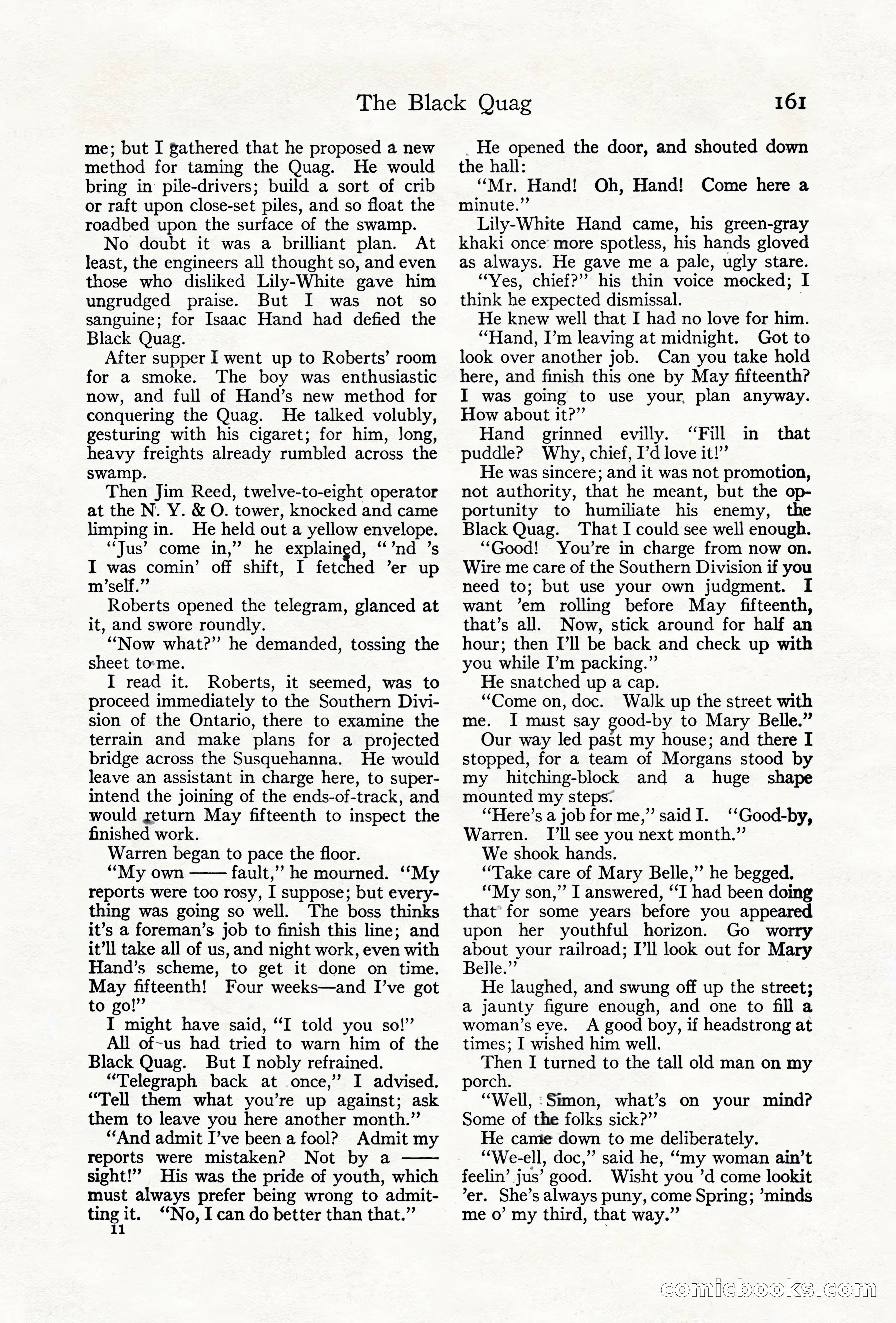
A restored page from Pulp Fiction, 1921. Page through the whole issue in the reader above.
📄 Transcribed text from this page (OCR, searchable)
Machine-transcribed from the original scan — historical spelling and the odd misread are preserved.
The Black Quag me; but I gathered that he proposed a new method for taming the Quag. He would bring in pile-drivers; build a sort of crib or raft upon close-set piles, and so float the roadbed upon the surface of the swamp. No doubt it was a brilliant plan. At least, the engineers all thought so, and even those who disliked Lily-White gave him ungrudged praise. But I was not so sanguine; for Isaac Hand had defied the Black Quag. After supper I went up to Roberts’ room for a smoke. The boy was enthusiastic now, and full of Hand’s new method for conquering the Quag. He talked volubly, gesturing with his cigaret; for him, Jong, heavy freights already rumbled across the swamp. Then Jim Reed, twelve-to-eight operator at the N. Y. & O. tower, knocked and came limping in. He held outa Oe envelope. ‘Jus’ come in,” he explained, “’nd ’s I was comin’ off shift, I fet Mea? ‘er up m’self.” Roberts opened the telegram, glanced at it, and swore roundly. ‘“‘Now what?” he demanded, tossing the sheet to:me. I read it. Roberts, it seemed, was to proceed immediately to the Southern Divi- sion of the Ontario, there to examine the terrain and make plans for a projected bridge across the Susquehanna. He would leave an assistant in charge here, to super- intend the joining of the ends-of-track, and would return May fifteenth to inspect the finished work. Warren began to pace the floor. “My own fault,’ he mourned. ‘‘My reports were too rosy, I suppose; but every- thing was going so well. The boss thinks it’s a foreman’s job to finish this line; and it'll take all of us, and night work, even with Hand’s scheme, to get it done on time. May fifteenth! Four weeks—and I’ve got to go!”’ I might have said, “I told you so!” All of-us had tried to warn him of the Black Quag. But I nobly refrained. “Telegraph back at once,’ I advised. “Tell them what you’re up against; ask them to leave you here another month.” ‘And admit I’ve been a fool? Admit my reports were mistaken? Not by a —— sight!’ His was the pride of youth, which must always prefer being wrong to admit- ting It. ‘No, I can do better than that.” 161 _ He opened the door, and shouted down the hall: “Mr. Hand! minute.” Lily-White Hand came, his green-gray khaki once: more spotless, his hands gloved as always. He gave me a pale, ugly stare. ‘Yes, chief?” his thin voice mocked; I think he expected dismissal. He knew well that I had no love for him. “Hand, I’m leaving at midnight. Got to look over another job. Can you take hold here, and finish this one by May fifteenth? I was going to use your, plan anyway. How about it?” Hand grinned evilly. “Fill in that puddle? Why, chief, I’d love it!” He was sincere; and it was not promotion, not authority, that he meant, but the op- portunity to humiliate his enemy, the Black Quag. That I could see well enough. ‘““Good! You’re in charge from now on. Wire me care of the Southern Division if you need to; but use your own judgment. I want ’em rolling before May fifteenth, that’s all. Now, stick around for half an hour; then I’ll be back and check up with you while I’m packing.” He snatched up a cap. “Come on, doc. Walk up the street with me. I must say good-by to Mary Belle.” Our way led past my house; and there I stopped, for a team of Morgans stood by my hitching-block and a huge _ shape mounted my steps: “‘Here’s a job for me,” said I. ‘‘Good-by, Warren. I'll see you next month.” We shook hands. “Take care of Mary Belle,” he begged. “My son,” I answered, “I had been doing that for some years before you appeared upon her youthful horizon. Go worry about your railroad; I’ll look out for Mary Belle.” He laughed, and swung off up the street; a jaunty figure enough, and one to fill a woman’s eve. A good boy, if headstrong at times; I wished him well. Then I turned to the tall old man on my porch. “Well, :Simon, what’s on your mind? Some of the folks sick?” He camie down to me deliberately. ““We- ell, doc,” said he, ‘‘my woman ain’t feelin’ jus’ good. Wisht you ’d come lookit ‘er. She’s always puny, come Spring; ’minds me o’ my third, that way.” Oh, Hand! Come here a COmiclboo ZN ) ©