
Pulp Fiction, 1921 · page 165 of 204
Adventure Magazine Cover, June 18, 1921 — page 165: what you’re looking at
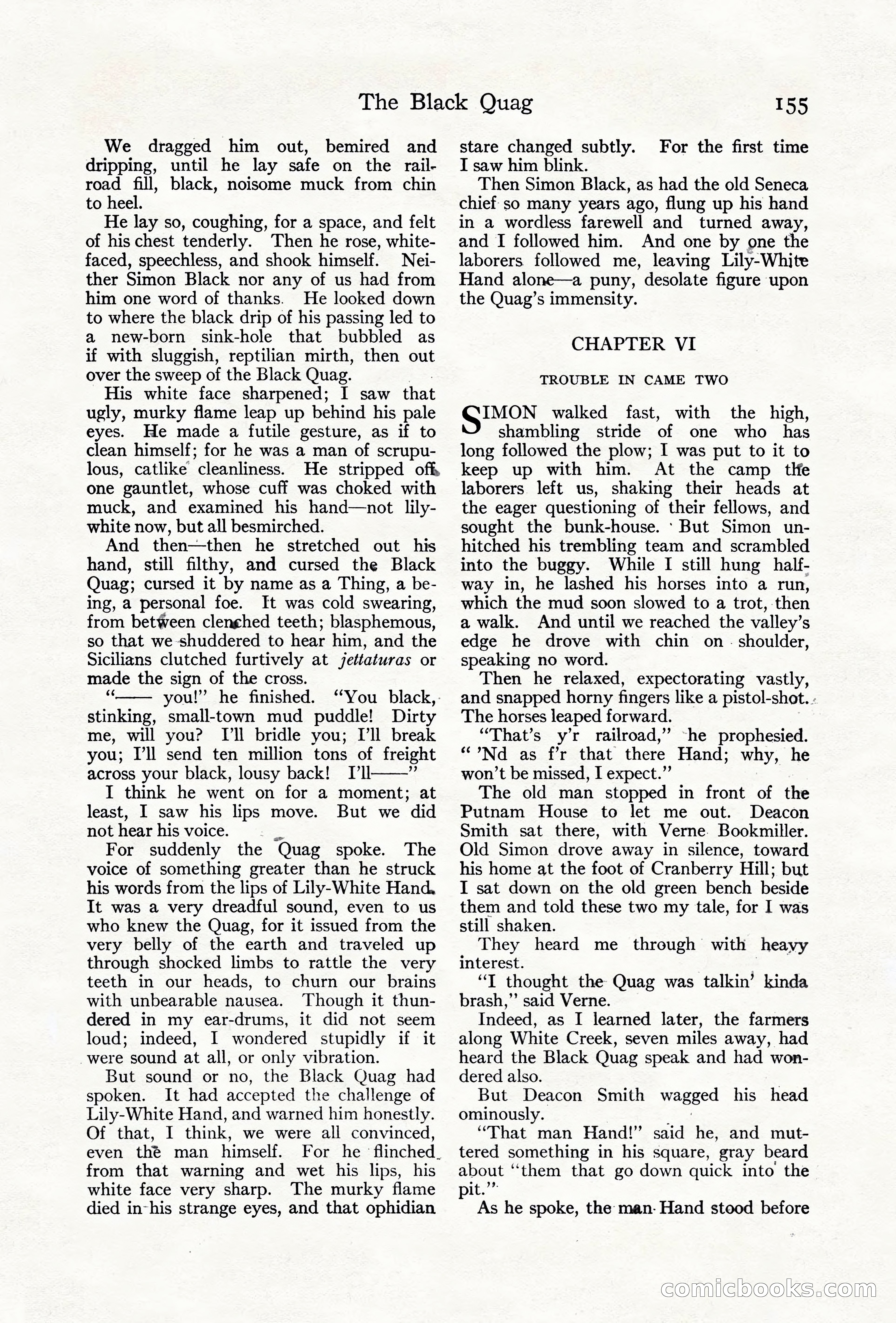
A restored page from Pulp Fiction, 1921. Page through the whole issue in the reader above.
📄 Transcribed text from this page (OCR, searchable)
Machine-transcribed from the original scan — historical spelling and the odd misread are preserved.
The Black Quag We dragged him out, bemired and dripping, until he lay safe on the rail- road fill, black, noisome muck from chin to heel. He lay so, coughing, for a space, and felt of his chest tenderly. Then he rose, white- faced, speechless, and shook himself. Nei- ther Simon Black nor any of us had from him one word of thanks. He looked down to where the black drip of his passing led to a new-born sink-hole that bubbled as if with sluggish, reptilian mirth, then out over the sweep of the Black Quag. His white face sharpened; I saw that ugly, murky flame leap up behind his pale eyes. He made a futile gesture, as if to clean himself; for he was a man of scrupu- lous, catlike cleanliness. He stripped ofk one gauntlet, whose cuff was choked with muck, and examined his hand—not lily- white now, but all besmirched. And then—then he stretched out his hand, still filthy, and cursed the Black Quag; cursed it by name as a Thing, a be- ing, a personal foe. It was cold swearing, from between clenghed teeth; blasphemous, so that we shuddered to hear him, and the Sicilians clutched furtively at jettaturas or made the sign of the cross. fe you!” he finished. ‘You black, stinking, small-town mud puddle! Dirty me, will you? Ill bridle you; Ill break you; Tl send ten million tons of freight across your black, lousy back! Tll——” I think he went on for a moment; at least, I saw his lips move. But we did not hear his voice. . _ For suddenly the Quag spoke. The voice of something greater than he struck his words from the lips of Lily-White Hand It was a very dreadful sound, even to us who knew the Quag, for it issued from the very belly of the earth and traveled up through shocked limbs to rattle the very teeth in our heads, to churn our brains with unbearable nausea. Though it thun- dered in my ear-drums, it did not seem loud; indeed, I wondered stupidly if it were sound at all, or only vibration. But sound or no, the Black Quag had spoken. It had accepted the challenge of Lily-White Hand, and warned him honestly. Of that, I think, we were all convinced, even the man himself. For he flinched. from that warning and wet his lips, his white face very sharp. The murky flame died in-his strange eyes, and that ophidian 155 stare changed subtly. For the first time I saw him blink. Then Simon Black, as had the old Seneca chief so many years ago, flung up his hand in a wordless farewell and turned away, and I followed him. And one by one the laborers followed me, leaving Lily-White Hand alone—a puny, desolate figure upon the Quag’s immensity. CHAPTER VI TROUBLE IN CAME TWO SON walked fast, with the high, shambling stride of one who has long followed the plow; I was put to it to keep up with him. At the camp tle laborers left us, shaking their heads at the eager questioning of their fellows, and sought the bunk-house. ‘But Simon un- hitched his trembling team and scrambled into the buggy. While I still hung half- way in, he lashed his horses into a run, which the mud soon slowed to a trot, then a walk. And until we reached the valley’s edge he drove with chin on. shoulder, speaking no word. Then he relaxed, expectorating vastly, and snapped horny fingers like a pistol-shot. : The horses leaped forward. “That’s y’r railroad,” ~he prophesied. “Nd as f’r that there Hand; why, he won’t be missed, I expect.” The old man stopped in front of the Putnam House to let me out. Deacon Smith sat there, with Verne. Bookmiller. Old Simon drove away in silence, toward his home at the foot of Cranberry Hill; but I sat down on the old green bench beside them and told these two my tale, for I was still shaken. They heard me through with heayy interest. “T thought the Quag was talkin’ kinda brash,” said Verne. Indeed, as I learned later, the farmers along White Creek, seven miles away, had heard the Black Quag speak and had won- dered also. But Deacon Smith wagged his head ominously. “That man Hand!” said he, and mut- tered something 1 in his square, gray beard about ‘them that go down quick into the pit.’” As he spoke, the man- Hand stood before COmicloo oN Uf) C©