
Pulp Fiction, 1921 · page 163 of 204
Adventure Magazine Cover, June 18, 1921 — page 163: what you’re looking at
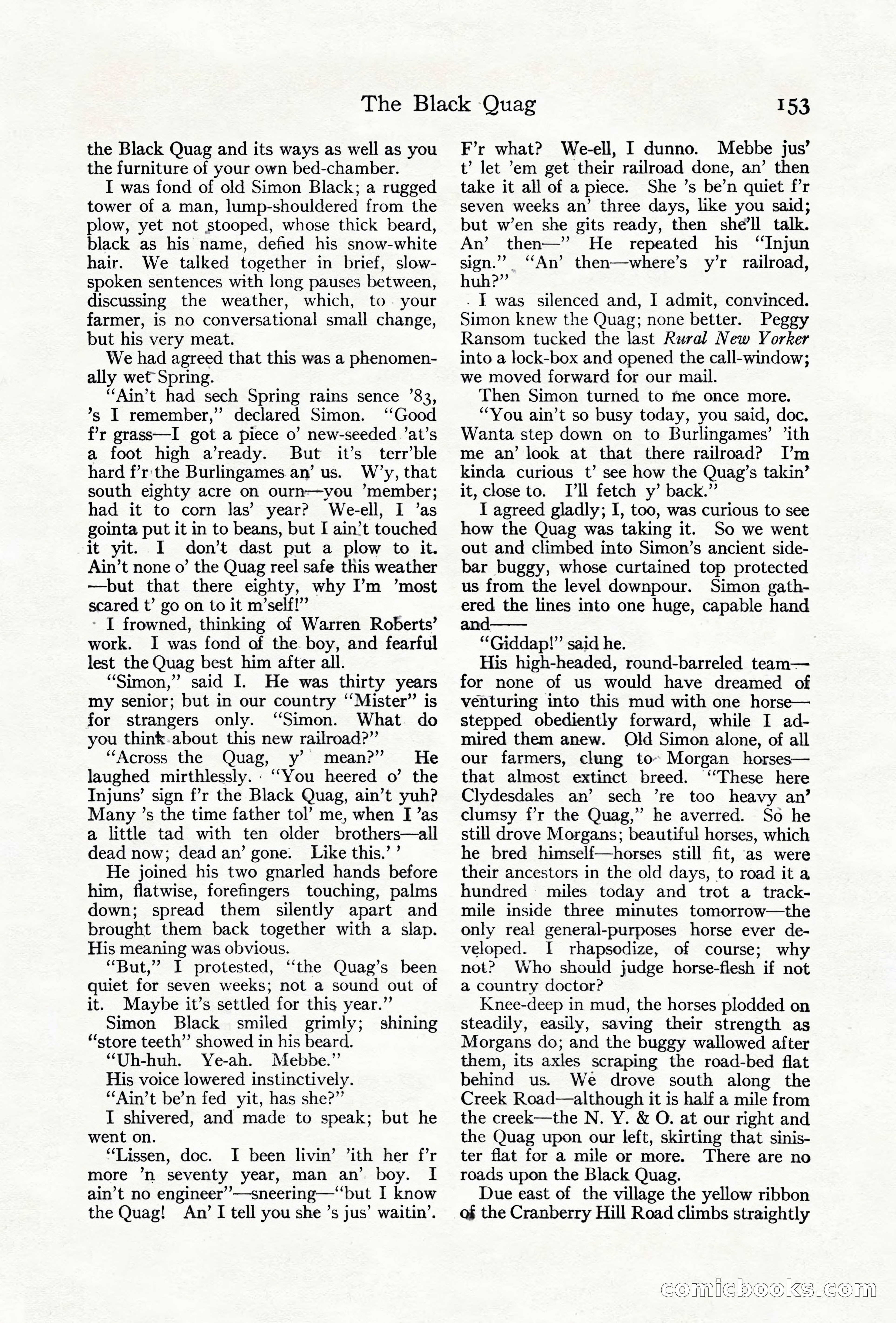
A restored page from Pulp Fiction, 1921. Page through the whole issue in the reader above.
📄 Transcribed text from this page (OCR, searchable)
Machine-transcribed from the original scan — historical spelling and the odd misread are preserved.
The Black Quag the Black Quag and its ways as well as you the furniture of your own bed-chamber. I was fond of old Simon Black; a rugged tower of a man, lump-shouldered from the plow, yet not stooped, whose thick beard, black as his name, defied his snow-white hair. We talked together in brief, slow- spoken sentences with long pauses between, discussing the weather, which, to. your farmer, is no conversational small change, but his very meat. We had agreed that this was a phenomen- ally wet Spring. ‘‘Ain’t had sech Spring rains sence ’83, ’s I remember,” declared Simon. ‘‘Good f’r grass—I got a piece o’ new-seeded ’at’s a foot high a’ready. But it’s terr’ble hard f’r the Burlingames an’ us. W’y, that south eighty acre on ourn—vyou ’member; had it to corn las’ year? We-ell, I ’as gointa put it in to beans, but I ain’t touched it yit. I don’t dast put a plow to it. Ain’t none o’ the Quag reel safe this weather —but that there eighty, why ’m ’most scared t’ go on to it m’self!” - I frowned, thinking of Warren Roberts’ work. I was fond of the boy, and fearful lest the Quag best him after all. “Simon,” said I. He was thirty years my senior; but in our country ‘Mister’ is for strangers only. “Simon. What. do you think-about this new railroad?” “Across the Quag, y’ mean?” He laughed mirthlessly. ‘You heered o’ the Injuns’ sign f’r the Black Quag, ain’t yuh? Many ’s the time father tol’ me, when I ’as a little tad with ten older brothers—all dead now; dead an’ gone. Like this.’ ’ He joined his two gnarled hands before him, flatwise, forefingers touching, palms down; spread them silently apart and brought them back together with a slap. His meaning was obvious. “But,” I protested, “the Quag’s been quiet for seven weeks; not a sound out of it. Maybe it’s settled for this year.” Simon Black smiled grimly; shining “store teeth” showed in his beard. “Uh-huh. Ye-ah. Mebbe.” His voice lowered instinctively. **Ain’t be’n fed yit, has she?”’ I shivered, and made to speak; but he went on. “Lissen, doc. I been livin’ ‘ith her f’r more ’n seventy year, man an’ boy. I ain’t no engineer’’—sneering—“‘but I know the Quag! An’ I tell you she ’s jus’ waitin’. 153 F’r what? We-ell, I dunno. Mebbe jus’ t’ let ’em get their railroad done, an’ then take it all of a piece. She ’s be’n quiet f’r seven weeks an’ three days, like you said; but w’en she gits ready, then she'll talk. An’ then—”’ He repeated his “Injun sign.” “‘An’ then—where’s y’r railroad, huh?” . | was silenced and, I admit, convinced. Simon knew the Quag; none better. Peggy Ransom tucked the last Rural New Yorker into a lock-box and opened the call-window; we moved forward for our mail. _ Then Simon turned to me once more. “You ain’t so busy today, you said, doc. Wanta step down on to Burlingames’ ’ith me an’ look at that there railroad? Tm kinda curious t’ see how the Quag’s takin’ it, close to. I'll fetch y’ back.” I agreed gladly; I, too, was curious to see how the Quag was taking it. So we went out and climbed into Simon’s ancient side- bar buggy, whose curtained top protected us from the level downpour. Simon gath- ered the lines into one huge, capable hand and—— “‘Giddap!”’ said he. His high-headed, round-barreled team— for none of us would have dreamed of venturing into this mud with one horse— stepped obediently forward, while I ad- mired them anew. Old Simon alone, of all our farmers, clung to~ Morgan horses— that almost extinct breed. ‘“‘These here Clydesdales an’ sech ’re too heavy an’ clumsy f’r the Quag,” he averred. So he still drove Morgans; beautiful horses, which he bred himself—horses still fit, as were their ancestors in the old days, to road it a hundred miles today and trot a track- mile inside three minutes tomorrow—the only real general-purposes horse ever de- veloped. I rhapsodize, of course; why not? Who should judge horse-flesh if not a country doctor? : Knee-deep in mud, the horses plodded on steadily, easily, saving their strength as Morgans do; and the buggy wallowed after them, its axles scraping the road-bed flat behind us. We drove south along the Creek Road—although it is half a mile from the creek—the N. Y. & O. at our right and the Quag upon our left, skirting that sinis- ter flat for a mile or more. There are no roads upon the Black Quag. Due east of the village the yellow ribbon of the Cranberry Hill Road climbs straightly COmiclboo \ Uf) ©