
Pulp Fiction, 1921 · page 150 of 204
Adventure Magazine Cover, June 18, 1921 — page 150: what you’re looking at
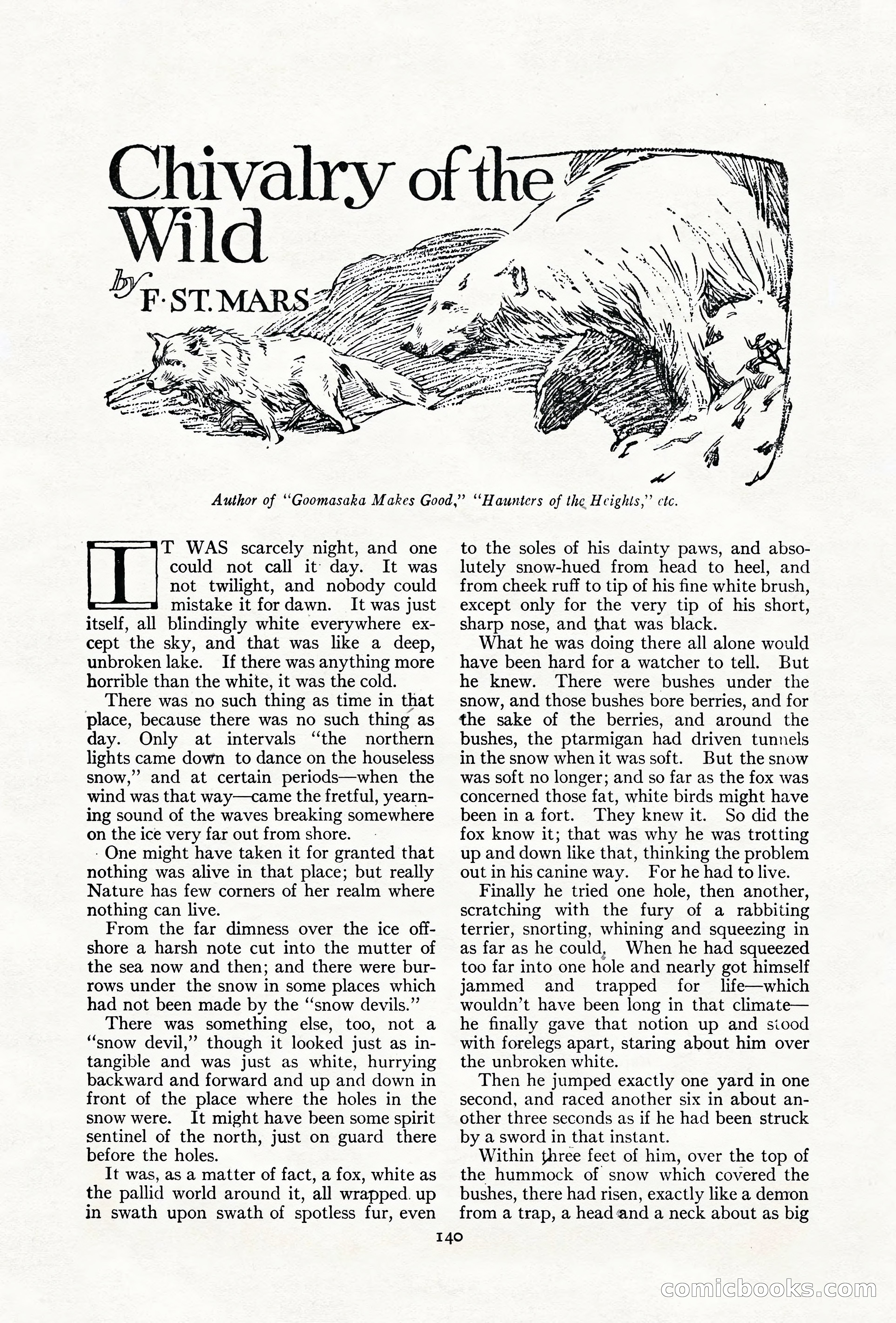
A restored page from Pulp Fiction, 1921. Page through the whole issue in the reader above.
📄 Transcribed text from this page (OCR, searchable)
Machine-transcribed from the original scan — historical spelling and the odd misread are preserved.
Chivalry of Wild as th Author of ‘“‘Goomasaka Makes Good,” ‘‘Haunters of the Heights,’ ctc. gis, T WAS scarcely night, and one could not call it day. It was not twilight, and nobody could mistake it for dawn. It was just itself, all blindingly white everywhere ex- cept the sky, and that was like a deep, unbroken lake. If there was anything more horrible than the white, it was the cold. There was no such thing as time in that place, because there was no such thing as day. Only at intervals “the northern lights came down to dance on the houseless snow,” and at certain periods—when the wind was that way—came the fretful, yearn- ing sound of the waves breaking somewhere on the ice very far out from shore. - One might have taken it for granted that nothing was alive in that place; but really Nature has few corners of her realm where nothing can live. From the far dimness over the ice off- shore a harsh note cut into the mutter of the sea now and then; and there were bur- rows under the snow in some places which had not been made by the “snow devils.” There was something else, too, not a “snow devil,” though it looked just as in- tangible and was just as white, hurrying backward and forward and up and down in front of the place where the holes in the snow were. It might have been some spirit sentinel of the north, just on guard there before the holes. It was, as a matter of fact, a fox, white as the pallid world around it, all wrapped. up in swath upon swath of spotless fur, even to the soles of his dainty paws, and abso- lutely snow-hued from head to heel, and from cheek ruff to tip of his fine white brush, except only for the very tip of his short, sharp nose, and that was black. What he was doing there all alone would have been hard for a watcher to tell. But he knew. There were bushes under the snow, and those bushes bore berries, and for the sake of the berries, and around the bushes, the ptarmigan had driven tunnels in the snow when it was soft. But the snow was soft no longer; and so far as the fox was concerned those fat, white birds might have been in a fort. They knew it. So did the fox know it; that was why he was trotting up and down like that, thinking the problem out in hiscanine way. For he had to live. Finally he tried one hole, then another, scratching with the fury of a rabbiting terrier, snorting, whining and squeezing in as far as he could, When he had squeezed too far into one hole and nearly got himself jammed and trapped for life—which wouldn’t have been long in that climate— he finally gave that notion up and siood with forelegs apart, staring about him over the unbroken white. Then he jumped exactly one yard in one second, and raced another six in about an- other three seconds as if he had been struck by a sword in that instant. Within three feet of him, over the top of the hummock of snow which covered the bushes, there had risen, exactly like a demon from a trap, a head and a neck about as big 140 COmiclboo CO