
Pulp Fiction, 1921 · page 14 of 204
Adventure Magazine Cover, June 18, 1921 — page 14: what you’re looking at
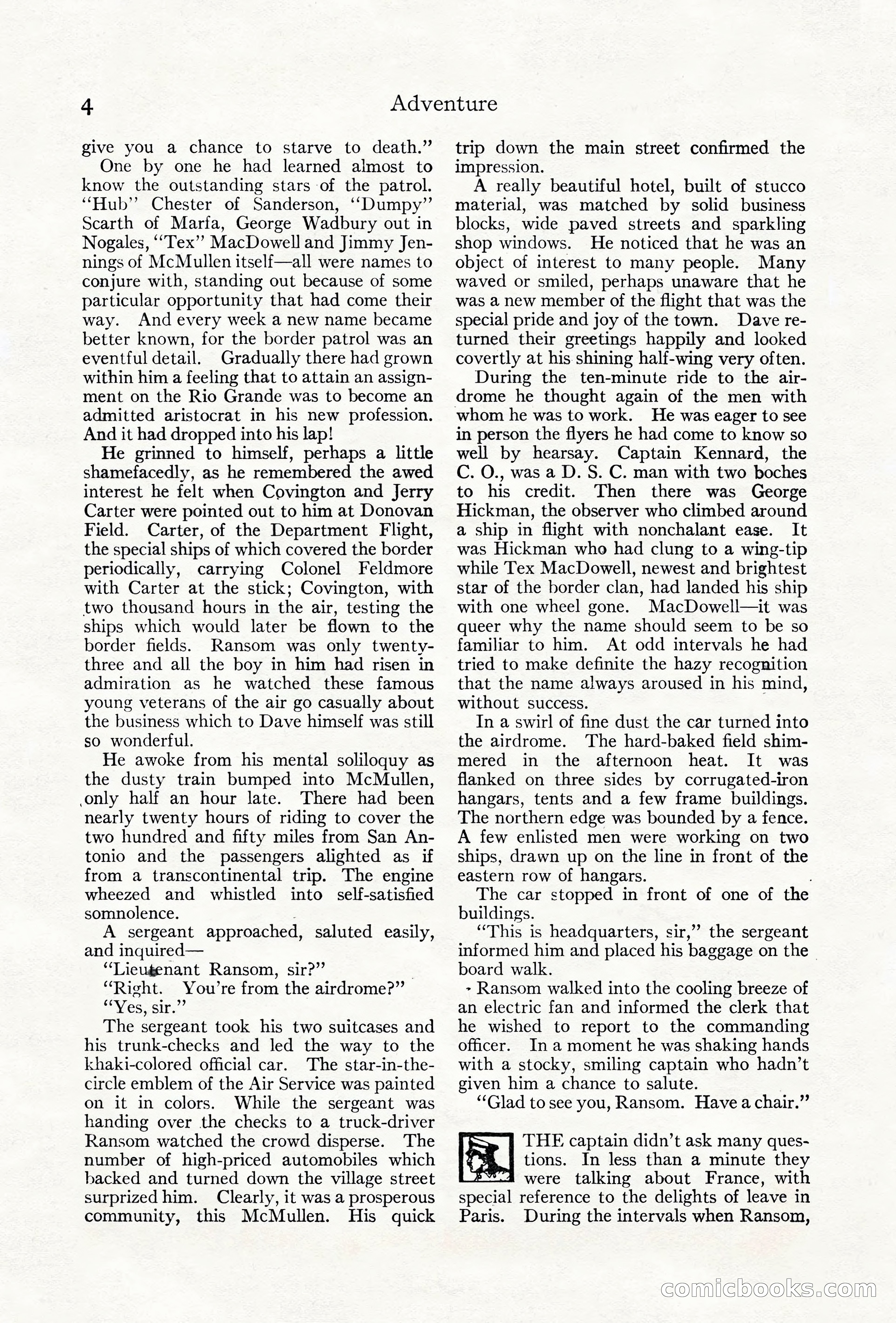
A restored page from Pulp Fiction, 1921. Page through the whole issue in the reader above.
📄 Transcribed text from this page (OCR, searchable)
Machine-transcribed from the original scan — historical spelling and the odd misread are preserved.
4. Adventure give you a chance to starve to death.” One by one he had learned almost to know the outstanding stars of the patrol. “Hub” Chester of Sanderson, ‘‘Dumpy”’ Scarth of Marfa, George Wadbury out in Nogales, ““Tex’”” MacDowell and Jimmy Jen- nings of McMullen itself—all were names to conjure with, standing out because of some particular opportunity that had come their way. And every week a new name became better known, for the border patrol was an eventful detail. Gradually there had grown within him a feeling that to attain an assign- ment on the Rio Grande was to become an admitted aristocrat in his new profession. And it had dropped into his lap! He grinned to himself, perhaps a little shamefacedly, as he remembered the awed interest he felt when Covington and Jerry Carter were pointed out to him at Donovan Field. Carter, of the Department Flight, the special ships of which covered the border periodically, carrying Colonel Feldmore with Carter at the stick; Covington, with two thousand hours in the air, testing the ships which would later be flown to the border fields. Ransom was only twenty- three and all the boy in him had risen in admiration as he watched these famous young veterans of the air go casually about the business which to Dave himself was still so wonderful. He awoke from his mental soliloquy as the dusty train bumped into McMullen, only half an hour late. There had been nearly twenty hours of riding to cover the two hundred and fifty miles from San An- tonio and the passengers alighted as if from a transcontinental trip. The engine wheezed and whistled into self-satisfied somnolence. A sergeant approached, saluted easily, and inquired— “Tieugenant Ransom, sir?” | “Right. You’re from the airdrome?”’ “Ves sr. The sergeant took his two suitcases and his trunk-checks and led the way to the khaki-colored official car. The star-in-the- circle emblem of the Air Service was painted on it in colors. While the sergeant was handing over the checks to a truck-driver Ransom watched the crowd disperse. The number of high-priced automobiles which backed and turned down the village street surprized him. Clearly, it was a prosperous community, this McMullen. His quick trip down the main street confirmed the impression. A really beautiful hotel, built of stucco material, was matched by solid business blocks, wide paved streets and sparkling shop windows. He noticed that he was an object of interest to many people. Many waved or smiled, perhaps unaware that he was a new member of the flight that was the special pride and joy of the town. Dave re- turned their greetings happily and looked covertly at his shining half-wing very often. During the ten-minute ride to the air- drome he thought again of the men with whom he was to work. He was eager to see in person the flyers he had come to know so well by hearsay. Captain Kennard, the C. O., was a D. S. C. man with two boches to his credit. Then there was George Hickman, the observer who climbed around a ship in flight with nonchalant ease. It was Hickman who had clung to a wing-tip while Tex MacDowell, newest and brightest star of the border clan, had landed his ship with one wheel gone. MacDowell—it was queer why the name should seem to be so familiar to him. At odd intervals he had tried to make definite the hazy recognition that the name always aroused in his mind, without success. In a swirl of fine dust the car turned into the airdrome. The hard-baked field shim- mered in the afternoon heat. It was flanked on three sides by corrugated-iron hangars, tents and a few frame buildings. The northern edge was bounded by a fence. A few enlisted men were working on two ships, drawn up on the line in front of the eastern row of hangars. The car stopped in front of one of the buildings. “This is headquarters, sir,” the sergeant informed him and placed his baggage on the board walk. - Ransom walked into the cooling breeze of an electric fan and informed the clerk that he wished to report to the commanding officer. Ina moment he was shaking hands with a stocky, smiling captain who hadn’t given him a chance to salute. “‘Glad to see you, Ransom. Have a chair.” THE captain didn’t ask many ques- tions. In less than a minute they were talking about France, with special reference to the delights of leave in Paris. During the intervals when Ransom, COmicloo oN ) CO