
Pulp Fiction, 1921 · page 132 of 204
Adventure Magazine Cover, June 18, 1921 — page 132: what you’re looking at
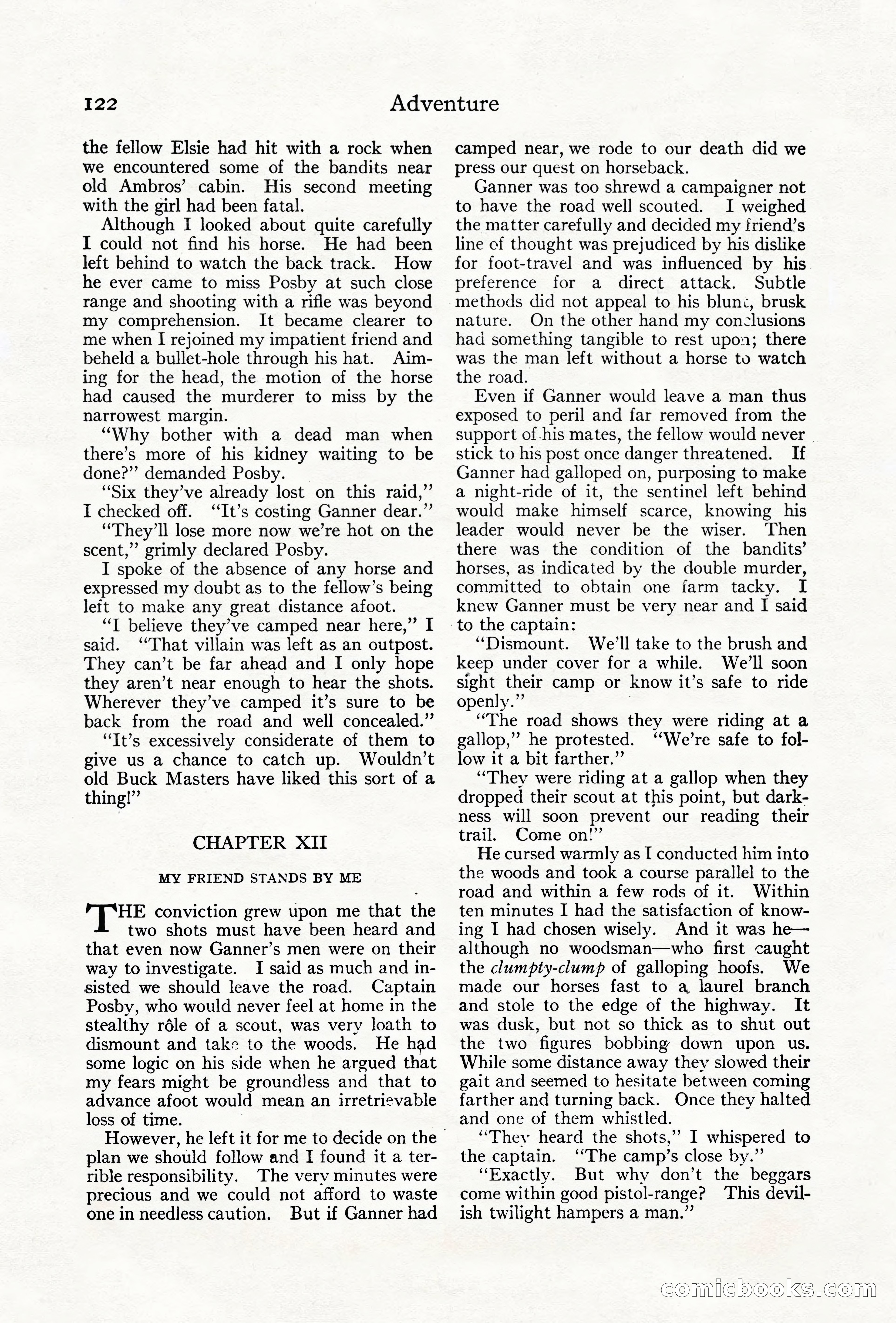
A restored page from Pulp Fiction, 1921. Page through the whole issue in the reader above.
📄 Transcribed text from this page (OCR, searchable)
Machine-transcribed from the original scan — historical spelling and the odd misread are preserved.
I22 the fellow Elsie had hit with a rock when we encountered some of the bandits near old Ambros’ cabin. His second meeting with the girl had been fatal. Although I looked about quite carefully I could not find his horse. He had been left behind to watch the back track. How he ever came to miss Posby at such close range and shooting with a rifle was beyond my comprehension. It became clearer to me when I rejoined my impatient friend and beheld a bullet-hole through his hat. Aim- ing for the head, the motion of the horse had caused the murderer to miss by the narrowest margin. “Why bother with a dead man when there’s more of his kidney waiting to be done?”’ demanded Posby. _ ‘Six they’ve already lost on this raid,” I checked off. “It’s costing Ganner dear.” ‘“‘They’ll lose more now we’re hot on the scent,”’ grimly declared Posby. I spoke of the absence of any horse and expressed my doubt as to the fellow’s being left to make any great distance afoot. “T believe they’ve camped near here,’ I said. “That villain was left as an outpost. They can’t be far ahead and I only hope they aren’t near enough to hear the shots. Wherever they’ve camped it’s sure to be back from the road and well concealed.” “It’s excessively considerate of them to give us a chance to catch up. Wouldn’t old Buck Masters have liked this sort of a thing!” CHAPTER XII MY FRIEND STANDS BY ME 4\ ete conviction grew upon me that the two shots must have been heard and that even now Ganner’s men were on their way to investigate. I said as much and in- sisted we should leave the road. Captain Posby, who would never feel at home in the stealthy réle of a scout, was very loath to dismount and take to the woods. He had some logic on his side when he argued that my fears might be groundless and that to advance afoot would mean an irretrievable loss of time. However, he left it for me to decide on the - plan we should follow and I found it a ter- rible responsibility. The very minutes were precious and we could not afford to waste one in needless caution. But if Ganner had Adventure camped near, we rode to our death did we press our quest on horseback. Ganner was too shrewd a campaigner not to have the road well scouted. I weighed the matter carefully and decided my friend’s line of thought was prejudiced by his dislike for foot-travel and was influenced by his. preference for a direct attack. Subtle ‘methods did not appeal to his blunc, brusk nature. On the other hand my conclusions had something tangible to rest upon; there was the man left without a horse to watch the road. Even if Ganner would leave a man thus exposed to peril and far removed from the support of his mates, the fellow would never | stick to his post once danger threatened. If Ganner had galloped on, purposing to make a night-ride of it, the sentinel left behind would make himself scarce, knowing his leader would never be the wiser. Then there was the condition of the bandits’ horses, as indicated by the double murder, committed to obtain one farm tacky. I knew Ganner must be very near and I said to the captain: ‘“Dismount. We'll take to the brush and keep under cover for a while. We’ll soon sight their camp or know it’s safe to ride openly.” ; ‘The road shows they were riding at a gallop,” he protested. ‘‘We’re safe to fol- low it a bit farther.” ‘“‘They were riding at a gallop when they dropped their scout at this point, but dark- ness will soon prevent our reading their trail. Come on!”’ He cursed warmly as I conducted him into the woods and took a course parallel to the road and within a few rods of it. Within ten minutes I had the satisfaction of know- ing I had chosen wisely. And it was he— although no woodsman—who first caught the clumpty-clump of galloping hoofs. We made our horses fast to a laurel branch and stole to the edge of the highway. It was dusk, but not so thick as to shut out the two figures bobbing down upon us. While some distance away they slowed their gait and seemed to hesitate between coming farther and turning back. Once they halted and one of them whistled. “They heard the shots,’’ I whispered to the captain. ‘“The camp’s close by.”’ “Exactly. But whv don’t the beggars come within good pistol-range? This devil- ish twilight hampers a man.” COmiclboo oN ) CO