
Pulp Fiction, 1921 · page 121 of 204
Adventure Magazine Cover, June 18, 1921 — page 121: what you’re looking at
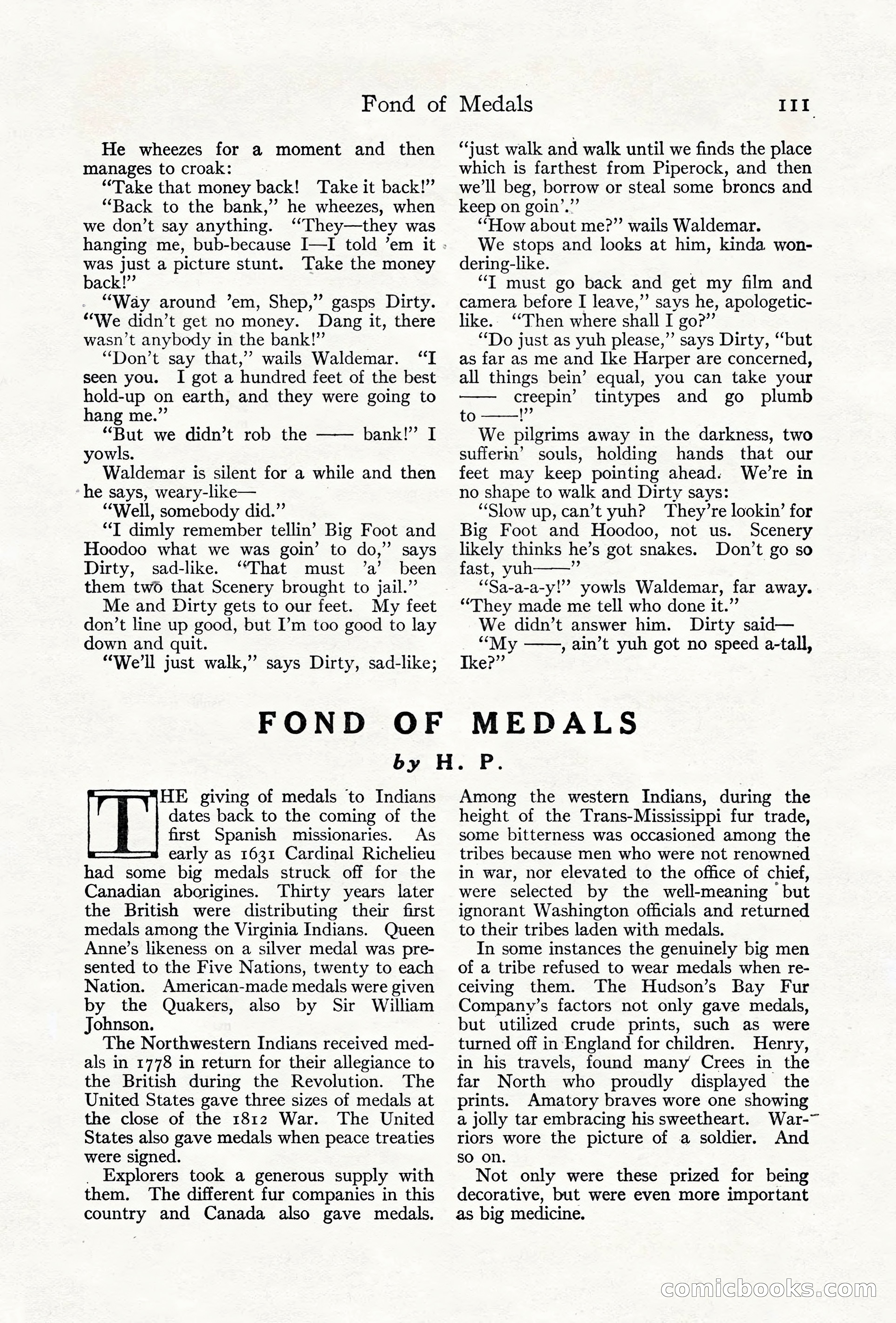
A restored page from Pulp Fiction, 1921. Page through the whole issue in the reader above.
📄 Transcribed text from this page (OCR, searchable)
Machine-transcribed from the original scan — historical spelling and the odd misread are preserved.
Fond of He wheezes for a moment and then manages to croak: “‘Take that money back! Take it back!” “Back to the bank,’’ he wheezes, when we don’t say anything. ‘‘They—they was hanging me, bub-because I—I told ’em it : was just a picture stunt. Take the money back!” ‘Way around ’em, Shep,” gasps Dirty. “We didn’t get no money. Dang it, there wasn’t anybody in the bank!” ‘Don’t say that,” wails Waldemar. “I seen you. I got a hundred feet of the best hold-up on earth, and they were going to hang me.” “But we didn’t rob the —— bank!” I yowls. Waldemar is silent for a while and then he says, weary-like— “Well, somebody did.” ok dimly remember tellin’ Big Foot and Hoodoo what we was goin’ to do,” says Dirty, sad-like. ‘‘That must ’a’ been them two that Scenery brought to jail.” Me and Dirty gets to our feet. don’t line up good, but I’m too good to lay down and quit. “We'll just walk,” says Dirty, sad-like; My feet Medals ‘Just walk and walk until we finds the place which is farthest from Piperock, and then we'll beg, borrow or steal some broncs and keep on goin’.”’ “How about me?” wails Waldemar. We stops and looks at him, kinda won- dering-like. “T must go back and get my film and camera before I leave,’’ says he, apologetic- like. “Then where shall I gor”? “Do just as yuh please,” says Dirty, ‘“‘but as far as me and Ike Harper are concerned, all things bein’ equal, you can take your — creepin’ tintypes and go plumb to ——!” We pilgrims away in the darkness, two sufferin’ souls, holding hands that our feet may keep pointing ahead. We’re in no shape to walk and Dirty says: “Slow up, can’t yuh? They’re lookin’ for Big Foot and Hoodoo, not us. Scenery likely thinks he’s got snakes. Don’t go so fast, yuh i ‘“Sa-a-a-y!”” yowls Waldemar, far away. “They made me tell who done it.” We didn’t answer him. Dirty said— “My , ain’t yuh got no speed a-tall, Ike?” FOND OF MEDALS by H. P. HE giving of medals to Indians dates back to the coming of the first Spanish missionaries. As early as 1631 Cardinal Richelieu had some big medals struck off for the Canadian aborigines. Thirty years later the British were distributing their first medals among the Virginia Indians. Queen Anne’s likeness on a silver medal was pre- sented to the Five Nations, twenty to each Nation. American-made medals were given by the Quakers, also by Sir William Johnson. The Northwestern Indians received med- als in 1778 in return for their allegiance to the British during the Revolution. The United States gave three sizes of medals at the close of the 1812 War. The United States also gave medals when peace treaties were signed. _ Explorers took a generous supply with them. The different fur companies in this country and Canada also gave medals. Among the western Indians, during the height of the Trans-Mississippi fur trade, some bitterness was occasioned among the tribes because men who were not renowned in war, nor elevated to the office of chief, were selected by the well-meaning “but ignorant Washington officials and returned to their tribes laden with medals. In some instances the genuinely big men of a tribe refused to wear medals when re- ceiving them. The Hudson’s Bay Fur Company’s factors not only gave medals, but utilized crude prints, such as were turned off in England for children. Henry, in his travels, found many Crees in the far North who proudly displayed the prints. Amatory braves wore one showing a jolly tar embracing his sweetheart. riors wore the picture of a soldier. sO on. Not only were these prized for being And decorative, but were even more important as big medicine. COmicloo IIL War-~ CN Vp) (©