
Pulp Fiction, 1919 · page 83 of 208
Adventure Magazine Cover — page 83: what you’re looking at
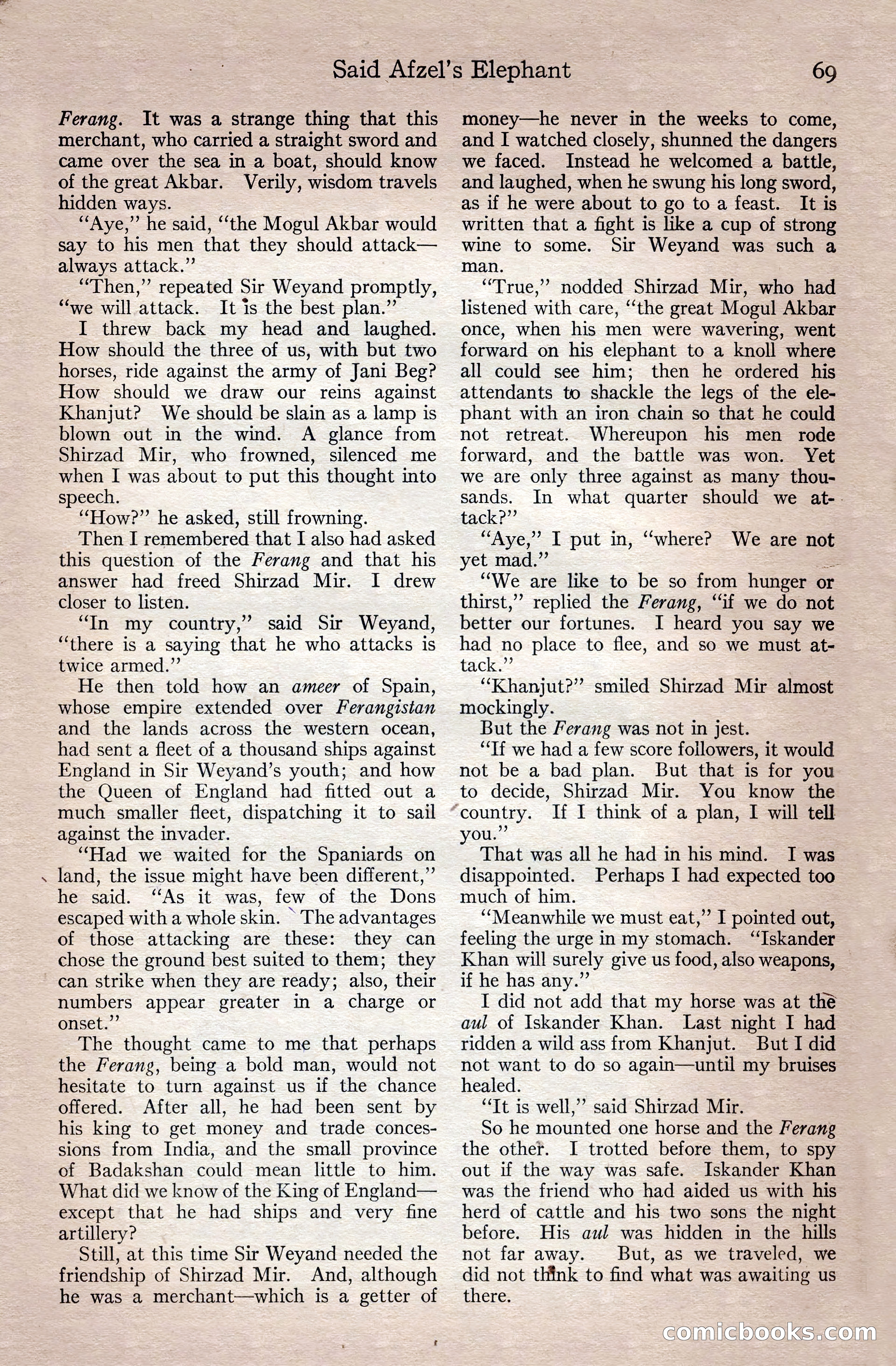
A restored page from Pulp Fiction, 1919. Page through the whole issue in the reader above.
📄 Transcribed text from this page (OCR, searchable)
Machine-transcribed from the original scan — historical spelling and the odd misread are preserved.
¥ said Afzel’s Elephant Ferang. It was a strange thing that this merchant, who carried a straight sword and came over the sea in a boat, should know of the great Akbar. Verily, wisdom travels hidden ways. : “Aye,” he said, ‘“‘the Mogul Akbar would say to his men that they should attack— always attack.” “Then,” repeated Sir Weyand promptly, “we will attack. It is the best plan.” I threw back my head and laughed. How should the three of us, with but two horses, ride against the army of Jani Beg? How should we draw our reins against Khanjut? We should be slain as a lamp is blown out in the wind. A glance from Shirzad Mir, who frowned, silenced me when I was about to put this thought into speech. “How?” he asked, still frowning. Then I remembered that I also had asked this question of the Ferang and that his answer had freed Shirzad Mir. I drew closer to listen. “In my country,’ said Sir Weyand, “there is a saying that he who attacks is twice armed.”’ He then told how an ameer of Spain, whose empire extended over Ferangistan and the lands across the western ocean, had sent a fleet of a thousand ships against England in Sir Weyand’s youth; and how the Queen of England had fitted out a much smaller fleet, dispatching it to sail against the invader. “Had we waited for the Spaniards on land, the issue might have been different,” he said. “As it was, few of the Dons escaped with a whole skin. © The advantages of those attacking are these: they can chose the ground best suited to them; they can strike when they are ready; also, their numbers appear greater in a charge or onset.” The thought came to me that perhaps the Ferang, being a bold man, would not hesitate to turn against us if the chance offered. After all, he had been sent by his king to get money and trade conces- sions from India, and the small province of Badakshan could mean little to him. What did we know of the King of England— except that he had ships and very fine artillery? Still, at this time Sir Weyand needed the friendship of Shirzad Mir. And, although he was a merchant—which is a getter of £ 69 money—he never in the weeks to come, and I watched closely, shunned the dangers we faced. Instead he welcomed a battle, and laughed, when he swung his long sword, as if he were about to go to a feast. It is written that a fight is like a cup of strong wine to some. Sir Weyand was such a man. “True,” nodded Shirzad Mir, who had listened with care, ‘“‘the great Mogul Akbar once, when his men were wavering, went forward on his elephant to a knoll where all could see him; then he ordered his attendants to shackle the legs of the ele- phant with an iron chain so that he could not retreat. Whereupon his men rode forward, and the battle was won. Yet we are only three against as many thou- sands. tack?” “Aye,” I put in, ‘where? We are not yet mad.” = “We are like to be so from hunger o thirst,’ replied the Ferang, “if we do not better our fortunes. I heard you say we had no place to flee, and so we must at- tack.” ‘““Khanjute”’ smiled Shirzad Mir almost mockingly. But the Ferang was not in jest. “Tf we had a few score followers, it would not be a bad plan. But that is for you to decide, Shirzad Mir. You know the ‘country. If I think of a plan, I will tell you.” That was all he had in his mind. I was disappointed. Perhaps I had expected too much of him. ‘“‘Meanwhile we must eat,” I pointed out, feeling the urge in my stomach. ‘“IJskander Khan will surely give us food, also weapons, if he has any.” I did not add that my horse was at thé aul of Iskander Khan. Last night I had ridden a wild ass from Khanjut. But I did not want to do so again—until my bruises healed. “Tt is well,” said Shirzad Mir. So he mounted one horse and the Ferang the other. I trotted before them, to spy out if the way was safe. Iskander Khan was the friend who had aided us with his herd of cattle and his two sons the night before. His aul was hidden in the hills not far away. But, as we traveled, we did not think to find what was awaiting us there. In what quarter should we at-. EComicboo cS (E(0) m