
Pulp Fiction, 1919 · page 75 of 208
Adventure Magazine Cover — page 75: what you’re looking at
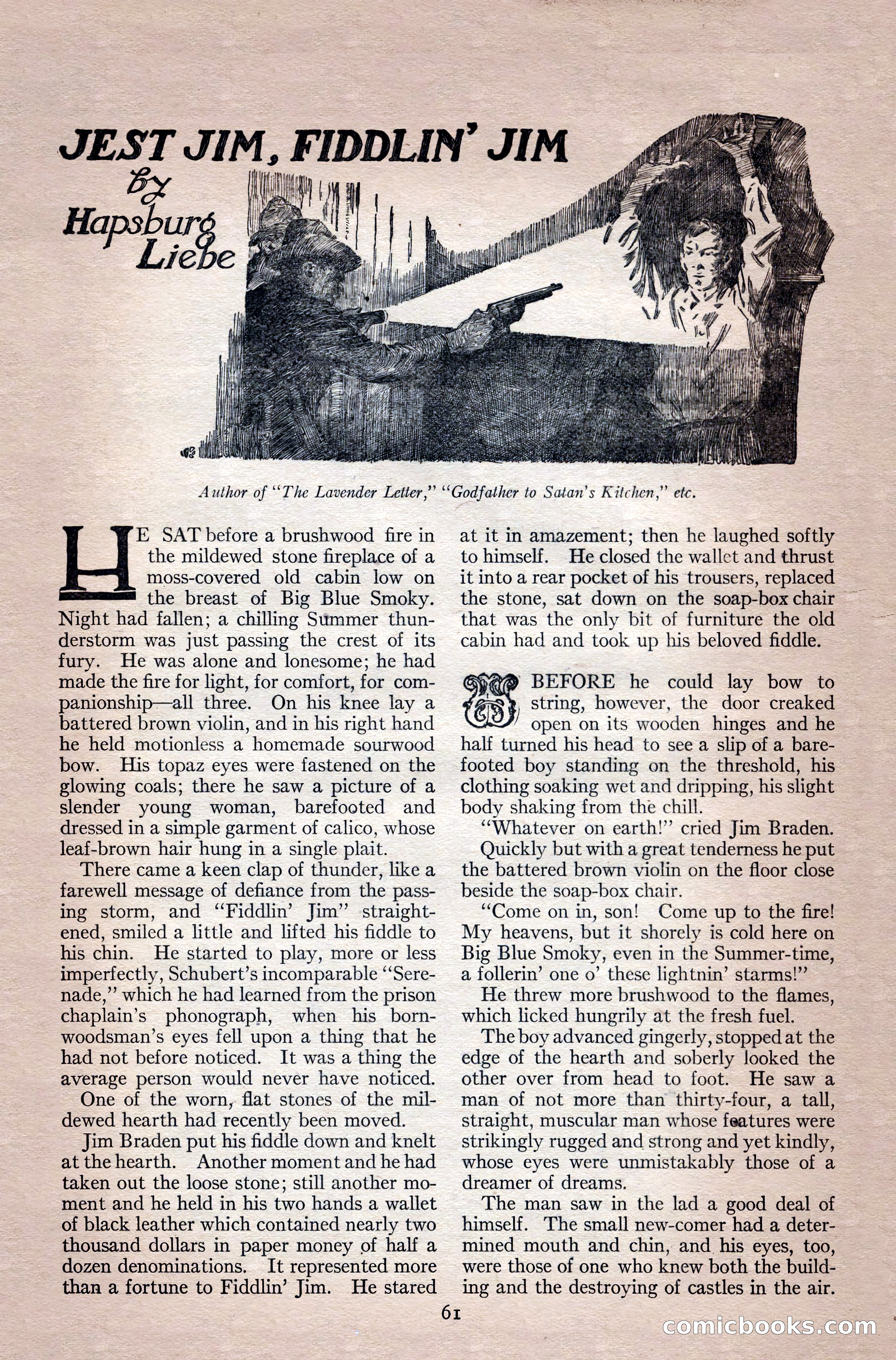
A restored page from Pulp Fiction, 1919. Page through the whole issue in the reader above.
📄 Transcribed text from this page (OCR, searchable)
Machine-transcribed from the original scan — historical spelling and the odd misread are preserved.
JEST JIM, ries JIM malig | E SAT before a brushwood fire in the mildewed stone fireplace of a moss-covered old cabin low on the breast of Big Blue Smoky. Night had fallen; a chilling Summer thun- derstorm was just passing the crest of its fury. He was alone and lonesome; he had made the fire for light, for comfort, for com- panionship—all three. On his knee lay a battered brown violin, and in his right hand he held motionless a homemade sourwood bow. His topaz eyes were fastened on the glowing coals; there he saw a picture of a slender young woman, barefooted and dressed in a simple garment of calico, whose leaf-brown hair hung in a single plait. There came a keen clap of thunder, like a farewell message of defiance from the pass- ing storm, and ‘‘Fiddlin’ Jim” straight- ened, smiled a little and lifted his fiddle to his chin. He started to play, more or less imperfectly, Schubert’s incomparable “‘Sere- nade,” which he had learned from the prison chaplain’s phonograph, when his_ born- woodsman’s eyes fell upon a thing that he had not before noticed. It was a thing the average person would never have noticed. One of the worn, flat stones of the mil- dewed hearth had recently been moved. Jim Braden put his fiddle down and knelt atthe hearth. Another moment and he had taken out the loose stone; still another mo- ment and he held in his two hands a wallet of black leather which contained nearly two thousand dollars in paper money of half a dozen denominations, It represented more than a fortune to Fiddlin’ Jim. He stared 61 Nh \ g hi SHUI ss 1a NN ij A\ - (RT i ii ( aN Author of ““The Lavender Letter,” “‘Godfather to Satan’s Kitchen,” etc. at it in amazement; then he laughed softly to himself. He closed the wallet and thrust it into a rear pocket of his trousers, replaced the stone, sat down on the soap-box chair — that was the only bit of furniture the old cabin had and took up his beloved fiddle. ' BEFORE he could lay bow to string, however, the door creaked open on its wooden hinges and he half turned his head to see a slip of a bare- footed boy standing on the threshold, his clothing soaking wet and dripping, his slight body shaking from the chill. ‘Whatever on earth!” cried Jim Braden. Quickly but with a great tenderness he put the battered brown violin on the floor close beside the soap-box chair. ‘Come on in, son! Come up to the fire! My heavens, but it shorely is cold here on Big Blue Smoky, even in the Summer-time, a follerin’ one o’ these lightnin’ starms!” He threw more brushwood to the flames, which licked hungrily at the fresh fuel. The boy advanced gingerly, stopped at the edge of the hearth and soberly looked the other over from head to foot. He saw a man of not more than thirty-four, a tall, straight, muscular man whose features were strikingly rugged and strong and yet kindly, whose eyes were unmistakably those of a dreamer of dreams. The man saw in the lad a good deal of himself. The small new-comer had a deter- mined mouth and chin, and his eyes, too, were those of one who knew both the build- ing and the destroying of castles in the air. Eomichboo (E cS (E(0) 0