
Pulp Fiction, 1919 · page 66 of 208
Adventure Magazine Cover — page 66: what you’re looking at
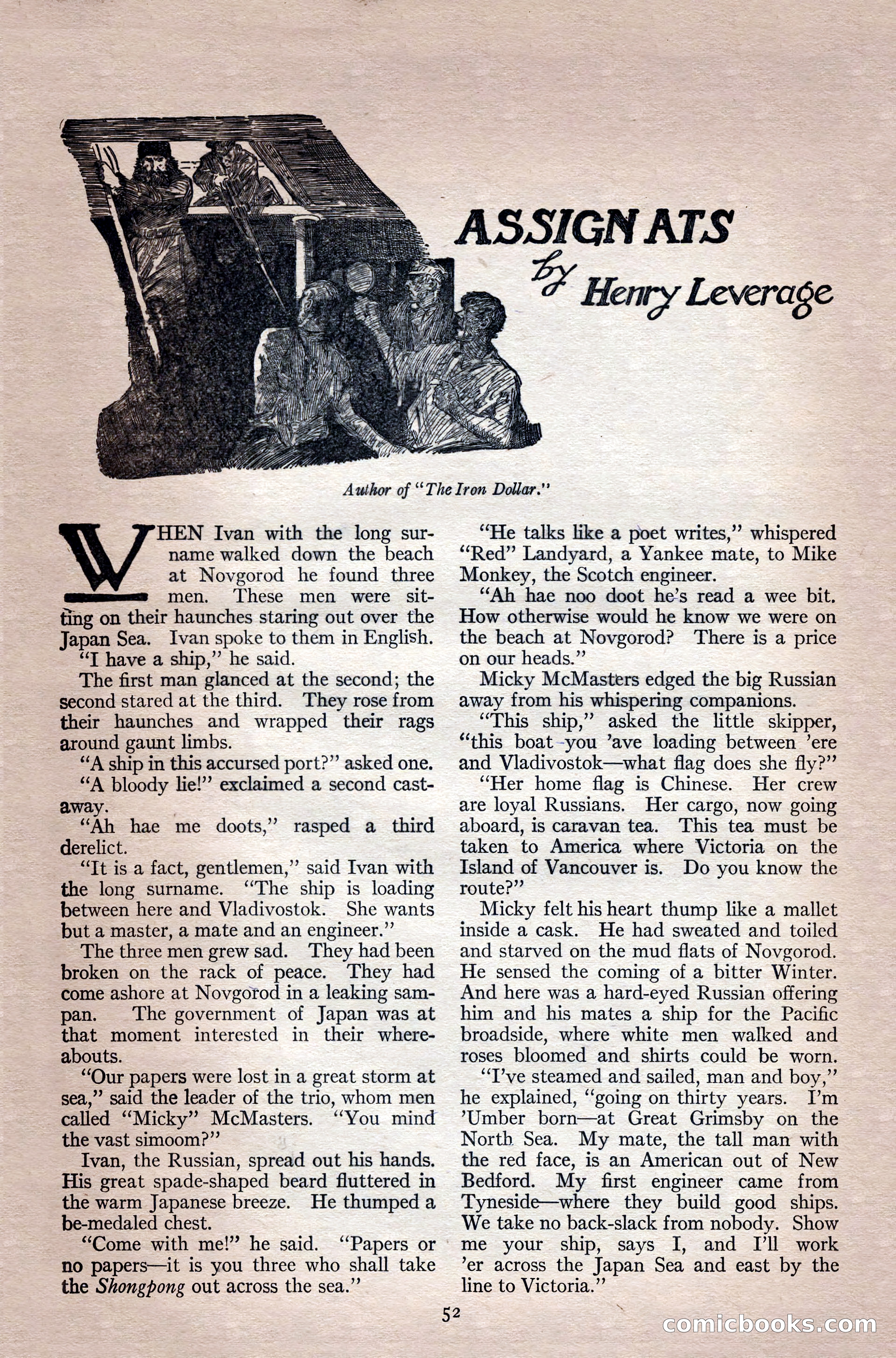
A restored page from Pulp Fiction, 1919. Page through the whole issue in the reader above.
📄 Transcribed text from this page (OCR, searchable)
Machine-transcribed from the original scan — historical spelling and the odd misread are preserved.
ela) all \\ yt ASSIGNATS oy Henry Leverage Author of “The Iron Dollar.” HEN Ivan with the long sur- name walked down the beach at Novgorod he found three quae men. Jhese men were sit- fing on their haunches staring out over the Japan Sea. Ivan spoke to them in English. “T have a ship,” he said. The first man glanced at the second; the second stared at the third. They rose from their haunches and wrapped their rags _ around gaunt limbs. “A ship in this accursed port?” asked one. ““A bloody lie!” exclaimed a second cast- away. ; “Ah hae me doots,” rasped a_ third derelict. “Tt is a fact, gentlemen,” said Ivan with the long surname. “The ship is loading between here and Vladivostok. She wants but a master, a mate and an engineer.” The three men grew sad. They had been broken on the rack of peace. They had come ashore at Novgorod in a leaking sam- pan. The government of Japan was at that moment interested in their where- abouts. “Our papers were lost in a great storm at sea,” said the leader of the trio, whom men called ““Micky” McMasters. “You mind the vast simoom?”’ Ivan, the Russian, spread out his hands. His great spade-shaped beard fluttered in the warm Japanese breeze. He thumped a be-medaled chest. “Come with me!” he said. “Papers or no papers—it is you three who shall take the Shongpong out across the sea.”’ 52 “He talks like a poet writes,” whispered “Red” Landyard, a Yankee mate, to Mike Monkey, the Scotch engineer. “‘Ah hae noo doot he’s read a wee bit. How otherwise would he know we were on the beach at Novgorod? There is a price on our heads.” Micky McMasters edged the big Russian away from his whispering companions. “This ship,” asked the little skipper, “this boat -you ’ave loading between ’ere and Vladivostok—what flag does she fly?” “Her home flag is Chinese. Her crew are loyal Russians. Her cargo, now going aboard, is caravan tea. This tea must be taken to America where Victoria on the Island of Vancouver is. Do you know the route?” Micky felt his heart thump like a mallet inside a cask. He had sweated and toiled and starved on the mud flats of Novgorod. He sensed the coming of a bitter Winter. And here was a hard-eyed Russian offering him and his mates a ship for the Pacific broadside, where white men walked and roses bloomed and shirts could be worn. “T’ve steamed and sailed, man and boy,” he explained, “going on thirty years. I’m "Umber born—at Great Grimsby on the North Sea. My mate, the tall man with the red face, is an American out of New Bedford. My first engineer came from Tyneside—where they build good ships. We take no back-slack from nobody. Show me your ship, says I, and I’ll work er across the Japan Sea and east by the line to Victoria.” Nicboo () cS