
Pulp Fiction, 1919 · page 63 of 208
Adventure Magazine Cover — page 63: what you’re looking at
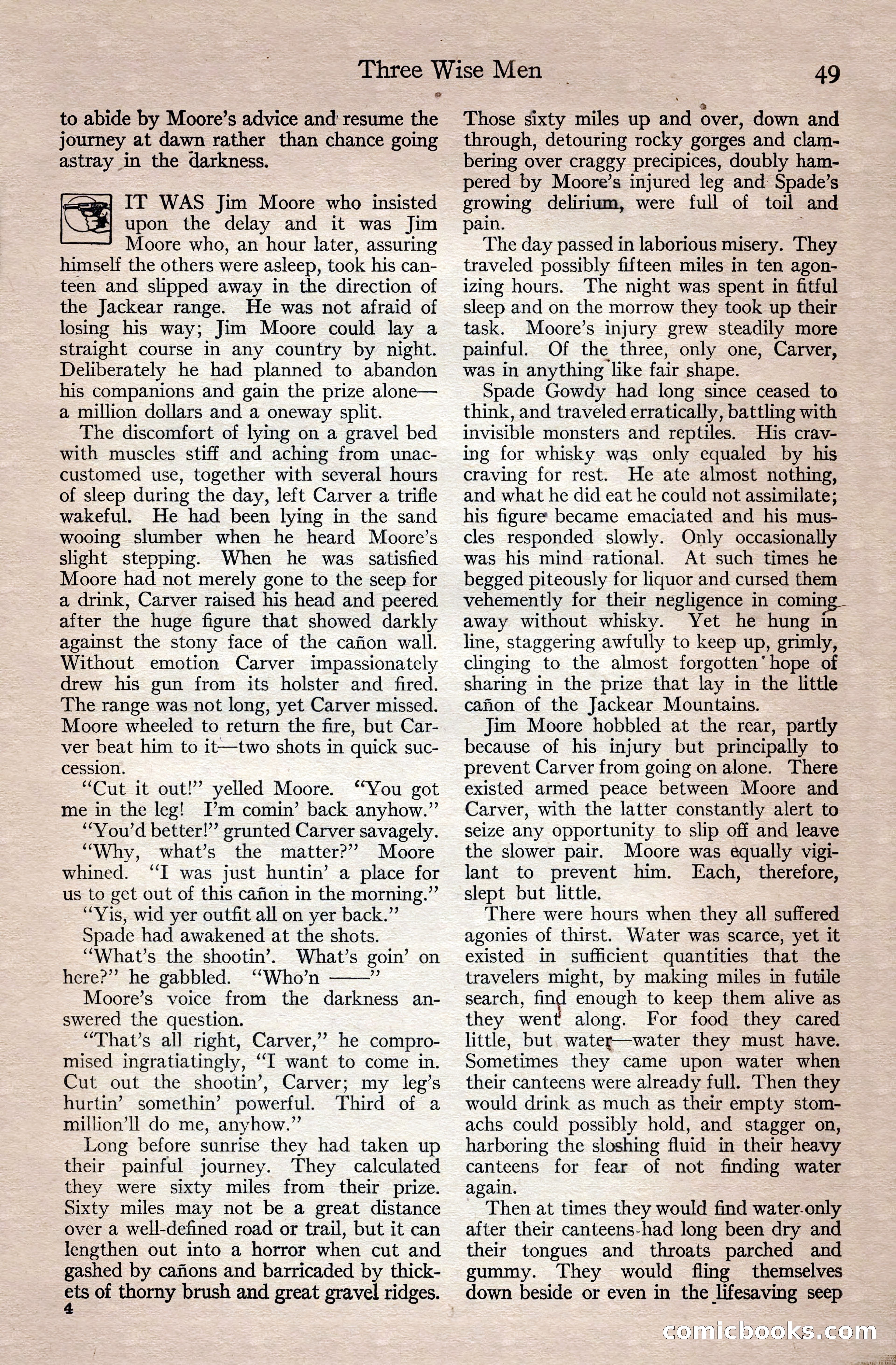
A restored page from Pulp Fiction, 1919. Page through the whole issue in the reader above.
📄 Transcribed text from this page (OCR, searchable)
Machine-transcribed from the original scan — historical spelling and the odd misread are preserved.
Three Wise Men - 49 to abide by Moore’s advice and resume fhe journey at dawn rather than chance going astray in the darkness. a.) upon the delay and it was Jim Moore who, an hour later, assuring himself the others were asleep, took his can- teen and slipped away in the direction of the Jackear range. He was not afraid of losing his way; Jim Moore could lay a straight course in any country by night. Deliberately he had planned to abandon his companions and gain the prize alone— a million dollars and a oneway split. The discomfort of lying on a gravel bed with muscles stiff and aching from unac- customed use, together with several hours of sleep during the day, left Carver a trifle wakeful. He had been lying in the sand wooing slumber when he heard Moore’s slight stepping. When he was satisfied Moore had not merely gone to the seep for a drink, Carver raised his head and peered after the huge figure that showed darkly against the stony face of the cafion wall. Without emotion Carver impassionately drew his gun from its holster and fired. The range was not long, yet Carver missed. Moore wheeled to return the fire, but Car- ver beat him to it—two shots in quick suc- cession. “Cut it out!” yelled Moore. “You got me in the leg! I’m comin’ back anyhow.” “You'd better!’ grunted Carver savagely. “Why, what’s the matter?’ Moore whined. “I was just huntin’ a place for us to get out of this cafion in the morning.” “Yis, wid yer outfit all on yer back.” Spade had awakened at the shots. ‘“What’s the shootin’. What’s goin’ on here?” he gabbled. ‘‘Who’n ——”’ Moore’s voice from the darkness an- swered the question. “That’s all right, Carver,’ he compro- mised ingratiatingly, “I want to come in. Cut out the shootin’, Carver; my leg’s hurtin’ somethin’ powerful. Third of a million’ll do me, anyhow.” Long before sunrise they had taken up their painful journey. They calculated they were sixty miles from their prize. Sixty miles may not be a great distance over a well-defined road or trail, but it can lengthen out into a horror when cut and gashed by cafions and barricaded by thick- ets of thorny brush and great gravel ridges. IT WAS Jim Moore who insisted Those sixty miles up aad over, down and through, detouring rocky gorges and clam- bering over craggy precipices, doubly ham- pered by Moore’s injured leg and: Spade’s growing delirium, were full of toil and pain. The day passed in laborious misery. They traveled possibly fifteen miles in ten agon- izing hours. The night was spent in fitful sleep and on the morrow they took up their task. Moore’s injury grew steadily more painful. Of the three, only one, Carver, was in anything like fair shape. Spade Gowdy had long since ceased to think, and traveled erratically, battling with invisible monsters and reptiles. His crav- ing for whisky was only equaled by his craving for rest. He ate almost nothing, and what he did eat he could not assimilate; his figure became emaciated and his mus- cles responded slowly. Only occasionally was his mind rational. At such times he begged piteously for liquor and cursed them vehemently for their negligence in comin away without whisky. Yet he hung in line, staggering awfully to keep up, grimly, clinging to the almost forgotten’ hope of sharing in the prize that lay in the little cafion of the Jackear Mountains. Jim Moore hobbled at the rear, partly because of his injury but principally to prevent Carver from going on alone. There existed armed peace between Moore and Carver, with the latter constantly alert to seize any opportunity to slp off and leave the slower pair. Moore was equally vigi- lant to prevent him. Each, therefore, slept but little. There were hours when they all suffered agonies of thirst. Water was scarce, yet it existed in sufficient quantities that the travelers might, by making miles in futile search, _ enough to keep them alive as they went along. For food they cared little, but water—water they must have. Sometimes they came upon water when their canteens were already full. Then they would drink as much as their empty stom- achs could possibly hold, and stagger on, harboring the sloshing fluid in their heavy canteens for fear of not finding water again. Then at times they would find water.only after their canteens-had long been dry and their tongues and throats parched and gummy. They would fling themselves down beside or even in the lifesaving seep Eomicbooks.co