
Pulp Fiction, 1919 · page 54 of 208
Adventure Magazine Cover — page 54: what you’re looking at
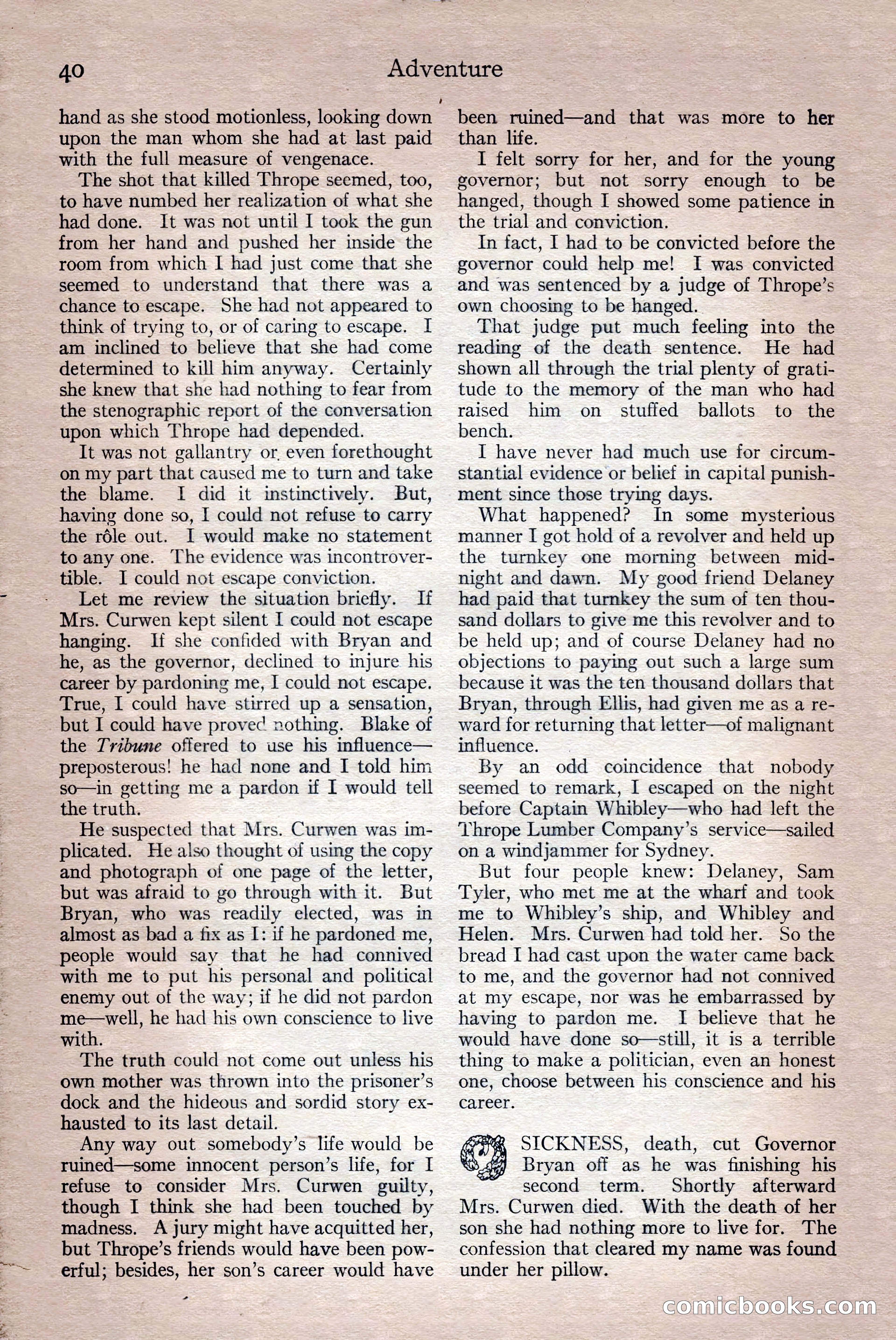
A restored page from Pulp Fiction, 1919. Page through the whole issue in the reader above.
📄 Transcribed text from this page (OCR, searchable)
Machine-transcribed from the original scan — historical spelling and the odd misread are preserved.
40 tible. hand as she stood motionless, looking down upon the man whom she had at last paid with the full measure of vengenace. The shot that killed Thrope seemed, too, to have numbed her realization of what she had done. It was not until I took the gun from her hand and pushed her inside the room from which I had just come that she seemed to understand that there was a chance to escape. She had not appeared to think of trying to, or of caring to escape. I am inclined to believe that she had come determined to kill him anyway. Certainly she knew that she had nothing to fear from the stenographic report of the conversation upon which Thrope had depended. It was not gallantry or. even forethought on my part that caused me to turn and take the blame. I did it instinctively. But, having done so, I could not refuse to carry the réle out. JI would make no statement to any one. The evidence was incontrover- I could not escape conviction. Let me review the situation briefly. If Mrs. Curwen kept silent I could not escape hanging. If she confided with Bryan and he, as the governor, declined to injure his career by pardoning me, I could not escape. True, I could have stirred up a sensation, but I could have proved nothing. Blake of the Tribune offered to use his influence— preposterous! he had none and I told him so—in getting me a pardon if I would tell the truth. He suspected that Mrs. Curwen was im- plicated. He also thought of using the copy and photograph of one page of the letter, but was afraid to go through with it. But Bryan, who was readily elected, was in almost as bad a fix as I: if he pardoned me, people would say that he had connived with me to put his personal and political enemy out of the way; if he did not pardon me—well, he had his own conscience to live with. The truth could not come out unless his own mother was thrown into the prisoner’s dock and the hideous and sordid story ex- hausted to its last detail. Any way out somebody’s life would be ruined—some innocent person’s life, for I refuse to consider Mrs. Curwen guilty, though I think she had been touched by madness. A jury might have acquitted her, but Thrope’s friends would have been pow- erful; besides, her son’s career would have + : Adventure been ruined—and that was more to her than life. I felt sorry for ee and for the young governor; but not sorry enough to be hanged, though I showed some patience in the trial and conviction. In fact, I had to be convicted before the governor could help me! I was convicted and was sentenced by a judge of Thrope’s own choosing to be hanged. That judge put much feeling into the reading of the death sentence. He had shown all through the trial plenty of grati- tude to the memory of the man who had raised him on stuffed ballots to the bench. I have never had much use for circum- stantial evidence or belief in capital punish- ment since those trying days. What happened? In some mysterious manner I got hold of a revolver and held up the turnkey one morning between mid- night and dawn. My good friend Delaney had paid that turnkey the sum of ten thou- sand dollars to give me this revolver and to be held up; and of course Delaney had no objections to paying out such a large sum because it was the ten thousand dollars that Bryan, through Ellis, had given me as a re- ward for returning that letter—of malignant mifluence. == By an odd coincidence that nobody seemed to remark, I escaped on the night before Captain Whibley—who had left the Thrope Lumber Company’s service—sailed on a windjammer for Sydney. But four people knew: Delaney, Sam Tyler, who met me at the wharf and took me to Whibley’s ship, and Whibley and Helen. Mrs. Curwen had told her. So the bread I had cast upon the water came back to me, and the governor had not connived at my escape, nor was he embarrassed by having to pardon me. I believe that he would have done so—still, it is a terrible thing to make a politician, even an honest one, choose between his conscience and his career. second term. pe ee afterward Mrs. Curwen died. With the death of her son she had nothing more to live for. The confession that cleared my name was found under her pillow. GComicbooks (Eo)