
Pulp Fiction, 1919 · page 51 of 208
Adventure Magazine Cover — page 51: what you’re looking at
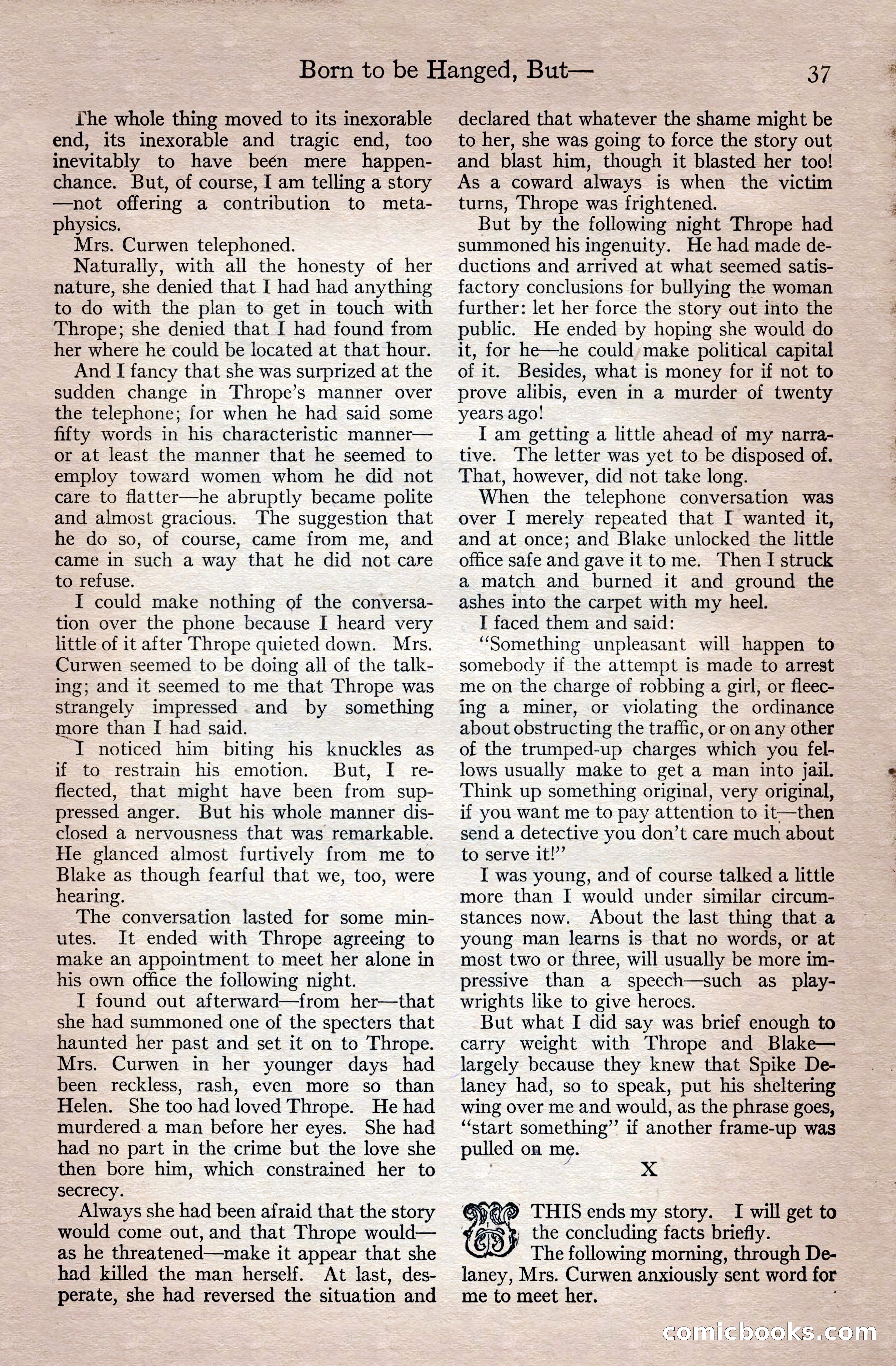
A restored page from Pulp Fiction, 1919. Page through the whole issue in the reader above.
📄 Transcribed text from this page (OCR, searchable)
Machine-transcribed from the original scan — historical spelling and the odd misread are preserved.
Born to be Hanged, But— The whole thing moved to its inexorable end, its inexorable and tragic end, too inevitably to have beén mere happen- chance. But, of course, I am telling a story —not offering a contribution to meta- physics. Mrs. Curwen telephoned. Naturally, with all the honesty of her nature, she denied that I had had anything to do with the plan to get in touch with Thrope; she denied that I had found from her where he could be located at that hour. And I fancy that she was surprized at the sudden change in Thrope’s manner over the telephone; for when he had said some fifty words in his characteristic manner— or at least the manner that he seemed to employ toward women whom he did not care to flatter—he abruptly became polite and almost gracious. The suggestion that he do so, of course, came from me, and came in such a way that he did not care to refuse. I could make nothing of the conversa- tion over the phone because I heard very little of it after Thrope quieted down. Mrs. Curwen seemed to be doing all of the talk- ing; and it seemed to me that Thrope was strangely impressed and by something more than I had said. I noticed him biting his knuckles as if to restrain his emotion. But, I re- flected, that might have been from sup- pressed anger. But his whole manner dis- closed a nervousness that was remarkable. He glanced almost furtively from me to Blake as though fearful that we, too, were hearing. The conversation lasted for some min- utes. It ended with Thrope agreeing to make an appointment to meet her alone in his own office the following night. I found out afterward—from her—that she had summoned one of the specters that haunted her past and set it on to Thrope. Mrs. Curwen in her younger days had been reckless, rash, even more so than Helen. She too had loved Thrope. He had murdered. a man before her eyes. She had had no part in the crime but the love she then bore him, which constrained her to secrecy. Always she had been afraid that the story would come out, and that Thrope would— as he threatened—make it appear that she had killed the man herself. At last, des- perate, she had reversed the situation and 37 declared that whatever the shame might be — to her, she was going to force the story out and blast him, though it blasted her too! As a coward always is when the victim turns, Thrope was frightened. But by the following night Thrope had summoned his ingenuity. He had made de- ductions and arrived at what seemed satis- factory conclusions for bullying the woman further: let her force the story out into the public. He ended by hoping she would do it, for he—he could make political capital of it. Besides, what is money for if not to prove alibis, even in a murder of twenty years ago! I am getting a little ahead of my narra- tive. The letter was yet to be disposed of. That, however, did not take long. When the telephone conversation was over I merely repeated that I wanted it, and at once; and Blake unlocked the little office safe and gave it tome. Then I struck a match and burned it and ground the ashes into the carpet with my heel. I faced them and said: “Something unpleasant will happen to somebody if the attempt is made to arrest me on the charge of robbing a girl, or fleec- ing a miner, or violating the ordinance about obstructing the traffic, or on any other of the trumped-up charges which you fel- lows usually make to get a man into jail. Think up something original, very original, if you want me to pay attention to it—then send a detective you don’t care much about to serve it!” I was young, and of course talked a little more than I would under similar circum- stances now. About the last thing that a young man learns is that no words, or at most two or three, will usually be more im- pressive than a speech—such as play- wrights like to give heroes. But what I did say was brief enough to carry weight with Thrope and Blake— largely because they knew that Spike De- laney had, so to speak, put his sheltering wing over me and would, as the phrase goes, “start something” if another frame-up was pulled on me. 3 Xx Gy@e@ THIS ends my story. I will get to e the concluding facts briefly. The following morning, through De- laney, Mrs. Curwen anxiously sent word for me to meet her. GEomicbooks..co