
Pulp Fiction, 1919 · page 49 of 208
Adventure Magazine Cover — page 49: what you’re looking at
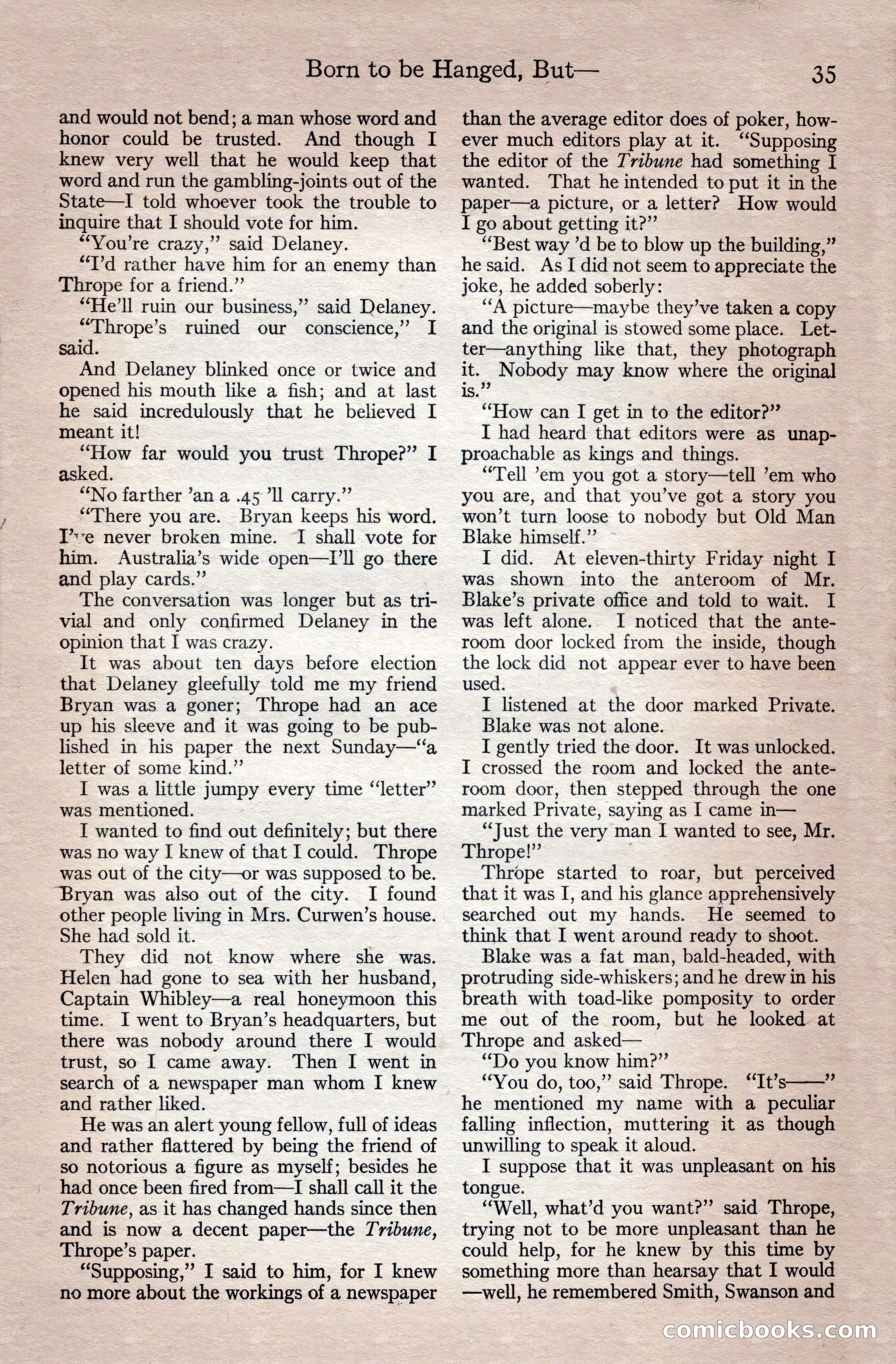
A restored page from Pulp Fiction, 1919. Page through the whole issue in the reader above.
📄 Transcribed text from this page (OCR, searchable)
Machine-transcribed from the original scan — historical spelling and the odd misread are preserved.
Born to be Hanged, But— and would not bend; a man whose word and honor could be trusted. And though I knew very well that he would keep that word and run the gambling-joints out of the State—I told whoever took the trouble to inquire that I should vote for him. “You're crazy,” said Delaney. “Yd rather have him for an enemy than -Thrope for a friend.” “He'll ruin our business,” said Delaney. “Thrope’s ruined our conscience,’ I said. And Delaney blinked once or twice and opened his mouth like a fish; and at last he said incredulously that he believed I meant it! “How far would you trust Thrope?” I asked. “No farther ’an a .45 ll carry.” ‘There you are. Bryan keeps his word. I’ve never broken mine. I shall vote for him. Australia’s wide open—lI’ll go there and play cards.” The conversation was longer but as tri- vial and only confirmed Delaney in the opinion that I was crazy. It was about ten days before election that Delaney gleefully told me my friend Bryan was a goner; Thrope had an ace up his sleeve and it was going to be pub- lished in his paper the next Sunday—“‘a letter of some kind.” I was a little jumpy every time “letter” was mentioned. I wanted to find out definitely; but there was no way I knew of that I could. Thrope was out of the city—or was supposed to be. Bryan was also out of the city. I found other people living in Mrs. Curwen’s house. She had sold it. : They did not know where she was. Helen had gone to sea with her husband, Captain Whibley—a real honeymoon this time. I went to Bryan’s headquarters, but there was nobody around there I would trust, so I came away. Then I went in search of a newspaper man whom I knew and rather liked. He was an alert young fellow, full of ideas and rather flattered by being the friend of so notorious a figure as myself; besides he had once been fired from—I shall call it the Tribune, as it has changed hands since then and is now a decent paper—the Tribune, Thrope’s paper. “Supposing,” I said to him, for I knew no more about the workings of a newspaper ) 39 than the average editor does of poker, how- ever much editors play at it. “Supposing the editor of the Tribune had something I wanted. That he intended to put it in the paper—a picture, or a letter? How would I go about getting it?” ‘Best way ’d be to blow up the building,” | he said. As I did not seem to appreciate the joke, he added soberly: “A picture—maybe they’ve taken a copy and the original is stowed some place. Let- ter—anything like that, they photograph it. Nobody may know where the original is.” ; : “How can I get in to the editor?” I had heard that editors were as unap- proachable as kings and things. ‘Tell ’em you got a story—tell ’em who you are, and that you’ve got a story you won’t turn loose to nobody but Old Man Blake himself.” ~ I did. At eleven-thirty Friday night I was shown into the anteroom of Mr. Blake’s private office and told to wait. I was left alone. I noticed that the ante- room door locked from the inside, though the lock did not appear ever to have been used. | I listened at the door marked Private. Blake was not alone. I gently tried the door. It was unlocked. I crossed the room and locked the ante- room door, then stepped through the one marked Private, saying as I came in— “Just the very man I wanted to see, Mr. Thrope!” Thrope started to roar, but perceived that it was I, and his glance apprehensively searched out my hands. He seemed to think that I went around ready to shoot. Blake was a fat man, bald-headed, with protruding side-whiskers; and he drew in his breath with toad-like pomposity to order me out of the room, but he looked at Thrope and asked— “Do you know him?” “You do, too,” said Thrope. “It’s——” he mentioned my name with a peculiar falling inflection, muttering it as though unwilling to speak it aloud. I suppose that it was unpleasant on his tongue. “Well, what’d you want?” said Thrope, trying not to be more unpleasant than he could help, for he knew by this time by something more than hearsay that I would —well, he remembered Smith, Swanson and Eomichooks.co