
Pulp Fiction, 1919 · page 40 of 208
Adventure Magazine Cover — page 40: what you’re looking at
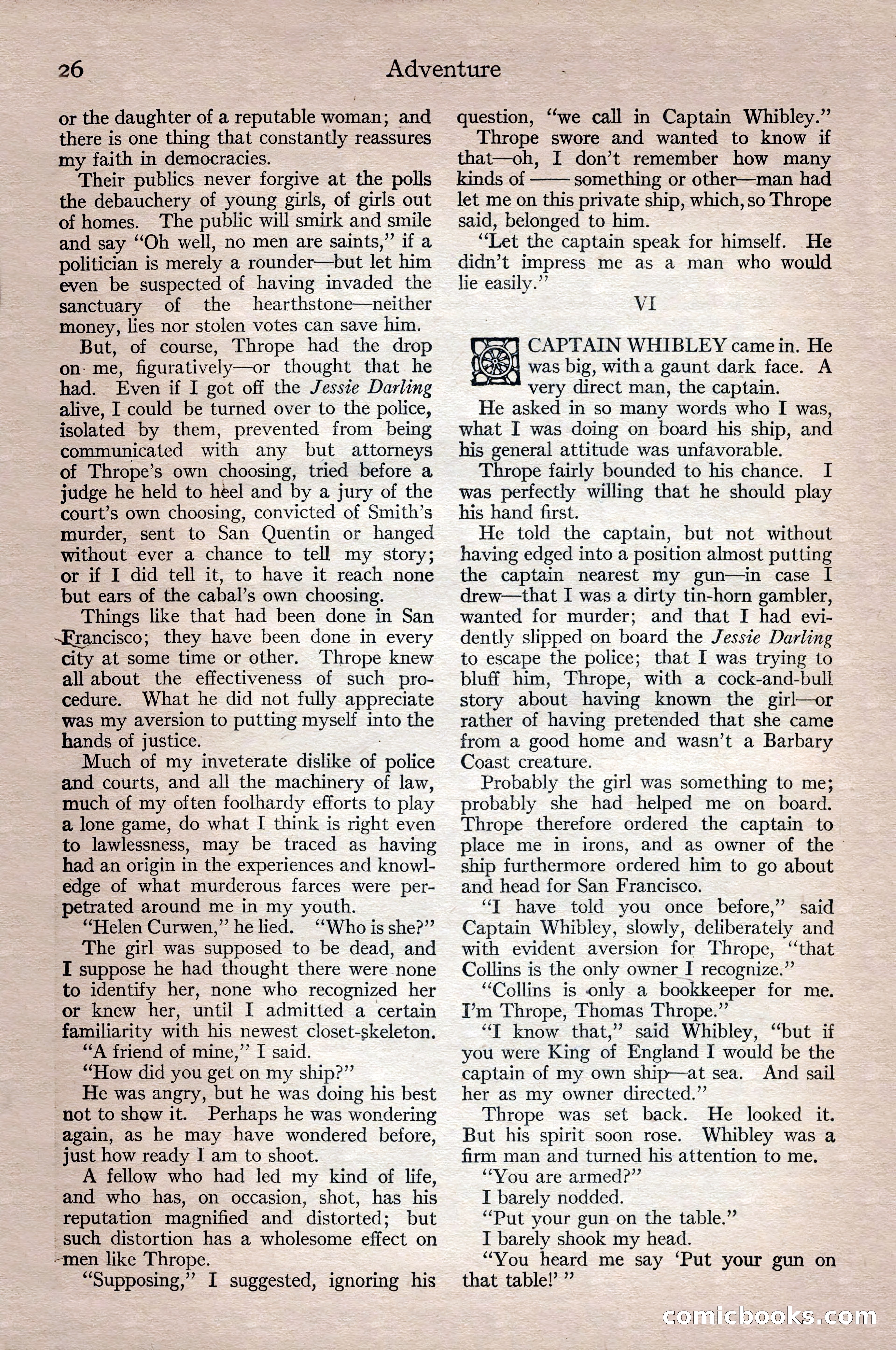
A restored page from Pulp Fiction, 1919. Page through the whole issue in the reader above.
📄 Transcribed text from this page (OCR, searchable)
Machine-transcribed from the original scan — historical spelling and the odd misread are preserved.
26 or the daughter of a reputable woman; and there is one thing that constantly reassures my faith in democracies. Their publics never forgive at the polls the debauchery of young girls, of girls out of homes. The public will smirk and smile and say “Oh well, no men are saints,” if a politician is merely a rounder—but let him even be suspected of having invaded the sanctuary of the hearthstone—neither money, lies nor stolen votes can save him. But, of course, Thrope had the drop on: me, figuratively—or thought that he had. Even if I got off the Jessie Darling alive, I could be turned over to the police, isolated by them, prevented from being communicated with any but attorneys of Thrope’s own choosing, tried before a judge he held to heel and by a jury of the court’s own choosing, convicted of Smith’s murder, sent to San Quentin or hanged without ever a chance to tell my story; or if I did tell it, to have it reach none but ears of the cabal’s own choosing. Things like that had been done in San ~Francisco; they have been done in every city at some time or other. Thrope knew all about the effectiveness of such pro- cedure. What he did not fully appreciate was my aversion to putting myself into the hands of justice. . Much of my inveterate dislike of police and courts, and all the machinery of law, much of my often foolhardy efforts to play a lone game, do what I think is right even to lawlessness, may be traced as having had an origin in the experiences and know]- edge of what murderous farces were per- trated around me in my youth. “Helen Curwen,” he lied. ‘“‘Who is she?” The girl was supposed to be dead, and I suppose he had thought there were none to identify her, none who recognized her or knew her, until I admitted a certain familiarity with his newest closet-skeleton. “fA friend of mine,” I said. “How did you get on my ship?” He was angry, but he was doing his best not to show it. Perhaps he was wondering again, as he may have wondered before, just how ready I am to shoot. A fellow who had led my kind of life, and who has, on occasion, shot, has his reputation magnified and distorted; but such distortion has a wholesome effect on ~men like Thrope. “Supposing,” I suggested, ignoring his Adventure question, “we call in Captain Whibley.” Thrope swore and wanted to know if that—oh, I don’t remember how many kinds of ——- something or other—man had let me on this private ship, which, so Thrope said, belonged to him. “Let the captain speak for himself. He didn’t impress me as a man who would hie easily.”’ VI } CAPTAIN WHIBLEY came in. He 4 was big, witha gaunt dark face. A very direct man, the captain. He asked in so many words who I was, what I was doing on board his ship, and his general attitude was unfavorable. Thrope fairly bounded to his chance. I was perfectly willing that he should play his hand first. He told the captain, but not without having edged into a position almost putting the captain nearest my gun—in case I drew—that I was a dirty tin-horn gambler, wanted for murder; and that I had evi- dently slipped on board the Jessie Darling to escape the police; that I was trying to bluff him, Thrope, with a cock-and-bull story about having known the girl—or rather of having pretended that she came from a good home and wasn’t a Barbary Coast creature. Probably the girl was something to me; probably she had helped me on board. Thrope therefore ordered the captain to place me in irons, and as owner of the ship furthermore ordered him to go about and head for San Francisco. “T have told you once before,” said Captain Whibley, slowly, deliberately and with evident aversion for Thrope, ‘that Collins is the only owner I recognize.” “Collins is only a bookkeeper for me. I’m Thrope, Thomas Thrope.” “T know that,’ said Whibley, “but if you were King of England I would be the captain of my own ship—at sea. And sail her as my owner directed.” Thrope was set back. He looked it. But his spirit soon rose. Whibley was a firm man and turned his attention to me. “You are armed?” I barely nodded. “Put your gun on the table.” I barely shook my head. “You heard me say ‘Put your gun on that table? ” com (@) books=co m