
Pulp Fiction, 1919 · page 37 of 208
Adventure Magazine Cover — page 37: what you’re looking at
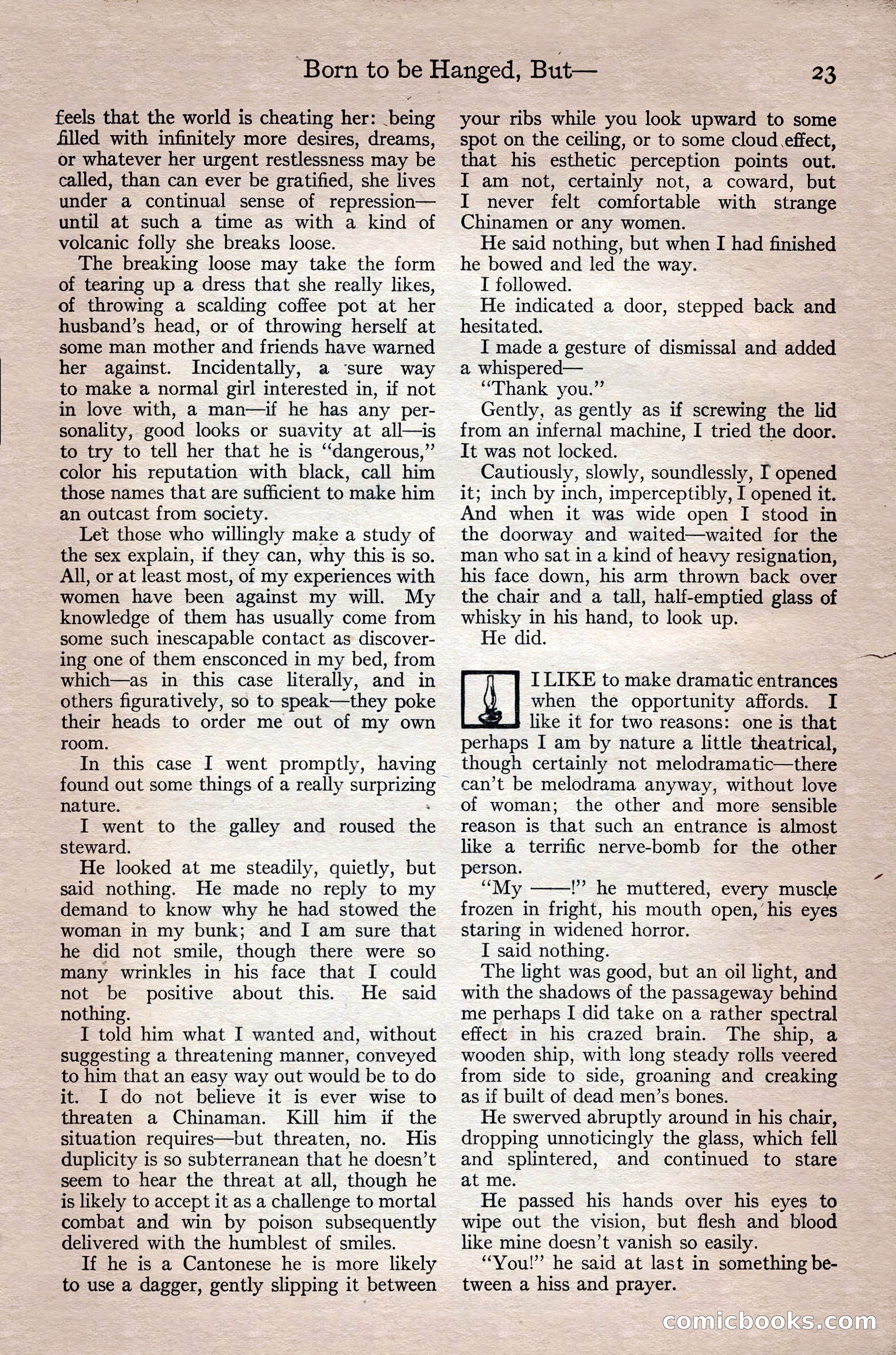
A restored page from Pulp Fiction, 1919. Page through the whole issue in the reader above.
📄 Transcribed text from this page (OCR, searchable)
Machine-transcribed from the original scan — historical spelling and the odd misread are preserved.
‘Born to be Hanged, But— feels that the world is cheating her: being filled with infinitely more desires, dreams, or whatever her urgent restlessness may be called, than can ever be gratified, she lives under a continual sense of repression— until at such a time as with a kind of volcanic folly she breaks loose. The breaking loose may take the form of tearing up a dress that she really likes, of throwing a scalding coffee pot at her husband’s head, or of throwing herself at some man mother and friends have warned her against. Incidentally, a ‘sure way to make a normal girl interested in, if not in love with, a man—if he has any per- sonality, good looks or suavity at all—is to try to tell her that he is ‘‘dangerous,”’ color his reputation with black, call him those names that are sufficient to make him an outcast from society. Let those who willingly make a study of the sex explain, if they can, why this is so. All, or at least most, of my experiences with women have been against my will. My knowledge of them has usually come from some such inescapable contact as discover- ing one of them ensconced in my bed, from which—as in this case literally, and in others figuratively, so to speak—they poke their heads to order me out of my own room. In this case I went promptly, having found out some things of a really surprizing nature. I went to the galley and roused the steward. He looked at me steadily, quietly, but said nothing. He made no reply to my demand to know why he had stowed the woman in my bunk; and I am sure that he did not smile, though there were so many wrinkles in his face that I could not be positive about this. He said nothing. I told him what I wanted and, without suggesting a threatening manner, conveyed to him that an easy way out would be to do it. I do not believe it is ever wise to threaten a Chinaman. Kill him if the situation requires—but threaten, no. His duplicity is so subterranean that he doesn’t seem to hear the threat at all, though he is likely to accept it as a challenge to mortal combat and win by poison subsequently delivered with the humblest of smiles. If he is a Cantonese he is more likely to use a dagger, gently slipping it between 23 your ribs while you look upward to some spot on the ceiling, or to some cloud effect, that his esthetic perception points out. I am not, certainly not, a coward, but I never felt comfortable with strange Chinamen or any women. He said nothing, but when I had finished he bowed and led the way. I followed. He indicated a door, stepped back and hesitated. I made a gesture of dismissal and added a whispered— “Thank you.” Gently, as gently as if screwing the lid from an infernal machine, I tried the door. It was not locked. Cautiously, slowly, soundlessly, I opened it; inch by inch, imperceptibly, I opened it. And when it was wide open I stood in the doorway and waited—waited for the man who sat in a kind of heavy resignation, his face down, his arm thrown back over the chair and a tall, half-emptied glass of whisky in his hand, to look up. He did. | I LIKE to make dramatic entrances when the opportunity affords. I Sect like it for two reasons: one is that perhaps I am by nature a little theatrical, though certainly not melodramatic—there can’t be melodrama anyway, without love of woman; the other and more sensible reason is that such an entrance is almost like a terrific nerve-bomb for the other person. “My ! he muttered, every muscle frozen in fright, his mouth open, ‘his eyes staring in widened horror. I said nothing. The light was good, but an oil light, and with the shadows of the passageway behind me perhaps I did take on a rather spectral effect in his crazed brain. The ship, a wooden ship, with long steady rolls veered from side to side, groaning and creaking as if built of dead men’s bones. He swerved abruptly around in his chair, dropping unnoticingly the glass, which fell and splintered, and continued to stare at me. He passed his hands over his eyes to wipe out the vision, but flesh and blood like mine doesn’t vanish so easily. “You!” he said at last in something be- tween a hiss and prayer. Gomicbooks.co