
Pulp Fiction, 1919 · page 33 of 208
Adventure Magazine Cover — page 33: what you’re looking at
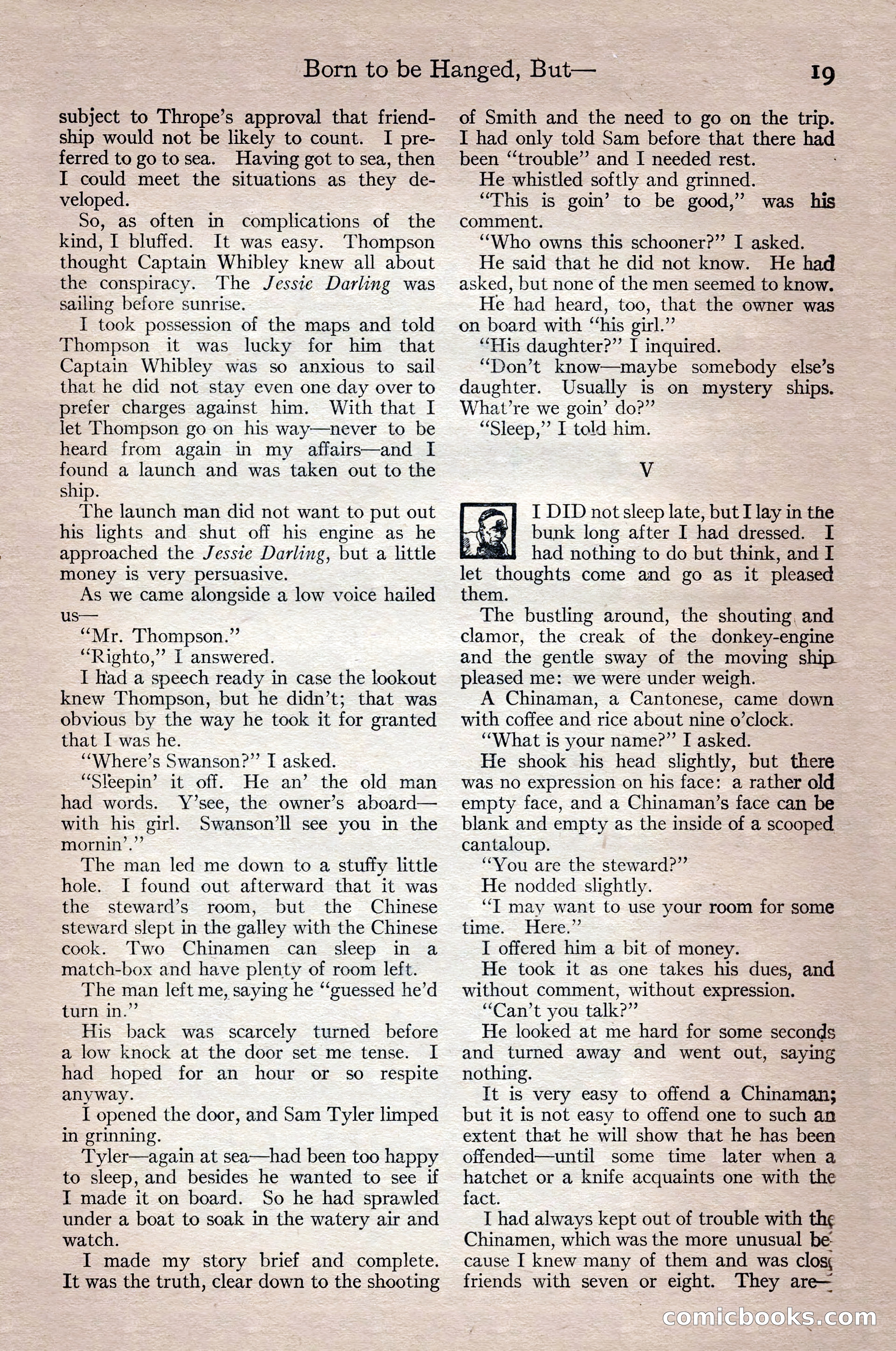
A restored page from Pulp Fiction, 1919. Page through the whole issue in the reader above.
📄 Transcribed text from this page (OCR, searchable)
Machine-transcribed from the original scan — historical spelling and the odd misread are preserved.
Born to be Hanged, But— subject to Thrope’s approval that friend- ship would not be likely to count. I pre- ferred to go to sea. Having got to sea, then I could meet the situations as they de- veloped. So, as often in complications of the kind, I bluffed. It was easy. Thompson thought Captain Whibley knew all about the conspiracy. The Jesste Darling was salling before sunrise. I took possession of the maps and told Thompson it was lucky for him that Captain Whibley was so anxious to sail that he did not stay even one day over to preier charges against him. With that I let Thompson go on his way—never to be heard from again in my affairs—and I found a launch and was taken out to the ship. The launch man did not want to put out his lights and shut off his engine as he approached the Jessze Darling, but a little money is very persuasive. As we came alongside a low voice hailed us— “Mr. Thompson.” “Righto,” I answered. I had a speech ready in case the lookout knew Thompson, but he didn’t; that was obvious by the way he took it for granted that I was he. ‘““Where’s Swanson?” I asked. ‘“Sleepin’ it off. He an’ the old man had words. Y’see, the owner’s aboard— with his girl. Swanson’ll see you in the mornin’.”’ The man led me down to a stuffy little hole. I found out afterward that it was the steward’s room, but the Chinese steward slept in the galley with the Chinese cook. Two Chinamen can sleep in a match-box and have plenty of room left. The man left me, saying he ‘‘guessed he’d turn in.” His back was scarcely turned before a low knock at the door set me tense. I had hoped for an hour or so _ respite anyway. I opened the door, and Sam Tyler limped in grinning. Tyler—again at sea—had been too happy to sleep, and besides he wanted to see if I made it on board. So he had sprawled under a boat to soak in the watery air and watch. I made my story brief and complete. It was the truth, clear down to the shooting a9 of Smith and the need to go on the trip. I had only told Sam before that there had been ‘‘trouble” and I needed rest. He whistled softly and grinned. “This is goin’ to be good,” was his comment. ‘‘Who owns this schooner?” I asked. He said that he did not know. He had asked, but none of the men seemed to know. He had heard, too, that the owner was on board with “his girl.” “His daughter?” I inquired. “Don’t know—maybe somebody else’s daughter. Usually is on mystery ships. What’re we goin’ doP” “Sleep,” I told him. V I DID not sleep late, but I lay in the bunk long after I had dressed. I Ajeet had nothing to do but think, and I let iaawhis come and go as it pleased them. The bustling around, the shouting, and clamor, the creak of the donkey-engine and the gentle sway of the moving ship pleased me: we were under weigh. A Chinaman, a Cantonese, came down with coffee and rice about nine o’clock. “What is your name?” I asked. He shook his head slightly, but there was no expression on his face: a rather old empty face, and a Chinaman’s face can be blank and empty as the inside of a scooped cantaloup. “You are the steward?” He nodded slightly. ‘“T may want to use your room for some time. — Here,” I offered him a bit of money. He took it as one takes his dues, and without comment, without expression. “Can’t you talk?” He looked at me hard for some seconds and turned away and went out, saying nothing. It is very easy to offend a Chinaman; but it is not easy to offend one to such an extent that he will show that he has been offended—until some time later when a hatchet or a knife acquaints one with the fact. I had always kept out of trouble with the Chinamen, which was the more unusual be- cause I knew many of them and was clos¢ friends with seven or eight. They are— ebooks com (e(0) m