
Pulp Fiction, 1919 · page 30 of 208
Adventure Magazine Cover — page 30: what you’re looking at
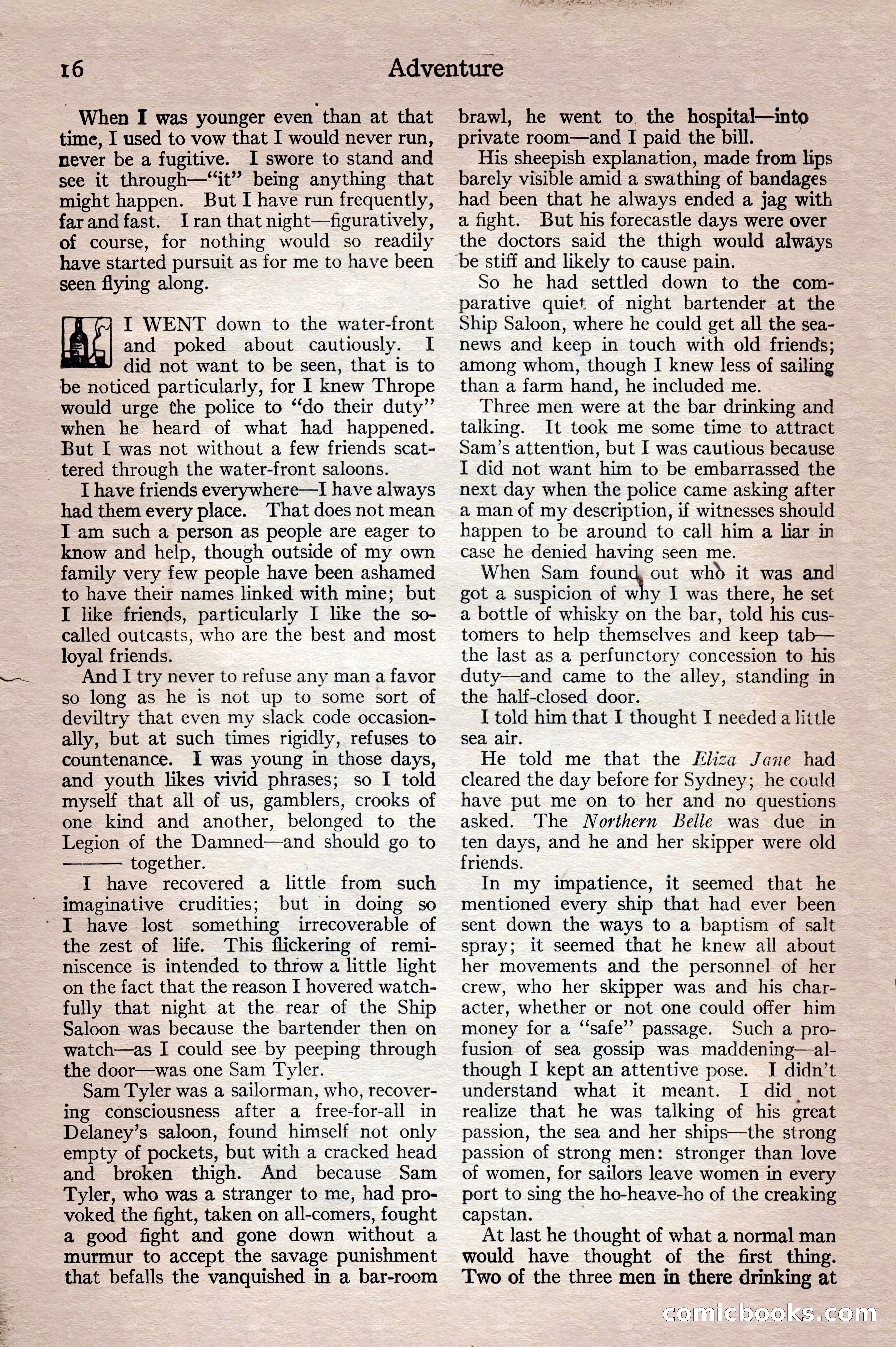
A restored page from Pulp Fiction, 1919. Page through the whole issue in the reader above.
📄 Transcribed text from this page (OCR, searchable)
Machine-transcribed from the original scan — historical spelling and the odd misread are preserved.
PEVARE TROP LS *" . 16 Adventure - When I was younger even than at that time, I used to vow that I would never run, never be a fugitive. I swore to stand and see it through—“‘it” being anything that might happen. But I have run frequently, far andfast. Iran that night—figuratively, of course, for nothing would so readily have started pursuit as for me to have been seen flying along. I WENT down to the water-front and poked about cautiously. I = did not want to be seen, that is to be noticed particularly, for I knew Thrope would urge the police to “do their duty” when he heard of what had happened. But I was not without a few friends scat- _ tered through the water-front saloons. I have friends everywhere—I have always had them every place. That does not mean I am such a person as people are eager to know and help, though outside of my own family very few people have been ashamed - to have their names linked with mine; but I like friends, particularly I like the so- called outcasts, who are the best and most loyal friends. And I try never to refuse any man a favor so long as he is not up to some sort of deviltry that even my slack code occasion- ally, but at such times rigidly, refuses to countenance. I was young in those days, and youth likes vivid phrases; so I told myself that all of us, gamblers, crooks of one kind and another, belonged to the Legion of the Damned—and should go to together. I have recovered a little from such imaginative crudities; but in doing so —— ‘ I have lost something irrecoverable of the zest of life. This flickerng of remi- niscence is intended to throw a little light on the fact that the reason I hovered watch- fully that night at the rear of the Ship Saloon was because the bartender then on watch—as I could see by peeping through the door—was one Sam Tyler. Sam Tyler was a sailorman, who, recover- ing consciousness after a free-for-all in Delaney’s saloon, found himself not only empty of pockets, but with a cracked head and broken thigh. And because Sam Tyler, who was a stranger to me, had pro- voked the fight, taken on all-comers, fought a good fight and gone down without a murmur to accept the savage punishment that befalls the vanquished in a bar-room brawl, he went to the hospital—into private room—and I paid the bill. | His sheepish explanation, made from lps barely visible amid a swathing of bandages had been that he always ended a jag with a fight. But his forecastle days were over the doctors said the thigh would always be stiff and likely to cause pain. So he had settled down to the com- parative quiet of night bartender at the Ship Saloon, where he could get all the sea- news and keep in touch with old friends; among whom, though I knew less of sailing than a farm hand, he included me. Three men were at the bar drinking and taiking. It took me some time to attract Sam’s attention, but I was cautious because I did not want him to be embarrassed the next day when the police came asking after a man of my description, if witnesses should happen to be around to call him a liar in case he denied having seen me. When Sam Sor whd it was and got a suspicion of why I was there, he set a bottle of whisky on the bar, told his cus- tomers to help themselves and keep tab— the last as a perfunctory concession to his duty—and came to the alley, standing in the half-closed door. I told him that I thought I needed a little sea air. He told me that the Eliza Jane had cleared the day before for Sydney; he could have put me on to her and no questions asked. The Northern Belle was due in ten days, and he and her skipper were old friends. In my impatience, it seemed that he mentioned every ship that had ever been sent down the ways to a baptism of salt spray; it seemed that he knew all about her movements and the personnel of her crew, who her skipper was and his char- acter, whether or not one could offer him money for a “‘safe’’ passage. Such a pro- fusion of sea gossip was maddening—al- though I kept an attentive pose. I didn’t understand what it meant. I did_ not realize that he was talking of his great passion, the sea and her ships—the strong passion of strong men: stronger than love of women, for sailors leave women in every port to sing the ho-heave-ho of the creaking capstan. At last he thought of what a normal man would have thought of the first thing. Two of the three men in there drinking at Eomicbooks.co