
Pulp Fiction, 1919 · page 28 of 208
Adventure Magazine Cover — page 28: what you’re looking at
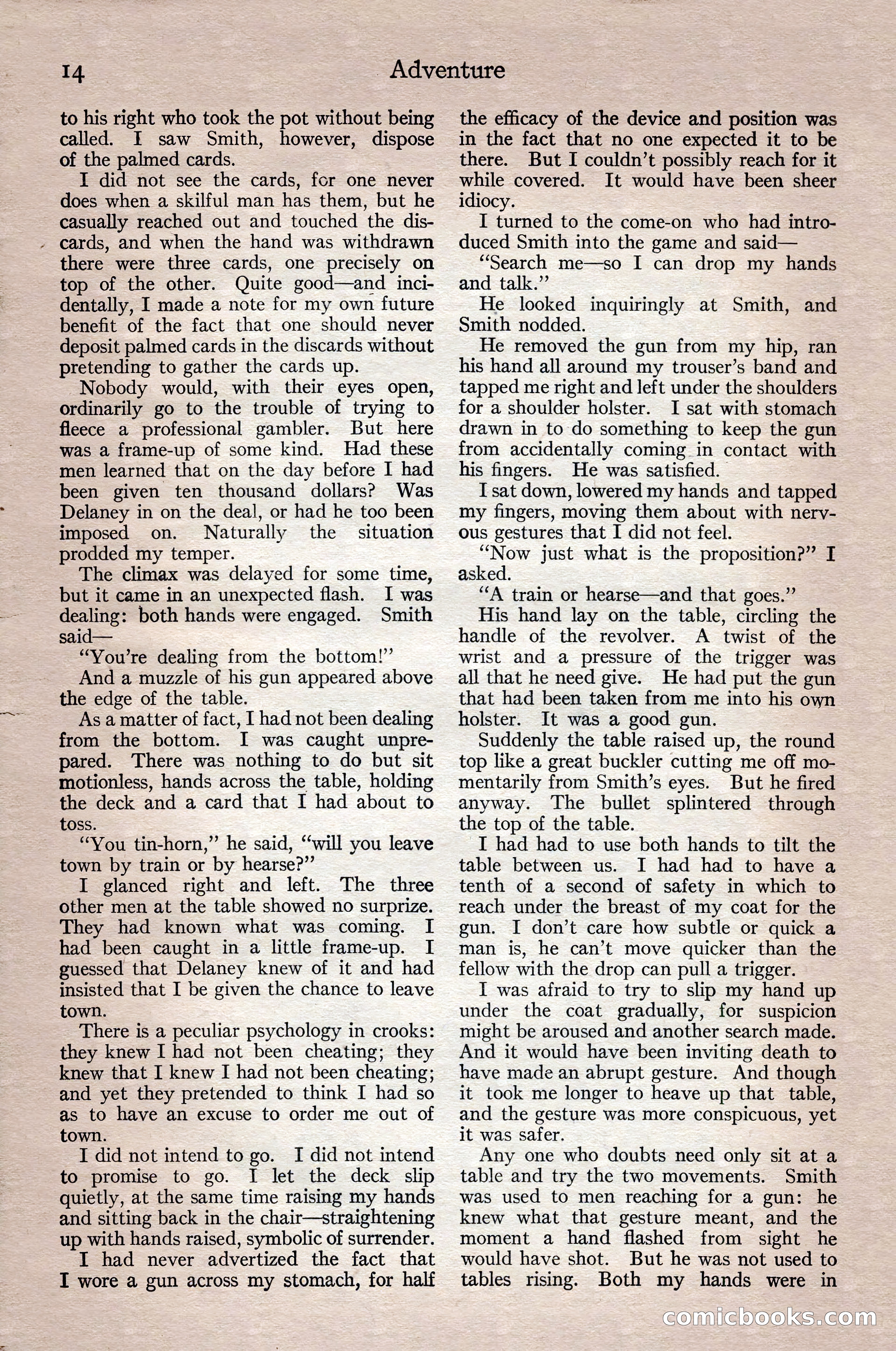
A restored page from Pulp Fiction, 1919. Page through the whole issue in the reader above.
📄 Transcribed text from this page (OCR, searchable)
Machine-transcribed from the original scan — historical spelling and the odd misread are preserved.
14 to his right who took the pot without being called. I saw Smith, however, dispose of the palmed cards. I did not see the cards, for one never does when a skilful man has them, but he casually reached out and touched the dis- - cards, and when the hand was withdrawn there were three cards, one precisely on top of the other. Quite good—and inci- dentally, I made a note for my own future benefit of the fact that one should never deposit palmed cards in the discards without pretending to gather the cards up. Nobody would, with their eyes open, ordinarily go to the trouble of trying to fleece a professional gambler. But here was a frame-up of some kind. Had these men learned that on the day before I had been given ten thousand dollars? Was Delaney in on the deal, or had he too been imposed on. Naturally the situation prodded my temper. The climax was delayed for some time, but it came in an unexpected flash. I was dealing: both hands were engaged. Smith said— “Vou’re dealing from the bottom!” And a muzzle of his gun appeared above the edge of the table. As a matter of fact, I had not been dealing from the bottom. I was caught unpre- pared. There was nothing to do but sit motionless, hands across the table, holding the deck and a card that I had about to toss. “You tin-horn,” he said, “will you leave town by train or by hearse?”’ I glanced right and left. The three other men at the table showed no surprize. They had known what was coming. I had been caught in a little frame-up. I guessed that Delaney knew of it and had insisted that I be given the chance to leave town. There is a peculiar psychology in crooks: they knew I had not been cheating; they knew that I knew I had not been cheating; and yet they pretended to think I had so as to have an excuse to order me out of town. I did not intend to go. I did not intend to promise to go. I let the deck slip quietly, at the same time raising my hands and sitting back in the chair—straightening up with hands raised, symbolic of surrender. I had never advertized the fact that I wore a gun across my stomach, for half Adventure the efficacy of the device and position was in the fact that no one expected it to be there. But I couldn’t possibly reach for it while covered. It would have been sheer idiocy. I turned to the come-on who had intro- duced Smith into the game and said— “Search me—so I can drop my hands and talk.” He looked inquiringly at Smith, and Smith nodded. He removed the gun from my hip, ran his hand all around my trouser’s band and tapped me right and left under the shoulders for a shoulder holster. I sat with stomach drawn in to do something to keep the gun from accidentally coming in contact with his fingers. He was satisfied. Isat down, lowered my hands and tapped my fingers, moving them about with nery- ous gestures that I did not feel. “Now just what is the proposition?” I asked. “A train or hearse—and that goes.” His hand lay on the table, circling the handle of the revolver. A twist of the wrist and a pressure of the trigger was all that he need give. He had put the gun that had been taken from me into his own holster. It was a good gun. Suddenly the table raised up, the round top like a great buckler cutting me off mo- mentarily from Smith’s eyes. But he fired anyway. The bullet splintered through the top of the table. I had had to use both hands to tilt the table between us. I had had to have a tenth of a second of safety in which to reach under the breast of my coat for the gun. I don’t care how subtle or quick a man is, he can’t move quicker than the fellow with the drop can pull a trigger. I was afraid to try to slip my hand up under the coat gradually, for suspicion might be aroused and another search made. And it would have been inviting death to have made an abrupt gesture. And though it took me longer to heave up that table, and the gesture was more conspicuous, yet it was safer. Any one who doubts need only sit at a table and try the two movements. Smith was used to men reaching for a gun: he knew what that gesture meant, and the moment a hand flashed from sight he would have shot. But he was not used to tables rising. Both my hands were in Gomicbooks (E)