
Pulp Fiction, 1919 · page 26 of 208
Adventure Magazine Cover — page 26: what you’re looking at
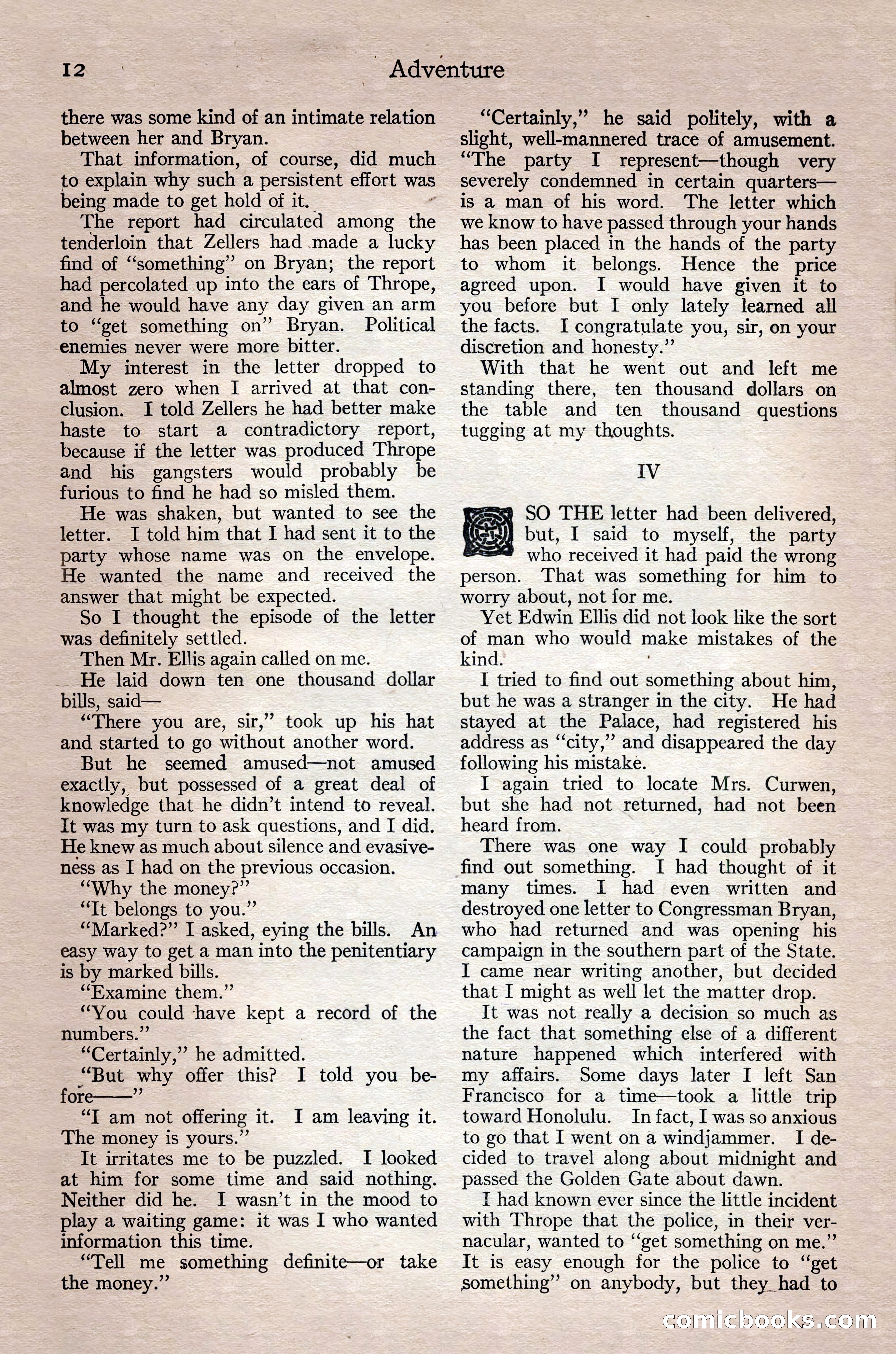
A restored page from Pulp Fiction, 1919. Page through the whole issue in the reader above.
📄 Transcribed text from this page (OCR, searchable)
Machine-transcribed from the original scan — historical spelling and the odd misread are preserved.
I2 there was some kind of an intimate relation between her and Bryan. That information, of course, did much to explain why such a persistent effort was being made to get hold of it. The report had circulated among the tenderloin that Zellers had made a lucky find of “something” on Bryan; the report had percolated up into the ears of Thrope, and he would have any day given an arm to “get something on” Bryan. Political enemies never were more bitter. My interest in the letter dropped to almost zero when I arrived at that con- clusion. I told Zellers he had better make haste to start a contradictory report, because if the letter was produced Thrope and his gangsters would probably be furious to find he had so misled them. He was shaken, but wanted to see the letter. I told him that I had sent it to the party whose name was on the envelope. He wanted the name and received the answer that might be expected. So I thought the episode of the letter was definitely settled. Then Mr. Ellis again called on me. _._ He laid down ten one thousand dollar bills, said— “There you are, sir,” took up his hat and started to go without another word. But he seemed amused—not amused exactly, but possessed of a great deal of knowledge that he didn’t intend to reveal. It was my turn to ask questions, and I did. He knew as much about silence and evasive- ness as I had on the previous occasion. “Why the money?” “Tt belongs to you.” “Marked?” I asked, eying the bills. An easy way to get a man into the penitentiary is by marked bills. “Examine them.” “You could have kept a record of the numbers.” “Certainly,” he admitted. “But why offer this? I told you be- fore——” “T am not offering it. The money is yours.”’ It irritates me to be puzzled. I looked at him for some time and said nothing. Neither did he. J wasn’t in the mood to play a waiting game: it was I who wanted information this time. “Tell me something definite—or take the money.” I am leaving it. - Adventure “Certainly,” he said politely, with a slight, well-mannered trace of amusement. “The party I represent—though very severely condemned in certain quarters— is a man of his word. The letter which we know to have passed through your hands has been placed in the hands of the party to whom it belongs. Hence the price agreed upon. I would have given it to you before but I only lately learned all the facts. I congratulate you, sir, on your discretion and honesty.” With that he went out and left me standing there, ten thousand dollars on the table and ten thousand questions tugging at my thoughts. IV axe SO THE letter had been delivered, ((cas)) but, I said to myself, the party PSS who received it had paid the wrong person. That was something for him to worry about, not for me. Yet Edwin Ellis did not look like the sort of man who would make mistakes of the kind. I tried to find out something about him, but he was a stranger in the city. He had stayed at the Palace, had registered his address as “‘city,’”’ and disappeared the day following his mistake. I again tried to locate Mrs. Curwen, but she had not returned, had not been heard from. There was one way I could probably find out something. I had thought of it many times. I had even written and destroyed one letter to Congressman Bryan, who had returned and was opening his campaign in the southern part of the State. I came near writing another, but decided that I might as well let the matter drop. It was not really a decision so much as the fact that something else of a different nature happened which interfered with my affairs. Some days later I left San Francisco for a time—took a little trip toward Honolulu. In fact, I was so anxious to go that I went on a windjammer. I de- cided to travel along about midnight and passed the Golden Gate about dawn. I had known ever since the little incident with Thrope that the police, in their ver- nacular, wanted to “‘get something on me.” It is easy enough for the police to “get something” on anybody, but they had to GEomicbooks (E(@)