
Pulp Fiction, 1919 · page 24 of 208
Adventure Magazine Cover — page 24: what you’re looking at
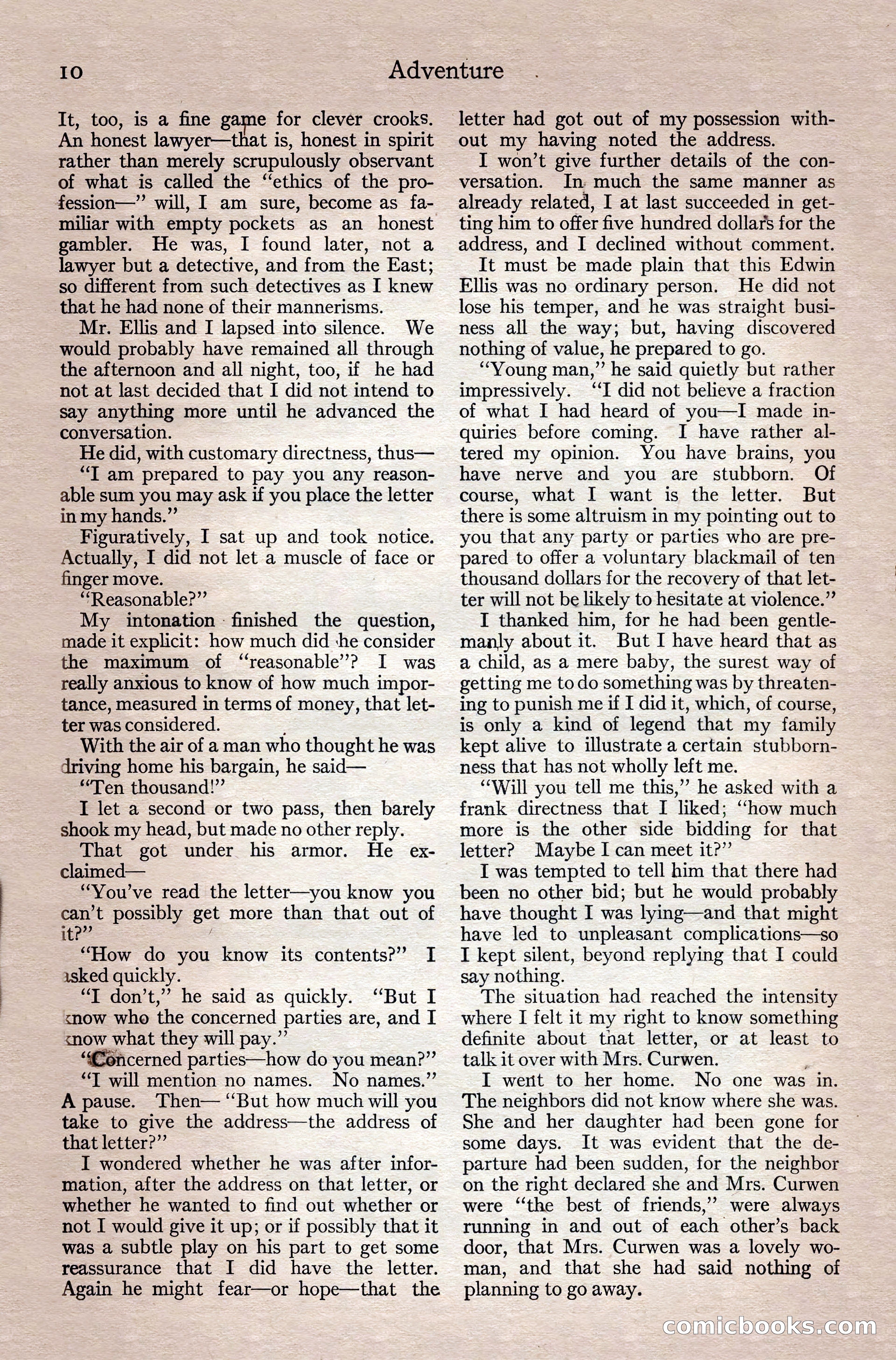
A restored page from Pulp Fiction, 1919. Page through the whole issue in the reader above.
📄 Transcribed text from this page (OCR, searchable)
Machine-transcribed from the original scan — historical spelling and the odd misread are preserved.
10 It, too, is a fine game for clever crooks. An honest lawyer—that is, honest in spirit rather than merely scrupulously observant of what is called the “ethics of the pro- fession—”’ will, I am sure, become as fa- miliar with empty pockets as an honest gambler. He was, I found later, not a lawyer but a detective, and from the East; so different from such detectives as I knew that he had none of their mannerisms. Mr. Ellis and I lapsed into silence. We would probably have remained all through the afternoon and all night, too, if he had not at last decided that I did not intend to say anything more until he advanced the conversation. He did, with customary directness, thus— “T am prepared to pay you any reason- able sum you may ask if you place the letter in my hands.” Figuratively, I sat up and took notice. Actually, I did not let a muscle of face or finger move. ‘“‘Reasonable?”’ My intonation - finished the question, made it explicit: how much did she consider the maximum of “reasonable”? I was really anxious to know of how much impor- tance, measured in terms of money, that let- ter was considered. : With the air of a man who thought he was driving home his bargain, he said— “Ten thousand!”’ I let a second or two pass, then barely shook my head, but made no other reply. That got under his armor. He ex- claimed— “You've read the letter—you know you can’t possibly get more than that out of it?” “How do you know its contents?” I usked quickly. “T don’t,” he said as quickly. ‘But I <now who the concerned parties are, and I snow what they will pay.” “Concerned parties—how do you mean?” “T will mention no names. No names.” A pause. Then— “But how much will you take to give the address—the address of that letter?” I wondered whether he was after infor- mation, after the address on that letter, or whether he wanted to find out whether or not I would give it up; or if possibly that it was a subtle play on his part to get some reassurance that I did have the letter. Again he might fear—or hope—that the Adventure letter had got out of my possession with- out my having noted the address. I won’t give further details of the con- versation. In much the same manner as already related, I at last succeeded in get- ting him to offer five hundred dollars for the address, and I declined without comment. It must be made plain that this Edwin Ellis was no ordinary person. He did not lose his temper, and he was straight busi- ness all the way; but, having discovered nothing of value, he prepared to go. “Young man,” he said quietly but rather impressively. “I did not believe a fraction of what I had heard of you—I made in- quiries before coming. I have rather al- tered my opinion. You have brains, you have nerve and you are stubborn. Of course, what I want is the letter. But there is some altruism in my pointing out to you that any party or parties who are pre- pared to offer a voluntary blackmail of ten thousand dollars for the recovery of that let- ter will not be likely to hesitate at violence.” I thanked him, for he had been gentle- manly about it. But I have heard that as a child, as a mere baby, the surest way of getting me todo something was by threaten- ing to punish me if I did it, which, of course, is only a kind of legend that my family kept alive to illustrate a certain stubborn- ness that has not wholly left me. “Will you tell me this,” he asked with a frank directness that I liked; ‘how much more is the other side bidding for that letter? Maybe I can meet it?” I was tempted to tell him that there had been no other bid; but he would probably have thought I was lying—and that might have led to unpleasant complications—so I kept silent, beyond replying that I could say nothing. The situation had reached the intensity where I felt it my nght to know something definite about tnat letter, or at least to talk it over with Mrs. Curwen. ; I wert to her home. No one was in. The neighbors did not know where she was. She and her daughter had been gone for some days. It was evident that the de- parture had been sudden, for the neighbor on the right declared she and Mrs. Curwen were ‘“‘the best of friends,’’ were always running in and out of each other’s back door, that Mrs. Curwen was a lovely wo- man, and that she had said nothing of planning to go away. Gomichboo S (E@)