
Pulp Fiction, 1919 · page 194 of 208
Adventure Magazine Cover — page 194: what you’re looking at
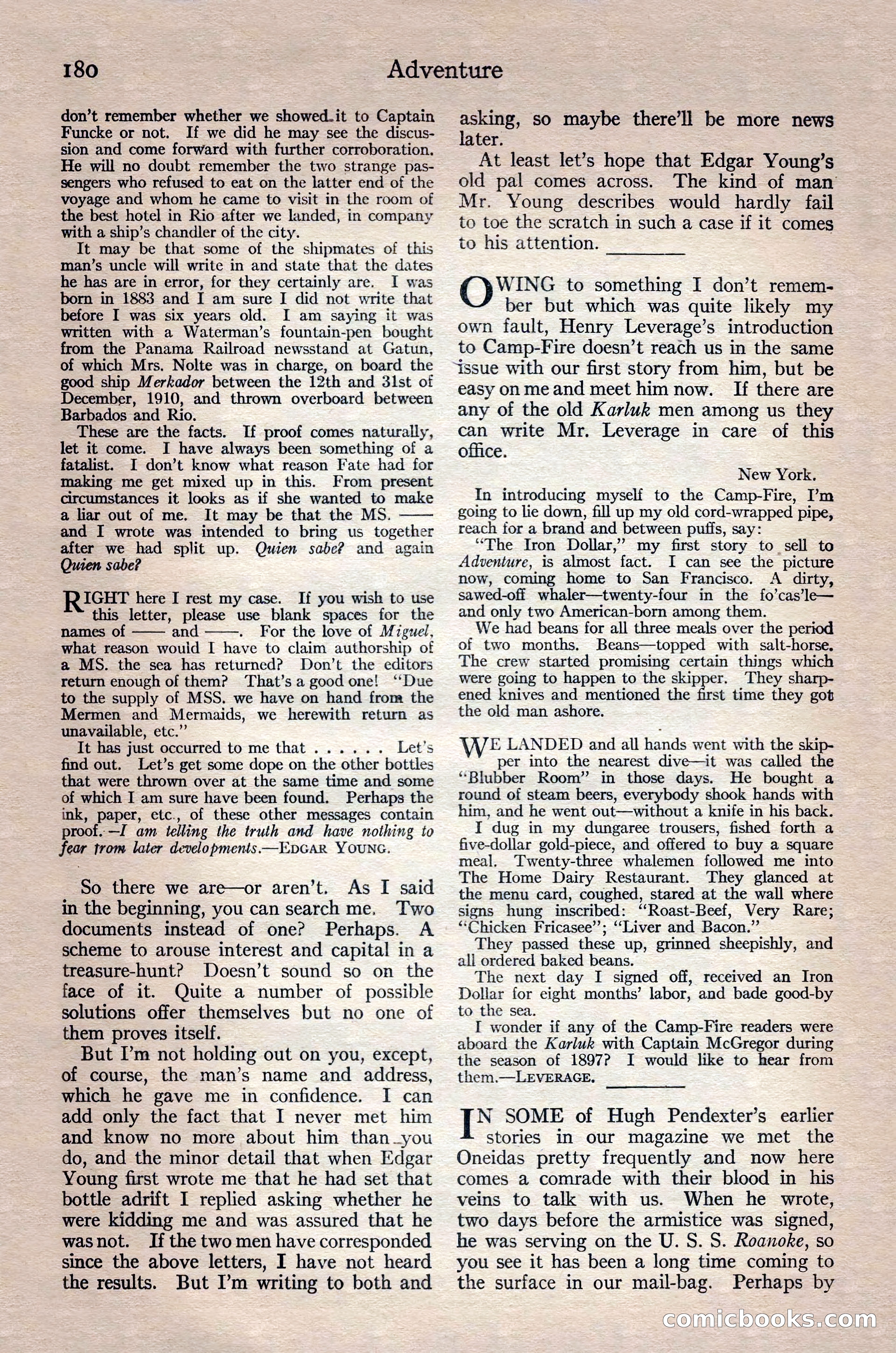
A restored page from Pulp Fiction, 1919. Page through the whole issue in the reader above.
📄 Transcribed text from this page (OCR, searchable)
Machine-transcribed from the original scan — historical spelling and the odd misread are preserved.
180 don’t remember whether we showed.it to Captain Funcke or not. If we did he may see the discus- sion and come forward with further corroboration. He will no doubt remember the two strange pas- sengers who refused to eat on the latter end of the voyage and whom he came to visit in the room of the best hotel in Rio after we landed, in company with a ship’s chandler of the city. It may be that some of the shipmates of this man’s uncle will write in and state that the dates he has are in error, for they certainly are. I was born in 1883 and I am sure I did not write that before I was six years old. I am saying it was written with a Waterman’s fountain-pen bought from the Panama Railroad newsstand at Gatun, of which Mrs, Nolte was in charge, on board the good ship Merkador between the 12th and 31st of December, 1910, and thrown overboard between Barbados and Rio. These are the facts. If proof comes naturally, let it come. I have always been something of a fatalist. I don’t know what reason Fate had for making me get mixed up in this. From present circumstances it looks as if she wanted to make a liar out of me. It may be that the MS. and I wrote was intended to bring us together after we had split up. Quien sabe? and again Quien sabe? RicHT here I rest my case. If you wish to use this letter, please use blank spaces for the names of and For the love of Mzgwuel, what reason wouid I have to claim authorship of a MS. the sea has returned? Don’t the editors return enough of them? ‘That’sa goodone! ‘Due to the supply of MSS. we have on hand from the Mermen and Mermaids, we herewith return as unavailable, etc.” It has just occurred to me that ...... Let’s find out. Let’s get some dope on the other bottles that were thrown over at the same time and some of which I am sure have been found. Perhaps the ink, paper, etc., of these other messages contain proof. —I am telling the truth and have nothing to fear trom later developments —EpGAR YOUNG. So there we are—or aren’t. As I said in the beginning, you can search me. Two documents instead of one? Perhaps. A scheme to arouse interest and capital in a treasure-hunt? Doesn’t sound so on the face of it. Quite a number of possible solutions offer themselves but no one of them proves itself. But I'm not holding out on you, except, of course, the man’s name and address, which he gave me in confidence. I can add only the fact that I never met him and know no more about him than_you do, and the minor detail that when Edgar Young first wrote me that he had set that bottle adrift I replied asking whether he were kidding me and was assured that he wasnot. If the two men have corresponded since the above letters, I have not heard the results. But I’m writing to both and Adventure eae so maybe there’ll be more news ter. At least let’s hope that Edgar Young’s old pal comes across. Mr. Young describes would hardly fail to toe the scratch in such a case if it comes to his attention. (js to something I don’t remem- ber but which was quite likely my own fault, Henry Leverage’s introduction to Camp-Fire doesn’t reach us in the same issue with our first story from him, but be easy on me and meet him now. If there are any of the old Karluk men among us they can write Mr. Leverage in care of this office. New York. In introducing myself to the Camp-Fire, I’m going to lie down, fill up my old cord-wrapped pipe, reach for a brand and between puffs, say: “The Iron Dollar,’”’ my first story to sell to Adventure, is almost fact. I can see the picture now, coming home to San Francisco. A dirty, sawed-off whaler—twenty-four in the fo’cas’le— and only two American-born among them. We had beans for all three meals over the period of two months. Beans—topped with salt-horse, The crew started promising certain things which were going to happen to the skipper. They sharp- ened knives and mentioned the first time they got the old man ashore. WE LANDED and all hands went with the skip- per into the nearest dive—it was called the ‘“Blubber Room” in those days. He bought a round of steam beers, everybody shook hands with him, and he went out—without a knife in his back. I dug in my dungaree trousers, fished forth a five-dollar gold-piece, and offered to buy a square meal, Twenty-three whalemen followed me into The Home Dairy Restaurant. They glanced at the menu card, coughed, stared at the wall where signs hung inscribed: “Roast-Beef, Very Rare; “Chicken Fricasee”; “Liver and Bacon.” They passed these up, grinned sheepishly, and all ordered baked beans. The next day I signed off, received an Iron Dollar for eight months’ labor, and bade good-by to the sea. I wonder if any of the Camp-Fire readers were aboard the Karluk with Captain McGregor during the season of 1897? I would like to hear from them.—LEVERAGE, [S SOME of Hugh Pendexter’s earlier stories in our magazine we met the Oneidas pretty frequently and now here comes a comrade with their blood in his veins to talk with us. When he wrote, two days before the armistice was signed, he was serving on the U. S. 8S. Roanoke, so you see it has been a long time coming to the surface in our mail-bag. Perhaps by Gomicbooks The kind of man (E(0)