
Pulp Fiction, 1919 · page 192 of 208
Adventure Magazine Cover — page 192: what you’re looking at
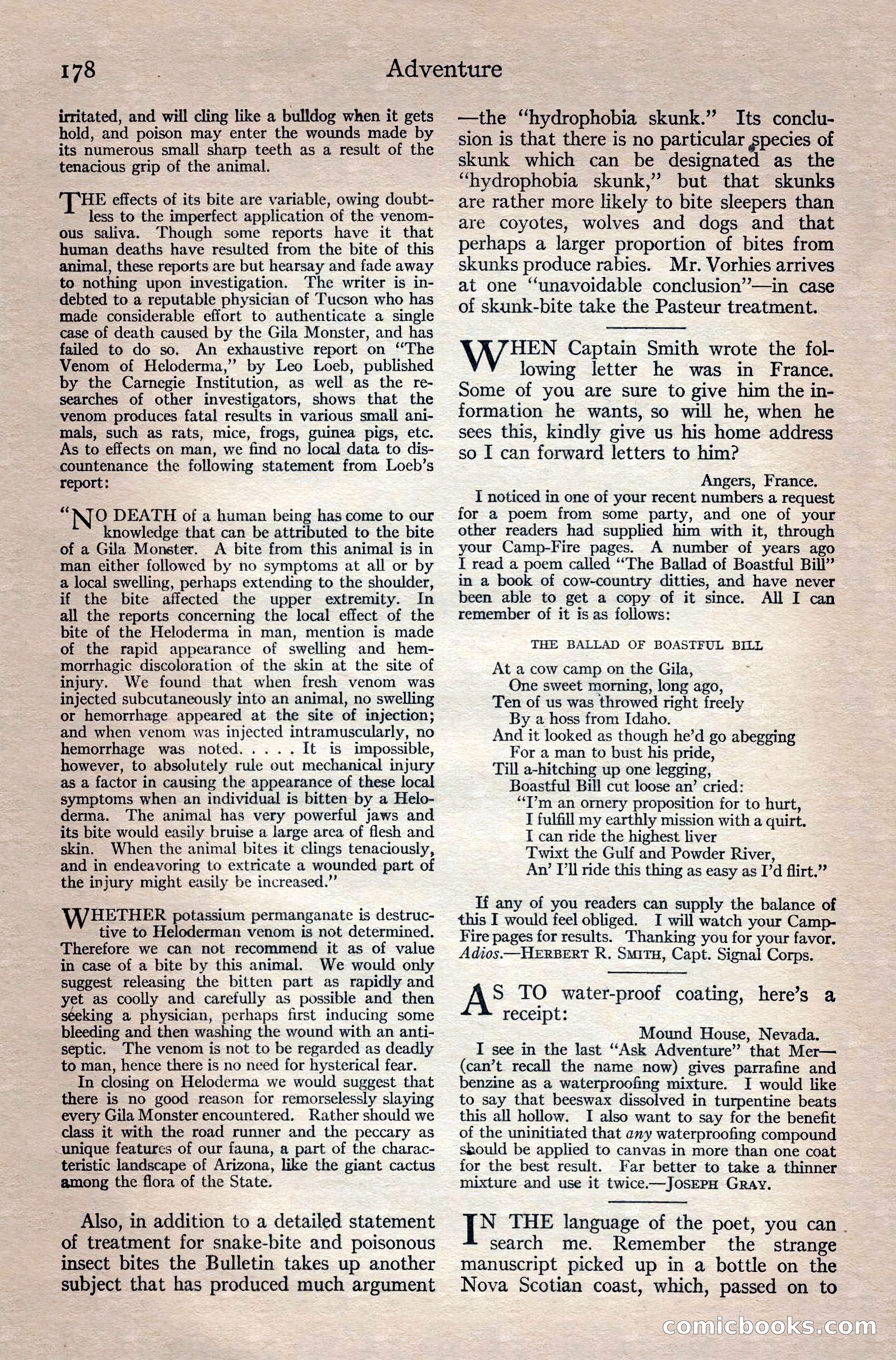
A restored page from Pulp Fiction, 1919. Page through the whole issue in the reader above.
📄 Transcribed text from this page (OCR, searchable)
Machine-transcribed from the original scan — historical spelling and the odd misread are preserved.
178 irritated, and will cling like a bulldog when it gets hold, and poison may enter the wounds made by its numerous small sharp teeth as a result of the tenacious grip of the animal. HE effects of its bite are variable, owing doubt- less to the imperfect application of the venom- ous saliva. Though some reports have it that human deaths have resulted from the bite of this animal, these reports are but hearsay and fade away to nothing upon investigation. The writer is in- debted to a reputable physician of Tucson who has made considerable effort to authenticate a single case of death caused by the Gila Monster, and has failed to do so. An exhaustive report on ‘‘The Venom of Heloderma,” by Leo Loeb, published by the Carnegie Institution, as well as the re- searches of other investigators, shows that the venom produces fatal results in various small ani- mals, such as rats, mice, frogs, guinea pigs, etc. As to effects on man, we find no local data to dis- countenance the following statement from Loeb’s report: “NO DEATH of a human being has come to our knowledge that can be attributed to the bite of a Gila Moneter. A bite from this animal is in man either followed by no symptoms at all or by a local swelling, perhaps extending to the shoulder, if the bite affected the upper extremity. In all the reports concerning the local effect of the bite of the Heloderma in man, mention is made of the rapid appearance of swelling and hem- morrhagic discoloration of the skin at the site of injury. We found that when fresh venom was injected subcutaneously into an animal, no swelling or hemorrhage appeared at the site of injection; and when venom was injected intramuscularly, no hemorrhage was noted..... It is impossible, however, to absolutely rule out mechanical injury as a factor in causing the appearance of these local symptoms when an individual is bitten by a Helo- derma. The animal has very powerful jaws and its bite would easily bruise a large area of flesh and skin. When the animal bites it clings tenaciously, and in endeavoring to extricate a wounded part of the injury might easily be increased.” WHETHER potassium permanganate is destruc- tive to Heloderman venom is not determined. Therefore we can not recommend it as of value in case of a bite by this animal. We would only suggest releasing the bitten part as rapidly and yet as coolly and carefully as possible and then seeking a physician, perhaps first inducing some bleeding and then washing the wound with an anti- septic. The venom is not to be regarded as deadly to man, hence there is no need for hysterical fear. In closing on Heloderma we would suggest that there is no good reason for remorselessly slaying every Gila Monster encountered. Rather should we class it with the road runner and the peccary as -unique features of our fauna, a part of the charac- teristic landscape of Arizona, like the giant cactus among the flora of the State. Also, in addition to a detailed statement of treatment for snake-bite and poisonous insect bites the Bulletin takes up another subject that has produced much argument Adventure —the “hydrophobia skunk.” Its conclu- sion is that there is no particular species of skunk which can be designated as the “hydrophobia skunk,” but that skunks are rather more likely to bite sleepers than are coyotes, wolves and dogs and that perhaps a larger proportion of bites from skunks produce rabies. Mr. Vorhies arrives at one “unavoidable conclusion’—in case of skunk-bite take the Pasteur treatment. WHEN Captain Smith wrote the fol- lowing letter he was in France. Some of you are sure to give him the in- formation he wants, so will he, when he sees this, kindly give us his home address so I can forward letters to him? Angers, France. I noticed in one of your recent numbers a request for a poem from some party, and one of your other readers had supplied him with it, through your Camp-Fire pages. A number of years ago I read a poem called ‘‘The Ballad of Boastful Bill’ in a book of cow-country ditties, and have never been able to get a copy of it since. All I can remember of it is as follows: THE BALLAD OF BOASTFUL BILL At a cow camp on the Gila, One sweet morning, long ago, Ten of us was throwed right freely By a hoss from Idaho. And it looked as though he’d go abegging For a man to bust his pride, Till a-hitching up one legging, Boastful Bill cut loose an’ cried: “T’m an ornery proposition for to hurt, I fulfill my earthly mission with a quirt. I can ride the highest liver Twixt the Gulf and Powder River, An’ [’ll ride this thing as easy as I’d flirt.” If any of you readers can supply the balance of this I would feel obliged. I will watch your Camp- Fire pages for results. Thanking you for your favor. Adios.—HERBERT R. Smita, Capt. Signal Corps. S TO water-proof coating, here’s a receipt: Mound House, Nevada. I see in the last “Ask Adventure” that Mer— (can’t recall the name now) gives parrafine and benzine as a waterproofing mixture. I would like to say that beeswax dissolved in turpentine beats this all hollow. I also want to say for the benefit of the uninitiated that any waterproofing compound should be applied to canvas in more than one coat for the best result. Far better to take a thinner mixture and use it twice.—JOSEPH GRAY. [* THE language of the poet, you can - search me. Remember the strange manuscript picked up in a bottle on the Nova Scotian coast, which, passed on to Gomicbooks.c¢