
Pulp Fiction, 1919 · page 187 of 208
Adventure Magazine Cover — page 187: what you’re looking at
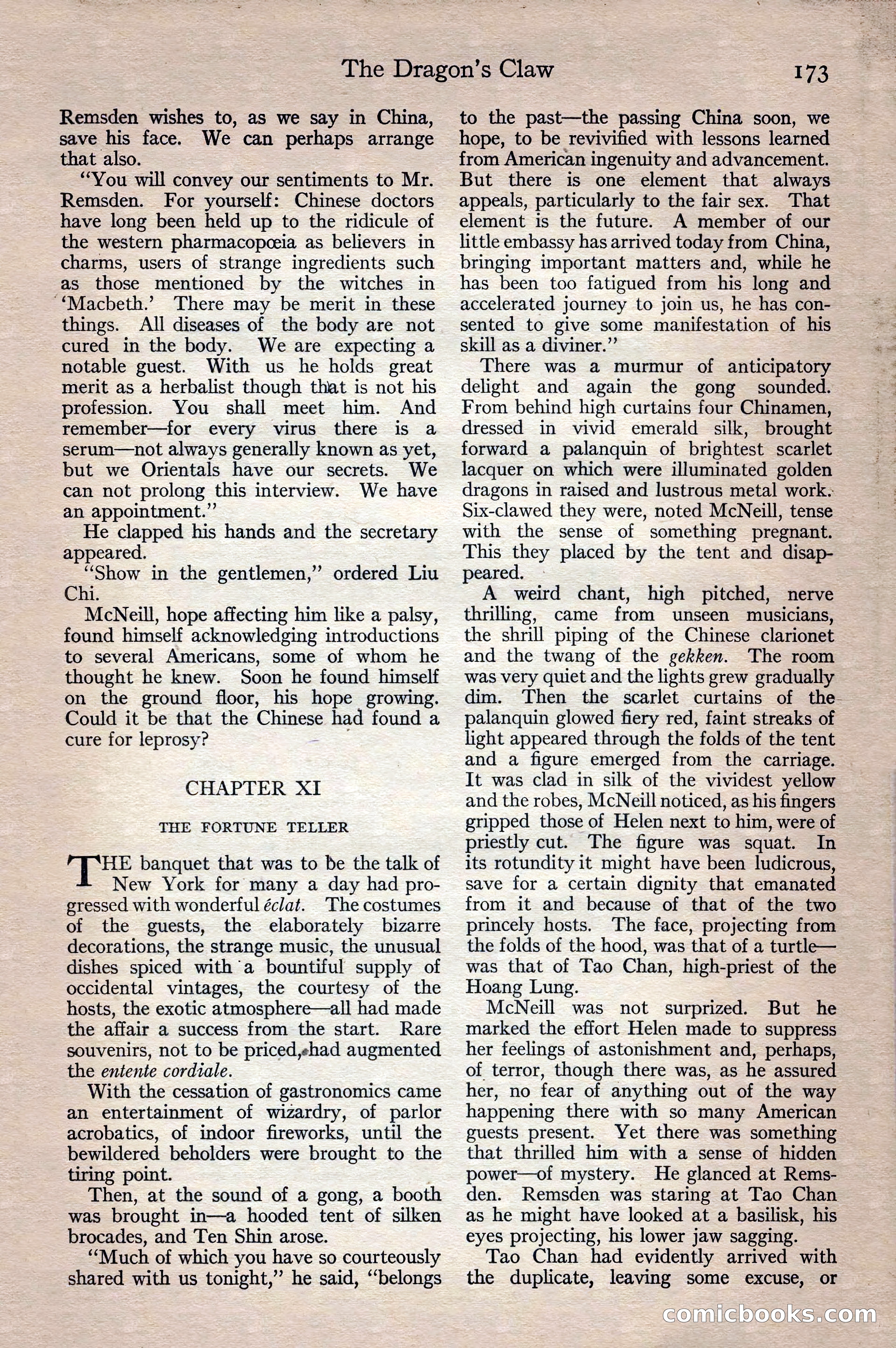
A restored page from Pulp Fiction, 1919. Page through the whole issue in the reader above.
📄 Transcribed text from this page (OCR, searchable)
Machine-transcribed from the original scan — historical spelling and the odd misread are preserved.
The Dragon’s Claw Remsden wishes to, as we say in China, save his face. We can perhaps arrange that also. “You will convey our sentiments to Mr. Remsden. For yourself: Chinese doctors have long been held up to the ridicule of the western pharmacopoeia as believers in charms, users of strange ingredients such as those mentioned by the witches in ‘Macbeth.’ There may be merit in these things. All diseases of the body are not cured in the body. We are expecting a notable guest. With us he holds great merit as a herbalist though that is not his profession. You shall meet him. And remember—for every virus there is a serum—not always generally known as yet, but we Orientals have our secrets. We can not prolong this interview. We have an appointment.” He clapped his hands and the secretary appeared. ‘Show in the gentlemen,” ordered Liu Chi. McNeill, hope affecting him like a palsy, found himself acknowledging introductions to several Americans, some of whom he thought he knew. Soon he found himself on the ground floor, his hope growing. Could it be that the Chinese had found a cure for leprosy? CHAPTER XI THE FORTUNE TELLER aq banquet that was to be the talk of New York for many a day had pro- gressed with wonderful éclat. The costumes of the guests, the elaborately bizarre decorations, the strange music, the unusual dishes spiced with a bountiful supply of occidental vintages, the courtesy of the hosts, the exotic atmosphere—all had made the affair a success from the start. Rare souvenirs, not to be pricedjehad augmented the entente cordiale. With the cessation of gastronomics came an entertainment of wizardry, of parlor acrobatics, of indoor fireworks, until the bewildered beholders were brought to the tiring point. 3 Then, at the sound of a gong, a booth was brought in—a hooded tent of silken brocades, and Ten Shin arose. “Much of which you have so courteously shared with us tonight,” he said, “belongs 173 to the past—the passing China soon, we hope, to be revivified with lessons learned from American ingenuity and advancement. But there is one element that always appeals, particularly to the fair sex. That element is the future. A member of our little embassy has arrived today from China, bringing important matters and, while he has been too fatigued from his long and accelerated journey to join us, he has con- sented to give some manifestation of his skill as a diviner.”’ There was a murmur of anticipatory delight and again the gong sounded. From behind high curtains four Chinamen, dressed in vivid emerald silk, brought forward a palanquin of brightest scarlet lacquer on which were illuminated golden dragons in raised and lustrous metal work. Six-clawed they were, noted McNeill, tense with the sense of something pregnant. This they placed by the tent and disap- peared, - A weird chant, high pitched, nerve thrilling, came from unseen musicians, the shrill piping of the Chinese clarionet and the twang of the gekken. The room was very quiet and the lights grew gradually dim. Then the scarlet curtains of the- palanquin glowed fiery red, faint streaks of light appeared through the folds of the tent and a figure emerged from the carriage. It was clad in silk of the vividest yellow and the robes, McNeill noticed, as his fingers gripped those of Helen next to him, were of priestly cut. The figure was squat. In its rotundity it might have been ludicrous, save for a certain dignity that emanated from it and because of that of the two princely hosts. The face, projecting from the folds of the hood, was that of a turtle— was that of Tao Chan, high-priest of the Hoang Lung. McNeill was not surprized. But he marked the effort Helen made to suppress her feelings of astonishment and, perhaps, of terror, though there was, as he assured her, no fear of anything out of the way happening there with so many American guests present. Yet there was something that thrilled him with a sense of hidden power—of mystery. He glanced at Rems- den. Remsden was staring at Tao Chan as he might have looked at a basilisk, his eyes projecting, his lower jaw sagging. Tao Chan had evidently arrived with the duplicate, leaving some excuse, or (E@PMel evexe) cS (E(@) m1