
Pulp Fiction, 1919 · page 185 of 208
Adventure Magazine Cover — page 185: what you’re looking at
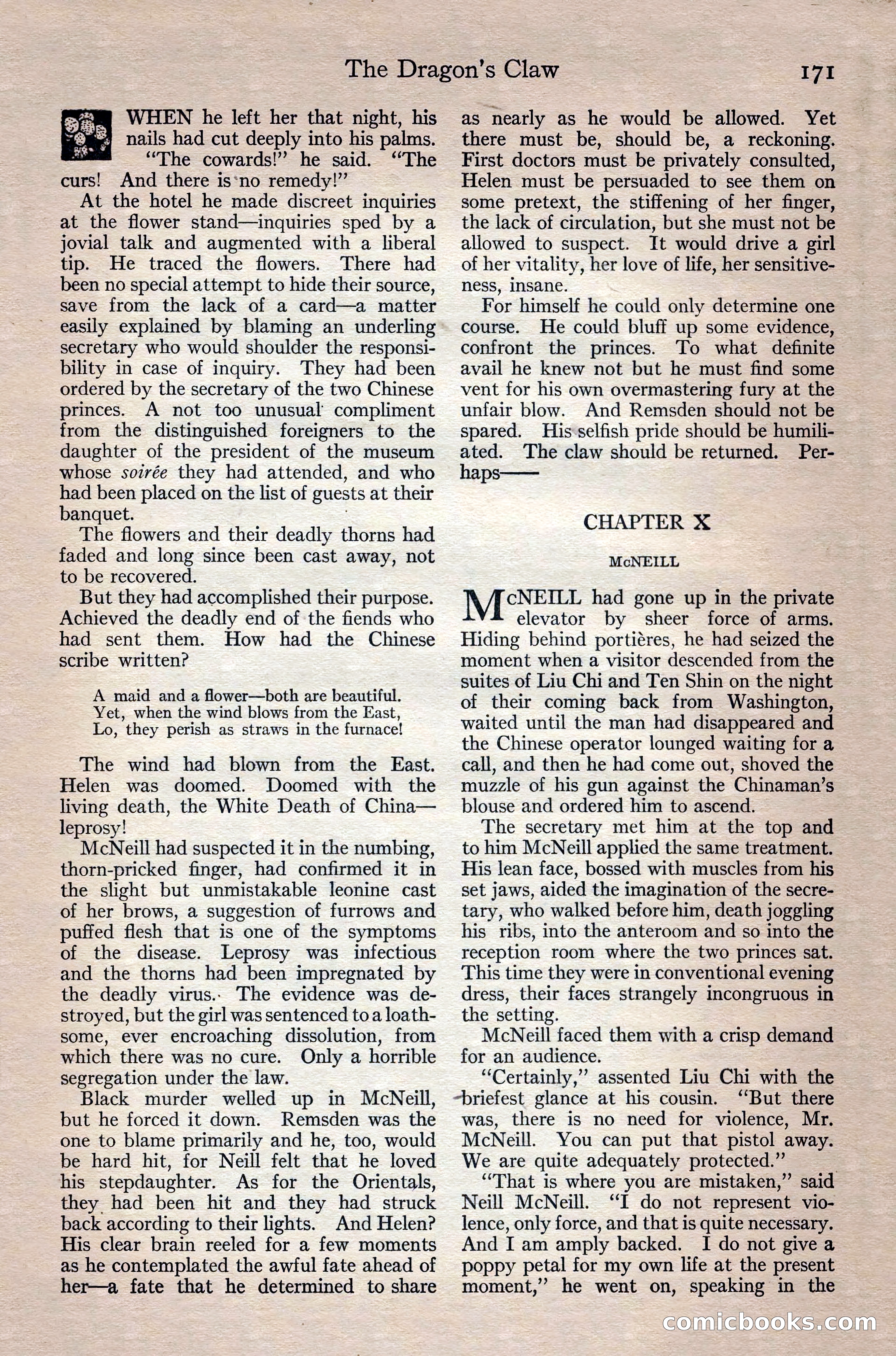
A restored page from Pulp Fiction, 1919. Page through the whole issue in the reader above.
📄 Transcribed text from this page (OCR, searchable)
Machine-transcribed from the original scan — historical spelling and the odd misread are preserved.
The Dragon's Claw WHEN he left her that night, his <M nails had cut deeply into his palms. “The cowards!” he said. ‘The |?? And there is‘no remedy curs! At the hotel he made discreet inquiries at the flower stand—inquiries sped by a jovial talk and augmented with a liberal tip. He traced the flowers. There had been no special attempt to hide their source, save from the lack of a card—a matter easily explained by blaming an underling secretary who would shoulder the responsi- bility in case of inquiry. They had been ordered by the secretary of the two Chinese princes. A not too unusual compliment from the distinguished foreigners to the daughter of the president of the museum whose soirée they had attended, and who had been placed on the list of guests at their banquet. : The flowers and their deadly thorns had faded and long since been cast away, not to be recovered. But they had accomplished their purpose. Achieved the deadly end of the fiends who had sent them. How had the Chinese scribe written? A maid and a flower—both are beautiful. Yet, when the wind blows from the East, Lo, they perish as straws in the furnace! The wind had blown from the East. Helen was doomed. Doomed with the living death, the White Death of China— leprosy! McNeill had suspected it in the numbing, thorn-pricked finger, had confirmed it in the slight but unmistakable leonine cast of her brows, a suggestion of furrows and puffed flesh that is one of the symptoms of the disease. Leprosy was infectious and the thorns had been impregnated by the deadly virus.. The evidence was de- stroyed, but the girl was sentenced toa loath- some, ever encroaching dissolution, from which there was no cure. Only a horrible segregation under the law. Black murder welled up in McNeill, but he forced it down. Remsden was the one to blame primarily and he, too, would be hard hit, for Neill felt that he loved his stepdaughter. As for the Orientals, they had been hit and they had struck back according to their lights. And Helen? His clear brain reeled for a few moments as he contemplated the awful fate ahead of her—a fate that he determined to share -briefest glance at his cousin. I7I as nearly as he would be allowed. Yet there must be, should be, a reckoning. First doctors must be privately consulted, Helen must be persuaded to see them on some pretext, the stiffening of her finger, the lack of circulation, but she must not be allowed to suspect. It would drive a girl of her vitality, her love of life, her sensitive- ness, insane. For himself he could only determine one course. He could bluff up some evidence, confront the princes. To what definite avail he knew not but he must find some vent for his own overmastering fury at the unfair blow. And Remsden should not be spared. His:selfish pride should be humili- ated. The claw should be returned. Per- haps—— CHAPTER X McNEILL av eee had gone up in the private elevator by sheer force of arms. Hiding behind portiéres, he had seized the moment when a visitor descended from the suites of Liu Chi and Ten Shin on the night of their coming back from Washington, waited until the man had disappeared and the Chinese operator lounged waiting for a call, and then he had come out, shoved the muzzle of his gun against the Chinaman’s blouse and ordered him to ascend. The secretary met him at the top and to him McNeill applied the same treatment. His lean face, bossed with muscles from his set jaws, aided the imagination of the secre- tary, who walked before him, death joggling his ribs, into the anteroom and so into the reception room where the two princes sat. This time they were in conventional evening dress, their faces strangely incongruous in the setting. McNeill faced them with a crisp demand — for an audience. “Certainly,” assented Liu Chi with the “But there was, there is no need for violence, Mr. McNeill. You can put that pistol away. We are quite adequately protected.” “That is where you are mistaken,” said Neill McNeill. “I do not represent vio- lence, only force, and that is quite necessary. And I am amply backed. I do not give a poppy petal for my own life at the present moment,” he went on, speaking in the Gomicbooks.co