
Pulp Fiction, 1919 · page 181 of 208
Adventure Magazine Cover — page 181: what you’re looking at
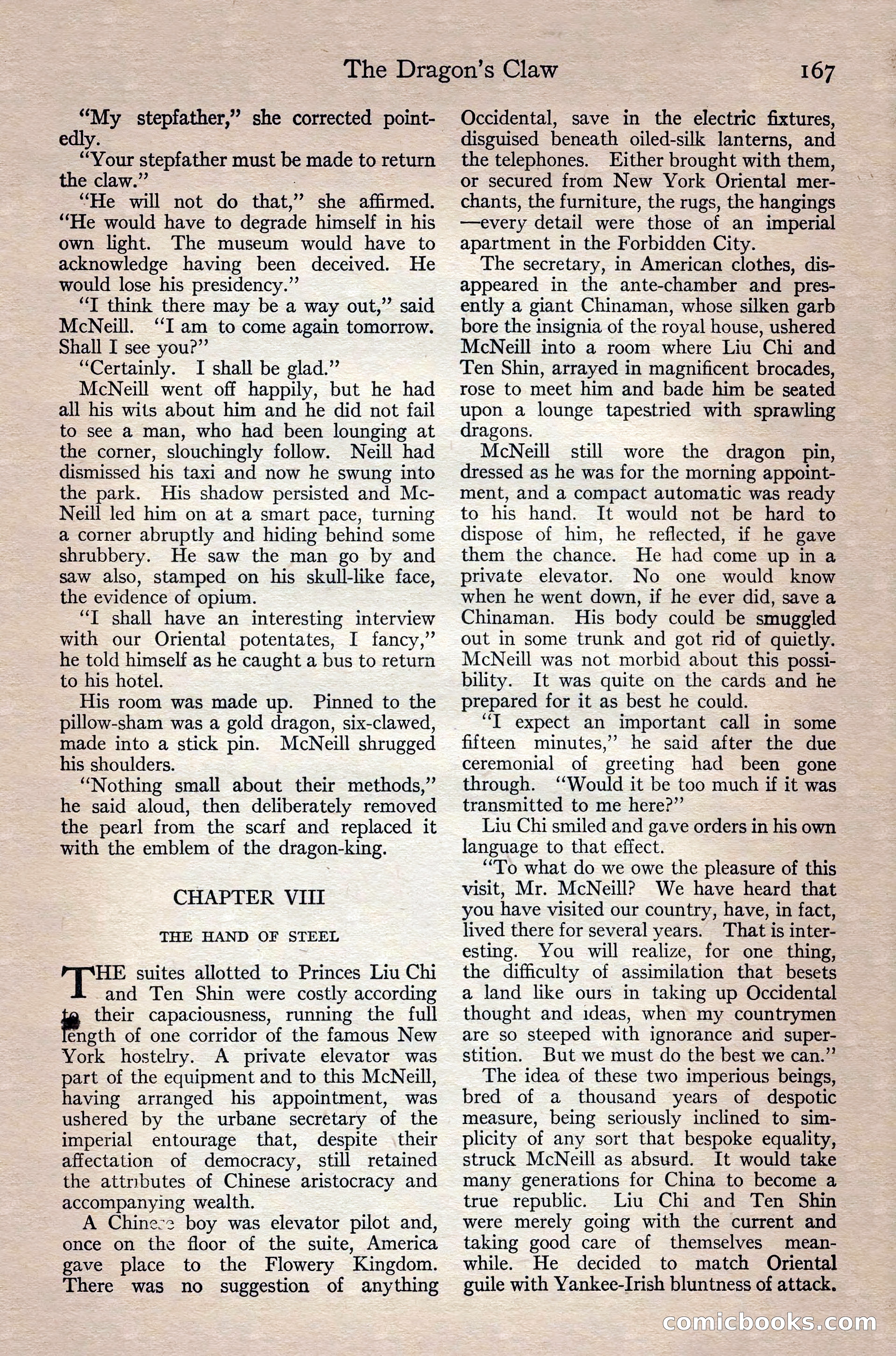
A restored page from Pulp Fiction, 1919. Page through the whole issue in the reader above.
📄 Transcribed text from this page (OCR, searchable)
Machine-transcribed from the original scan — historical spelling and the odd misread are preserved.
The Dragon's Claw “My stepfather,” she corrected point- edly. “Your stepfather must be made to return the claw.” . “He will not do that,’ she affirmed. “He would have to degrade himself in his own light. The museum would have to acknowledge having been deceived. He would lose his presidency.” “T think there may be a way out,” said McNeill. “Iam to come again tomorrow. Shall I see your” “Certainly. I shall be glad.” McNeill went off happily, but he had all his wits about him and he did not fail to see a man, who had been lounging at the corner, slouchingly follow. Neill had dismissed his taxi and now he swung into the park. His shadow persisted and Mc- Neill led him on at a smart pace, turning a corner abruptly and hiding behind some shrubbery. He saw the man go by and saw also, stamped on his skull-like face, the evidence of opium. “T shall have an interesting interview with our Oriental potentates, I fancy,” he told himself as he caught a bus to return to his hotel. His room was made up. Pinned to the pillow-sham was a gold dragon, six-clawed, made into a stick pin. McNeill shrugged his shoulders. “Nothing small about their methods,” he said aloud, then deliberately removed the pearl from the scarf and replaced it with the emblem of the dragon-king. CHAPTER VIII THE HAND OF STEEL HE suites allotted to Princes Liu Chi and Ten Shin were costly according their capaciousness, running the full ength of one corridor of the famous New York hostelry. A private elevator was part of the equipment and to this McNeill, having arranged his appointment, was ushered by the urbane secretary of the imperial entourage that, despite their affectation of democracy, still retained the attributes of Chinese aristocracy and accompanying wealth. A Chines2 boy was elevator pilot and, once on the floor of the suite, America gave place to the Flowery Kingdom. There was no suggestion of anything 167 Occidental, save in the electric fixtures, disguised beneath oiled-silk lanterns, and the telephones. Either brought with them, or secured from New York Oriental mer- chants, the furniture, the rugs, the hangings —every detail were those of an imperial apartment in the Forbidden City. The secretary, in American clothes, dis- appeared in the ante-chamber and pres- ently a giant Chinaman, whose silken garb bore the insignia of the royal house, ushered McNeill into a room where Liu Chi and Ten Shin, arrayed in magnificent brocades, rose to meet him and bade him be seated upon a lounge tapestried with sprawling dragons. McNeill still wore the dragon pin, dressed as he was for the morning appoint- ment, and a compact automatic was ready to his hand. It would not be hard to dispose of him, he reflected, if he gave them the chance. He had come up in a private elevator. No one would know when he went down, if he ever did, save a Chinaman. His body could be smuggled out in some trunk and got rid of quietly. McNeill was not morbid about this possi- bility. It was quite on the cards and he prepared for it as best he could. “I expect an important call in some fifteen minutes,” he said after the due ceremonial of greeting had been gone through. ‘Would it be too much if it was transmitted to me here?” Liu Chi smiled and gave orders in his own language to that effect. “To what do we owe the pleasure of this visit, Mr. McNeill? We have heard that you have visited our country, have, in fact, lived there for several years. That is inter- esting. You will realize, for one thing, the difficulty of assimilation that besets a land like ours in taking up Occidental thought and ideas, when my countrymen are so steeped with ignorance ard super- stition. But we must do the best we can.” The idea of these two imperious beings, bred of a thousand years of despotic measure, being seriously inclined to sim- plicity of any sort that bespoke equality, struck McNeill as absurd. It would take many generations for China to become a true republic. Liu Chi and Ten Shin were merely going with the current and taking good care of themselves mean- while. He decided to match Oriental guile with Yankee-Irish bluntness of attack. Gomicbooks (E(0)