
Pulp Fiction, 1919 · page 148 of 208
Adventure Magazine Cover — page 148: what you’re looking at
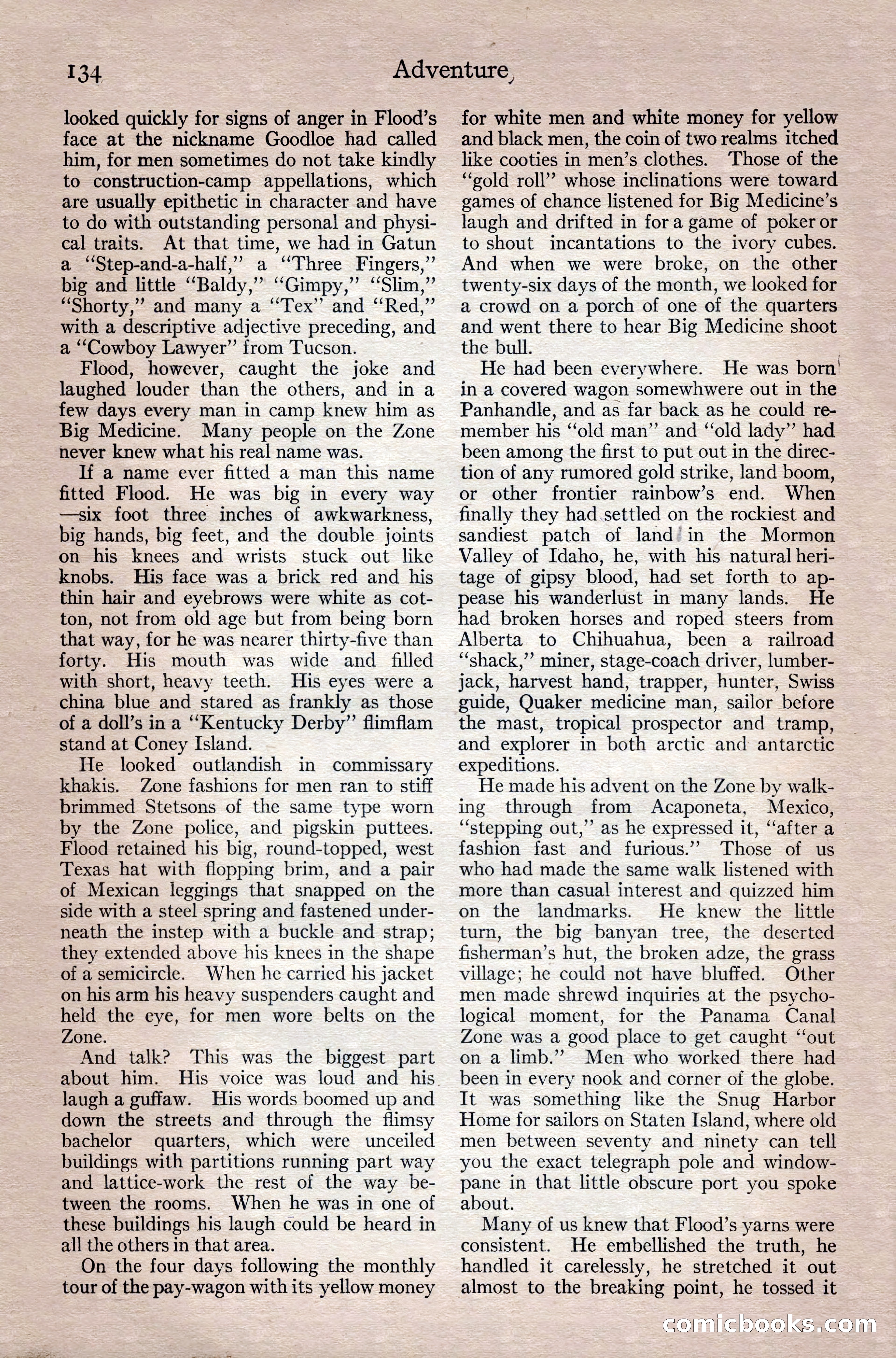
A restored page from Pulp Fiction, 1919. Page through the whole issue in the reader above.
📄 Transcribed text from this page (OCR, searchable)
Machine-transcribed from the original scan — historical spelling and the odd misread are preserved.
u 134 looked quickly for signs of anger in Flood’s face at the nickname Goodloe had called him, for men sometimes do not take kindly to construction-camp appellations, which are usually epithetic in character and have to do with outstanding personal and physi- cal traits. At that time, we had in Gatun a “Step-and-a-half,” a “Three Fingers,” big and little “Baldy,” “‘Gimpy,” “Slim,” “Shorty,” and many a “Tex” and “Red,” with a descriptive adjective preceding, and a “‘Cowboy Lawyer” from Tucson. Flood, however, caught the joke and laughed louder than the others, and in a few days every man in camp knew him as Big Medicine. Many people on the Zone never knew what his real name was. If a name ever fitted a man this name fitted Flood. He was big in every way —six foot three inches of awkwarkness, big hands, big feet, and the double joints on his knees and wrists stuck out like knobs. His face was a brick red and his thin hair and eyebrows were white as cot- ton, not from old age but from being born that way, for he was nearer thirty-five than forty. His mouth was wide and filled with short, heavy teeth. His eyes were a china blue and stared as frankly as those of a doll’s in a “Kentucky Derby” flimflam stand at Coney Island. He looked outlandish in commissary khakis. Zone fashions for men ran to stiff brimmed Stetsons of the same type worn by the Zone police, and pigskin puttees. Flood retained his big, round-topped, west Texas hat with flopping brim, and a pair of Mexican leggings that snapped on the side with a steel spring and fastened under- neath the instep with a buckle and strap; they extended above his knees in the shape of a semicircle. When he carried his jacket on his arm his heavy suspenders caught and held the eye, for men wore belts on the Zone. And talk? This was the biggest part about him. His voice was loud and his laugh a guffaw. His words boomed up and down the streets and through the flimsy bachelor quarters, which were unceiled buildings with partitions running part way and lattice-work the rest of the way be- tween the rooms. When he was in one of these buildings his laugh could be heard in all the others in that area. On the four days following the monthly tour of the pay-wagon with its yellow money Adventure, for white men and white money for yellow and black men, the coin of two realms itched like cooties in men’s clothes. ‘Those of the “gold roll”? whose inclinations were toward games of chance listened for Big Medicine’s laugh and drifted in fora game of poker or to shout incantations to the ivory cubes. And when we were broke, on the other twenty-six days of the month, we looked for a crowd on a porch of one of the quarters and went there to hear Big Medicine shoot the bull. He had been everywhere. He was born! in a covered wagon somewhwere out in the Panhandle, and as far back as he could re- member his ‘‘old man” and ‘“‘old lady” had been among the first to put out in the direc- tion of any rumored gold strike, land boom, or other frontier rainbow’s end. When finally they had.settled on the rockiest and sandiest patch of land’ in the Mormon Valley of Idaho, he, with his natural heri- tage of gipsy blood, had set forth to ap- pease his wanderlust in many lands. He had broken horses and roped steers from Alberta to Chihuahua, been a railroad “‘shack,’’ miner, stage-coach driver, lumber- jack, harvest hand, trapper, hunter, Swiss guide, Quaker medicine man, sailor before the mast, tropical prospector and tramp, and explorer in both arctic and antarctic expeditions. He made his advent on the Zone by walk- ing through from Acaponeta, Mexico, “stepping out,” as he expressed it, “‘after a fashion fast and furious.” Those of us who had made the same walk listened with more than casual interest and quizzed him on the landmarks. He knew the little turn, the big banyan tree, the deserted fisherman’s hut, the broken adze, the grass village; he could not have bluffed. Other men made shrewd inquiries at the psycho- logical moment, for the Panama Canal Zone was a good place to get caught ‘out on a limb.”” Men who worked there had been in every nook and corner of the globe. It was something like the Snug Harbor Home for sailors on Staten Island, where old men between seventy and ninety can tell you the exact telegraph pole and window- pane in that little obscure port you spoke about. Many of us knew that Flood’s yarns were consistent. He embellished the truth, he handled it carelessly, he stretched it out almost to the breaking point, he tossed it Gomicbooks (E(0)