
Pulp Fiction, 1919 · page 131 of 208
Adventure Magazine Cover — page 131: what you’re looking at
A restored page from Pulp Fiction, 1919. Page through the whole issue in the reader above.
📄 Transcribed text from this page (OCR, searchable)
Machine-transcribed from the original scan — historical spelling and the odd misread are preserved.
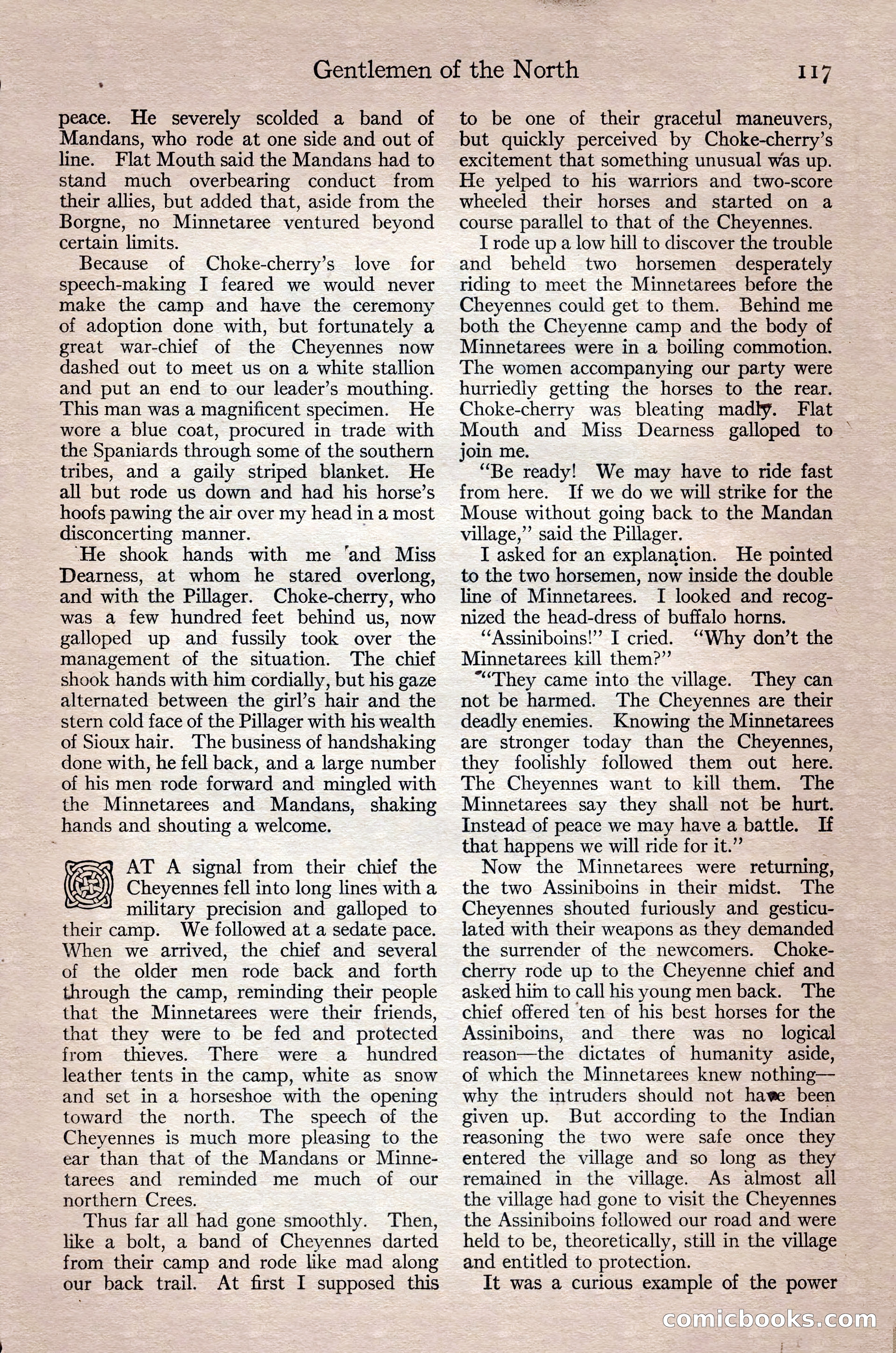
Gentlemen of the North . peace. He severely scolded a band of Mandans, who rode at one side and out of line. Flat Mouth said the Mandans had to stand much overbearing conduct from their allies, but added that, aside from the Borgne, no Minnetaree ventured beyond certain limits. Because of Choke-cherry’s love for speech-making I feared we would never make the camp and have the ceremony of adoption done with, but fortunately a great war-chief of the Cheyennes now dashed out to meet us on a white stallion and put an end to our leader’s mouthing. This man was a magnificent specimen. He wore a blue coat, procured in trade with the Spaniards through some of the southern tribes, and a gaily striped blanket. He all but rode us down and had his horse’s hoofs pawing the air over my head in a most disconcerting manner. ‘He shook hands with me ‘and Miss Dearness, at whom he stared overlong, and with the Pillager. Choke-cherry, who was a few hundred feet behind us, now galloped up and fussily took over the management of the situation. The chief shook hands with him cordially, but his gaze alternated between the girl’s hair and the stern cold face of the Pillager with his wealth of Sioux hair. The business of handshaking done with, he fell back, and a large number of his men rode forward and mingled with the Minnetarees and Mandans, shaking hands and shouting a welcome. (Ss BY Gheyenres fell into long lines with a military precision and galloped to their camp. We followed at a sedate pace. When we arrived, the chief and several of the older men rode back and forth through the camp, reminding their people that the Minnetarees were their friends, that they were to be fed and protected from thieves. There were a _ hundred leather tents in the camp, white as snow and set in a horseshoe with the opening toward the north. The speech of the Cheyennes is much more pleasing to the ear than that of the Mandans or Minne- tarees and reminded me much of our northern Crees. Thus far all had gone smoothly. Then, like a bolt, a band of Cheyennes darted from their camp and rode like mad along our back trail. At first I supposed this AT A signal from their chief the 117 to be one of their gracetul maneuvers, but quickly perceived by Choke-cherry’s excitement that something unusual was up. He yelped to his warriors and two-score wheeled their horses and started on a course parallel to that of the Cheyennes. I rode up a low hill to discover the trouble and beheld two horsemen desperately riding to meet the Minnetarees before the Cheyennes could get to them. Behind me both the Cheyenne camp and the body of Minnetarees were in a boiling commotion. The women accompanying our party were hurriedly getting the horses to the rear. Choke-cherry was bleating madly. Flat Mouth and Miss Dearness galloped to join me. “Be ready! We may have to nde fast from here. If we do we will strike for the Mouse without going back to the Mandan village,” said the Pillager. I asked for an explanation. He pointed to the two horsemen, now inside the double line of Minnetarees. nized the head-dress of buffalo horns. ‘“‘Assiniboins!” I cried. ‘“‘Why don’t the Minnetarees kill them?” “They came into the village. They can not be harmed. The Cheyennes are their deadly enemies. Knowing the Minnetarees are stronger today than the Cheyennes, they foolishly followed them out here. The Cheyennes want to kill them. The Minnetarees say they shall not be hurt. Instead of peace we may have a battle. If that happens we will ride for it.” Now the Minnetarees were returning, the two Assiniboins in their midst. The Cheyennes shouted furiously and gesticu- lated with their weapons as they demanded the surrender of the newcomers. Choke- cherry rode up to the Cheyenne chief and asked him to call his young men back. The chief offered ten of his best horses for the Assiniboins, and there was no _ logical reason—the dictates of humanity aside, of which the Minnetarees knew nothing— why the intruders should not hawe been given up. But according to the Indian reasoning the two were safe once they entered the village and so long as they remained in the village. As almost all the village had gone to visit the Cheyennes the Assiniboins followed our road and were held to be, theoretically, still in the village and entitled to protection. It was a curious example of the power I looked and recog- A EGOMmIE cS (E(0) ,OO