
Pulp Fiction, 1919 · page 109 of 208
Adventure Magazine Cover — page 109: what you’re looking at
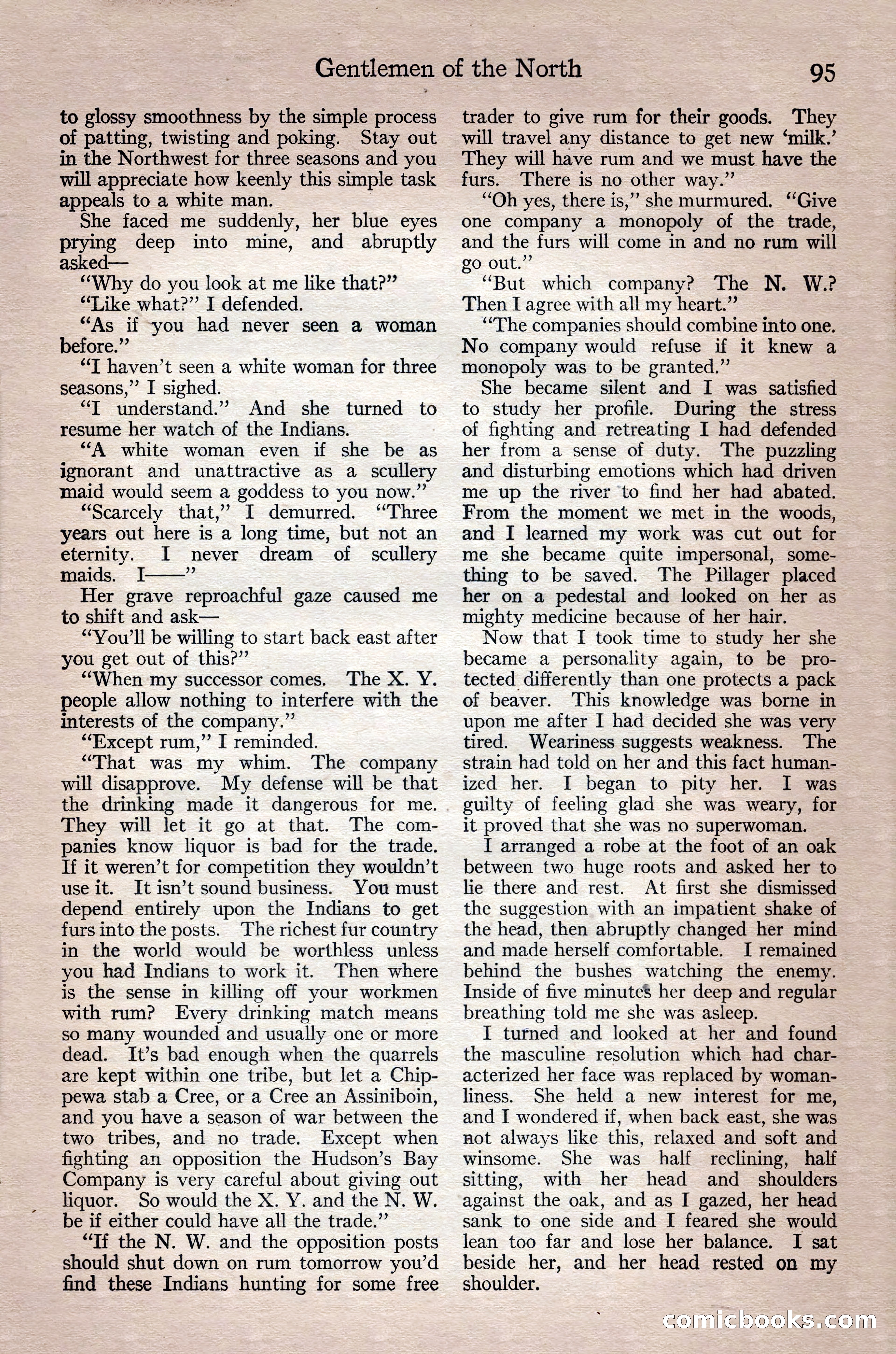
A restored page from Pulp Fiction, 1919. Page through the whole issue in the reader above.
📄 Transcribed text from this page (OCR, searchable)
Machine-transcribed from the original scan — historical spelling and the odd misread are preserved.
Gentlemen of the North to glossy smoothness by the simple process of patting, twisting and poking. Stay out in the Northwest for three seasons and you will appreciate how keenly this simple task appeals to a white man. | She faced me suddenly, her blue eyes prying deep into mine, and abruptly asked— “Why do you look at me like that?” “Like what?” I defended. “As if you had never seen @ woman before.” “T haven’t seen a white woman for three seasons,”’ I sighed. “T understand.” And she turned to resume her watch of the Indians. ‘“‘“A white woman even if she be as ignorant and unattractive as a scullery maid would seem a goddess to you now.” *“‘Scarcely that,’ I demurred. ‘“Three years out here is a long time, but not an eternity. I never dream of scullery maids. J——” Her grave reproachful gaze caused me to shift and ask— “You'll be willing to start back east after you get out of this?” “‘When my successor comes. The X. Y. people allow nothing to interfere with the interests of the company.” “Except rum,” I reminded. “That was my whim. The company will disapprove. My defense will be that the drinking made it dangerous for me. They will let it go at that. The com- panies know liquor is bad for the trade. If it weren’t for competition they wouldn’t use it. It isn’t sound business. You must depend entirely upon the Indians to get furs into the posts. The richest fur country in the world would be worthless unless you had Indians to work it. Then where is the sense in killing off your workmen with rum? Every drinking match means so many wounded and usually one or more dead. It’s bad enough when the quarrels are kept within one tribe, but let a Chip- pewa stab a Cree, or a Cree an Assiniboin, and you have a season of war between the two tribes, and no trade. Except when fighting an opposition the Hudson’s Bay Company is very careful about giving out liquor. So would the X. Y. and the N. W. be if either could have all the trade.” “Tf the N. W. and the opposition posts should shut down on rum tomorrow you’d find these Indians hunting for some free 95 trader to give rum for their goods. They will travel any distance to get new ‘milk.’ They will have rum and we must have the furs. There is no other way.” “Oh yes, there is,’ she murmured. “Give one company a monopoly of the trade, and the furs will come in and no rum will go out.” “But which company? The N. W.? Then I agree with all my heart.” ‘“‘The companies should combine into one. No company would refuse if it knew a monopoly was to be granted.” She became silent and I was satisfied to study her profile. During the stress of fighting and retreating I had defended her from a sense of duty. The puzzling and disturbing emotions which had driven me up the river to find her had abated. From the moment we met in the woods, and I learned my work was cut out for me she became quite impersonal, some- thing to be saved. The Pillager placed her on a pedestal and looked on her as mighty medicine because of her hair. Now that I took time to study her she became a personality again, to be pro- tected differently than one protects a pack of beaver. This knowledge was borne in upon me after I had decided she was very tired. Weariness suggests weakness. The strain had told on her and this fact human- ized her. I began to pity her. I was guilty of feeling glad she was weary, for it proved that she was no superwoman. I arranged a robe at the foot of an oak between two huge roots and asked her to lie there and rest. At first she dismissed the suggestion with an impatient shake of the head, then abruptly changed her mind and made herself comfortable. I remained behind the bushes watching the enemy. Inside of five minute$ her deep and regular breathing told me she was asleep. I turned and looked at her and found the masculine resolution which had char- acterized her face was replaced by woman- liness. She held a new interest for me, and I wondered if, when back east, she was not always like this, relaxed and soft and winsome. She was half reclining, half sitting, with her head and_ shoulders against the oak, and as I gazed, her head sank to one side and I feared she would lean too far and lose her balance. I sat beside her, and her head rested on my shoulder. (a)! com ibooks.co