
Pulp Fiction, 1919 · page 104 of 208
Adventure Magazine Cover — page 104: what you’re looking at
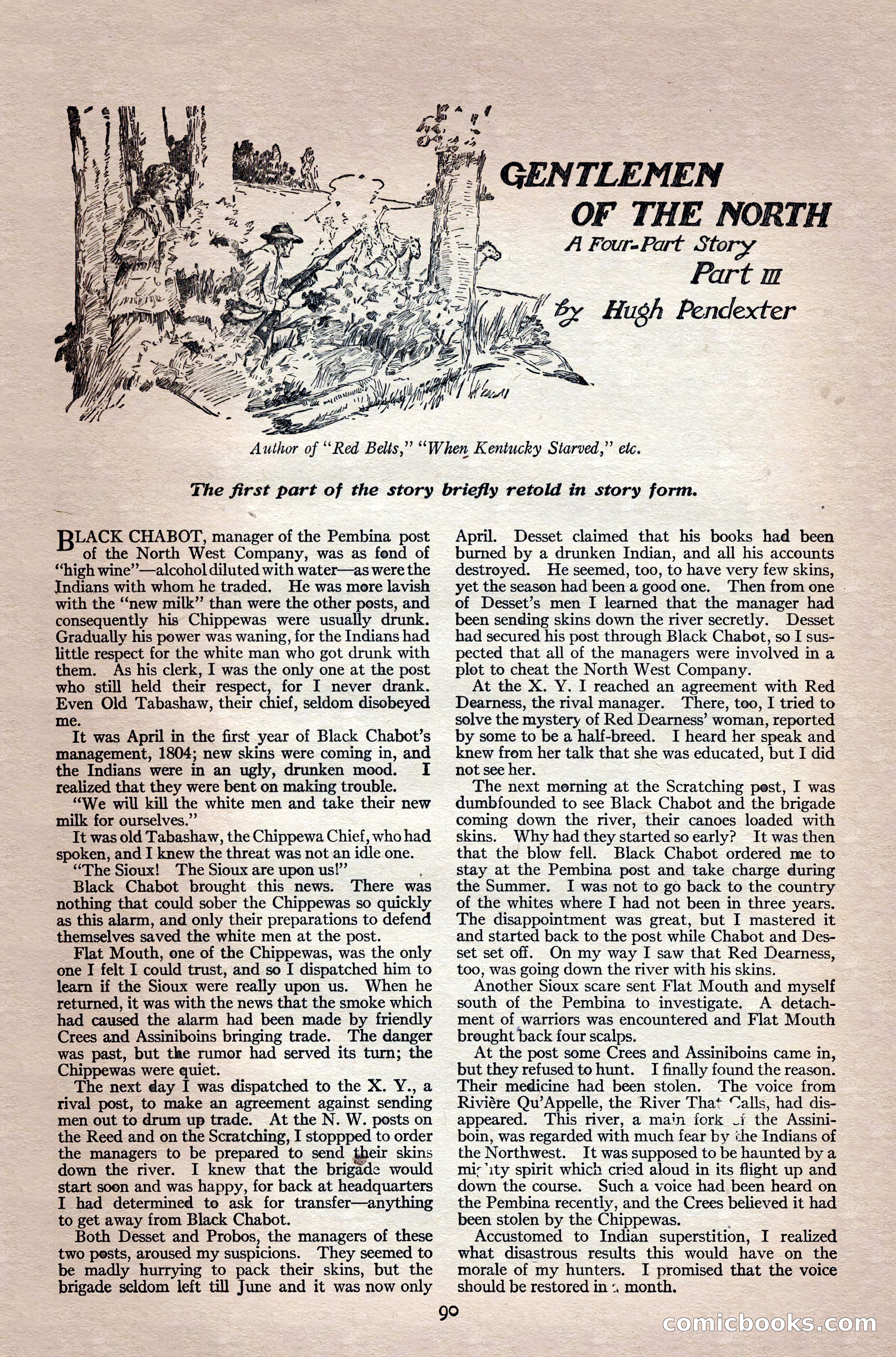
A restored page from Pulp Fiction, 1919. Page through the whole issue in the reader above.
📄 Transcribed text from this page (OCR, searchable)
Machine-transcribed from the original scan — historical spelling and the odd misread are preserved.
XN Wrracrcenane Jf} ————— SS -= Sy SAN \\\\ A ae Se > —>=..” Ss —_ ~*~ ees Ne = Sa \ ee WX \ Wd - ‘ 3 < / Gis - ee GENTLEMEN © OF THE NORTH A Four=Part Story Fart m ae Author of “Red Belts,” “When Kentucky Starved,” etc The first part of the story briefly retold in story form. BLACK CHABOT, manager of the Pembina post of the North West Company, was as fond of “high wine” —alcohol diluted with water—as were the Indians with whom he traded. He was more lavish with the ‘‘new milk” than were the other posts, and consequently his Chippewas were usually drunk. Gradually his power was waning, for the Indians had little respect for the white man who got drunk with them. As his clerk, I was the only one at the post who still held their respect, for I never drank. es Old Tabashaw, their chief, seldom disobeyed Tt was April in the first year of Black Chabot’s management, 1804; new skins were coming in, and the Indians were in an ugly, drunken mood. I realized that they were bent on making trouble. “We will kill the white men and take their new milk for ourselves.”’ It was old Tabashaw, the Chippewa Chief, who had spoken, and I knew the threat was not an idle one. ‘The Sioux! ‘The Sioux are upon us!” Black Chabot brought this news. ‘There was nothing that could sober the Chippewas so quickly as this alarm, and only their preparations to defend themselves saved the white men at the post. Flat Mouth, one of the Chippewas, was the only one I felt I could trust, and so I dispatched him to learn if the Sioux were really upon us. When he returned, it was with the news that the smoke which had caused the alarm had been made by friendly Crees and Assiniboins bringing trade. The danger was past, but the rumor had served its turn; the Chippewas were quiet. The next day I was dispatched to the X. Y., a rival post, to make an agreement against sending men out to drum up trade. At the N. W. posts on the Reed and on the Scratching, I stoppped to order the managers to be prepared to send heir skins down the river. I knew that the brigade would start soon and was happy, for back at headquarters I had determined to ask for transfer—anything to get away from Black Chabot. Both Desset and Probos, the managers of these two pests, aroused my suspicions. ‘They seemed to be madly hurrying to pack their skins, but the brigade saidort left till June and it was now only go April. Desset claimed that his books had been burned by a drunken Indian, and all his accounts destroyed. He seemed, too, to have very few skins, yet the season had been a good one. of Desset’s men I learned that the manager had been sending skins down the river secretly. Desset had secured his post through Black Chabot, so I sus- pected that all of the managers were involved in a plot to cheat the North West Company. At the X. Y. I reached an agreement with Red Dearness, the rival manager. There, too, I tried to solve the mystery of Red Dearness’ woman, reported by some to be a half-breed. I heard her speak and knew from her talk that she was educated, but I did not see her. The next morning at the Scratching pest, I was dumbfounded to see Black Chabot and the brigade coming down the river, their canoes loaded with skins. Why had they started soearly? It was then that the blow fell. Black Chabot ordered me to stay at the Pembina post and take charge during the Summer. I was not to go back to the country of the whites where I had not been in three years. The disappointment was great, but I mastered it and started back to the post while Chabot and Des- set set off. On my way I saw that Red Dearness, too, was going down the river with his skins. Another Sioux scare sent Flat Mouth and myself south of the Pembina to investigate. A detach- ment of warriors was encountered and Flat Mouth brought back four scalps. At the post some Crees and Assiniboins came in, but they refused to hunt. I finally found the reason. Their medicine had been stolen. The voice from Riviére Qu’Appelle, the River That Calls, had dis- appeared. This river, a main fork -i the Assini- boin, was regarded with much fear by the Indians of the Northwest. It was supposed to be haunted by a mir ‘ity spirit which cried aloud in its flight up and down the course. Such a voice had been heard on the Pembina recently, and the Crees believed it had been stolen by the Chippewas. Accustomed to Indian superstition, I realized what disastrous results this would have on the morale of my hunters. I promised that the voice should be restored in «. month, Then from one . Gomichooks:Gco im