
Pulp Fiction, 1918 · page 83 of 194
Adventure Magazine Cover, April 3, 1918 — page 83: what you’re looking at
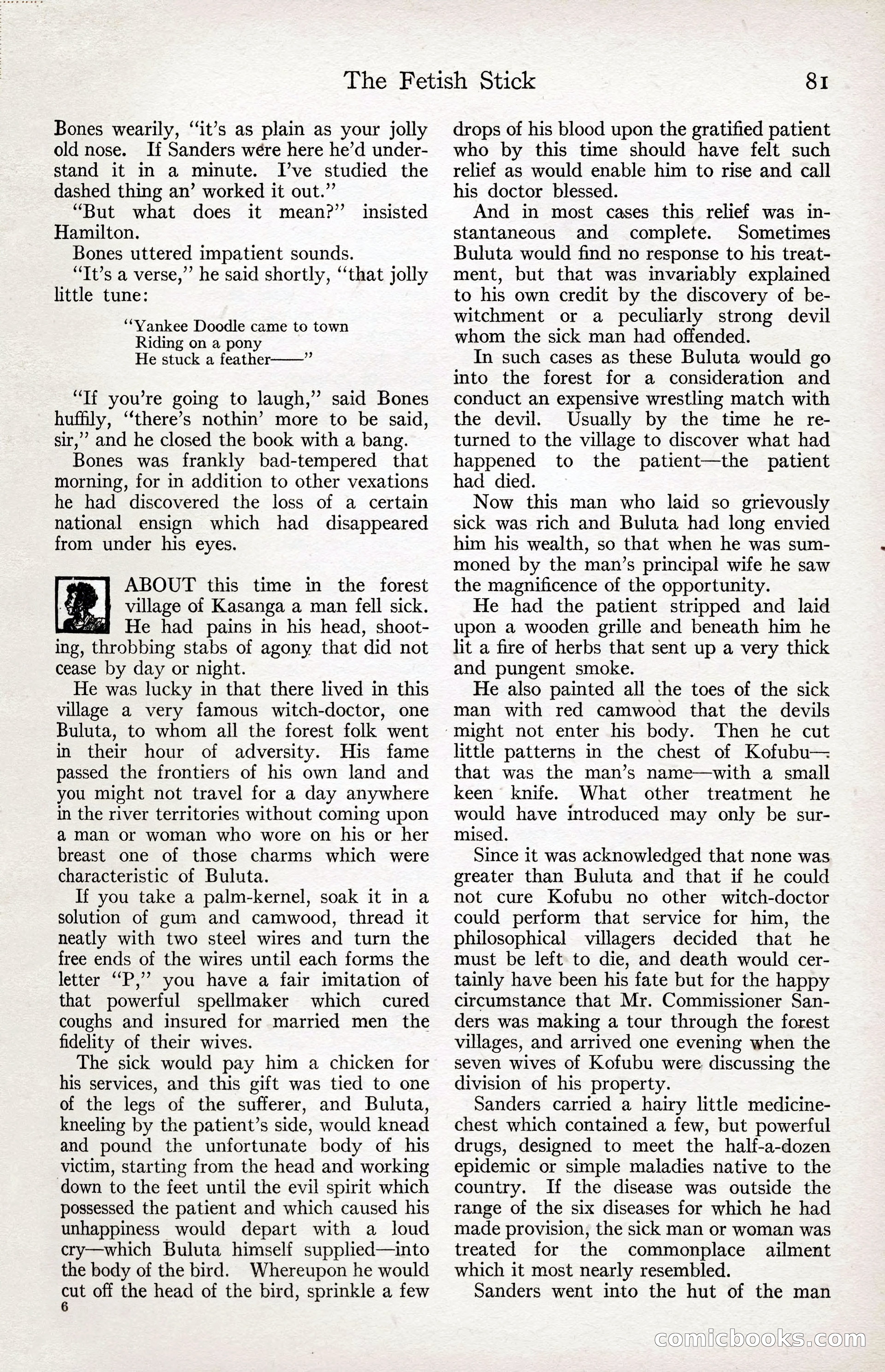
A restored page from Pulp Fiction, 1918. Page through the whole issue in the reader above.
📄 Transcribed text from this page (OCR, searchable)
Machine-transcribed from the original scan — historical spelling and the odd misread are preserved.
The Fetish Stick Bones wearily, ‘‘it’s as plain as your jolly old nose. If Sanders wére here he’d under- stand it m a mimute. I’ve studied the dashed thing an’ worked it out.” “But what does it mean?” Hamilton. Bones uttered impatient sounds. “Tt’s a verse,”’ he said shortly, “‘that jolly ttle tune: insisted “Yankee Doodle came to town Riding on a pony He stuck a feather “Tf you’re going to laugh,” said Bones huffily, ‘“‘there’s nothin’ more to be said, sir,’ and he closed the book with a bang. Bones was frankly bad-tempered that morning, for in addition to other vexations he had discovered the loss of a certain national ensign which had disappeared from under his eyes. ABOUT this time in the forest village of Kasanga a man fell sick. Rima ~=He had pains in his head, shoot- ny, throbbing stabs of agony that did not cease by day or night. He was lucky in that there lived in this village a very famous witch-doctor, one Buluta, to whom all the forest folk went in their hour of adversity. His fame passed the frontiers of his own land and you might not travel for a day anywhere in the river territories without coming upon a man or woman who wore on his or her breast one of those charms which were characteristic of Buluta. If you take a palm-kernel, soak it in a solution of gum and camwood, thread it neatly with two steel wires and turn the free ends of the wires until each forms the letter “P,’’ you have a fair imitation of that powerful spellmaker which cured coughs and insured for married men the fidelity of their wives. The sick would pay him a chicken for his services, and this gift was tied to one of the legs of the sufferer, and Buluta, kneeling by the patient’s side, would knead and pound the unfortunate body of his victim, starting from the head and working down to the feet until the evil spirit which possessed the patient and which caused his unhappiness would depart with a loud cry—which Buluta himself supplied—into the body of the bird. Whereupon he would cut off the head of the bird, sprinkle a few SI drops of his blood upon the gratified patient who by this time should have felt such relief as would enable him to rise and call his doctor blessed. And in most cases this relief was in- stantaneous and complete. Sometimes Buluta would find no response to his treat- ment, but that was invariably explained to his own credit by the discovery of be- witchment or a peculiarly strong devil whom the sick man had offended. In such cases as these Buluta would go into the forest for a consideration and conduct an expensive wrestling match with the devil. Usually by the time he re- turned to the village to discover what had happened to the patient—the patient had died. Now this man who laid so grievously sick was rich and Buluta had long envied him his wealth, so that when he was sum- moned by the man’s principal wife he saw the magnificence of the opportunity. He had the patient stripped and laid upon a wooden grille and beneath him he lit a fire of herbs that sent up a very thick and pungent smoke. He also painted all the toes of the sick man with red camwood that the devils ‘might not enter his body. Then he cut little patterns in the chest of Kofubu— that was the man’s name—with a small keen knife. What other treatment he would have introduced may only be sur- mised. Since it was acknowledged that none was greater than Buluta and that if he could not cure Kofubu no other witch-doctor could perform that service for him, the philosophical villagers decided that he must be left to die, and death would cer- tainly have been his fate but for the happy circumstance that Mr. Commissioner San- ders was making a tour through the forest villages, and arrived one evening when the seven wives of Kofubu were discussing the division of his property. Sanders carried a hairy little medicine- chest which contained a few, but powerful drugs, designed to meet the half-a-dozen epidemic or simple maladies native to the country. If the disease was outside the range of the six diseases for which he had made provision, the sick man or woman was treated for the commonplace ailment which it most nearly resembled. Sanders went into the hut of the man COnnIELooo S (C@