
Pulp Fiction, 1918 · page 28 of 194
Adventure Magazine Cover, April 3, 1918 — page 28: what you’re looking at
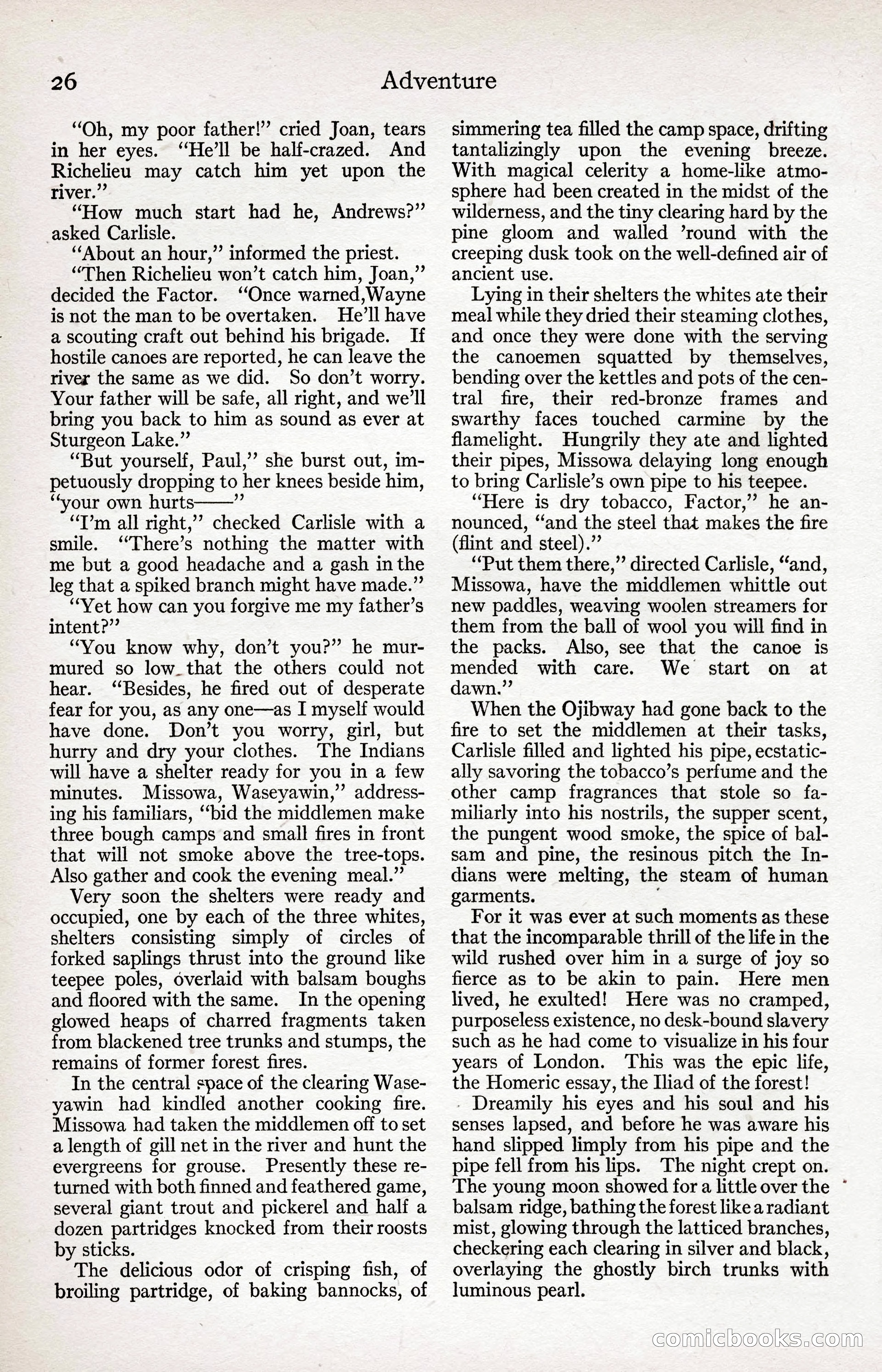
A restored page from Pulp Fiction, 1918. Page through the whole issue in the reader above.
📄 Transcribed text from this page (OCR, searchable)
Machine-transcribed from the original scan — historical spelling and the odd misread are preserved.
26 “Oh, my poor father!’’ cried Joan, tears in her eyes. ‘‘He’ll be half-crazed. And Richelieu may catch him yet upon the river.” “How much start had he, Andrews?” asked Carlisle. ‘“‘About an hour,” informed the priest. “Then Richelieu won’t catch him, Joan,”’ decided the Factor. “Once warned,Wayne is not the man to be overtaken. He'll have a scouting craft out behind his brigade. If hostile canoes are reported, he can leave the river the same as we did. So don’t worry. Your father will be safe, all right, and we'll bring you back to him as sound as ever at Sturgeon Lake.” “But yourself, Paul,” she burst out, im- petuously dropping to her knees beside him, “your own hurts——”’ “T’m all right,’’ checked Carlisle with a smile. ‘“There’s nothing the matter with me but a good headache and a gash in the leg that a spiked branch might have made.” “Vet how can you forgive me my father’s intent?” “You know why, don’t you?” he mur- mured so low_that the others could not hear. “Besides, he fired out of desperate fear for you, as any one—as I myself would have done. Don’t you worry, girl, but hurry and dry your clothes. The Indians will have a shelter ready for you in a few minutes. Missowa, Waseyawin,” address- ing his familiars, ‘“bid the middlemen make three bough camps and small fires in front that will not smoke above the tree-tops. Also gather and cook the evening meal.” Very soon the shelters were ready and occupied, one by each of the three whites, shelters consisting simply of circles of forked saplings thrust into the ground like teepee poles, overlaid with balsam boughs and floored with the same. In the opening glowed heaps of charred fragments taken from blackened tree trunks and stumps, the remains of former forest fires. In the central space of the clearing Wase- yawin had kindled another cooking fire. Missowa had taken the middlemen off to set a length of gill net in the river and hunt the evergreens for grouse. Presently these re- turned with both finned and feathered game, several giant trout and pickerel and half a dozen partridges knocked from their roosts by sticks. The delicious odor of crisping fish, of broiling partridge, of baking bannocks, of Adventure simmering tea filled the camp space, drifting tantalizingly upon the evening breeze. With magical celerity a home-like atmo- sphere had been created in the midst of the wilderness, and the tiny clearing hard by the pine gloom and walled ’round with the creeping dusk took on the well-defined air of ancient use. Lying in their shelters the whites ate their meal while they dried their steaming clothes, and once they were done with the serving the canoemen squatted by themselves, bending over the kettles and pots of the cen- tral fire, their red-bronze frames and swarthy faces touched carmine by the flamelight. Hungrily they ate and lighted their pipes, Missowa delaying long enough to bring Carlisle’s own pipe to his teepee. “Here is dry tobacco, Factor,’ he an- nounced, “and the steel that makes the fire (flint and steel).” “Put them there,’’ directed Carlisle, “and, Missowa, have the middlemen whittle out new paddles, weaving woolen streamers for them from the ball of wool you will find in the packs. Also, see that the canoe is mended with care. We start on at dawn.” When the Ojibway had gone back to the fire to set the middlemen at their tasks, Carlisle filled and lighted his pipe, ecstatic- ally savoring the tobacco’s perfume and the other camp fragrances that stole so fa- miliarly into his nostrils, the supper scent, the pungent wood smoke, the spice of bal- sam and pine, the resinous pitch the In- dians were melting, the steam of human garments. For it was ever at such moments as these that the incomparable thrill of the life in the wild rushed over him in a surge of joy so fierce as to be akin to pain. Here men lived, he exulted! Here was no cramped, purposeless existence, no desk-bound slavery such as he had come to visualize in his four years of London. This was the epic life, the Homeric essay, the Iliad of the forest! - Dreamily his eyes and his soul and his senses lapsed, and before he was aware his hand slipped limply from his pipe and the pipe fell from his lips. The night crept on. The young moon showed for a little over the ~ balsam ridge, bathing the forest likea radiant mist, glowing through the latticed branches, checkering each clearing in silver and black, overlaying the ghostly birch trunks with luminous pearl. COnniclo@oo SS (C@