
Pulp Fiction, 1918 · page 191 of 194
Adventure Magazine Cover, April 3, 1918 — page 191: what you’re looking at
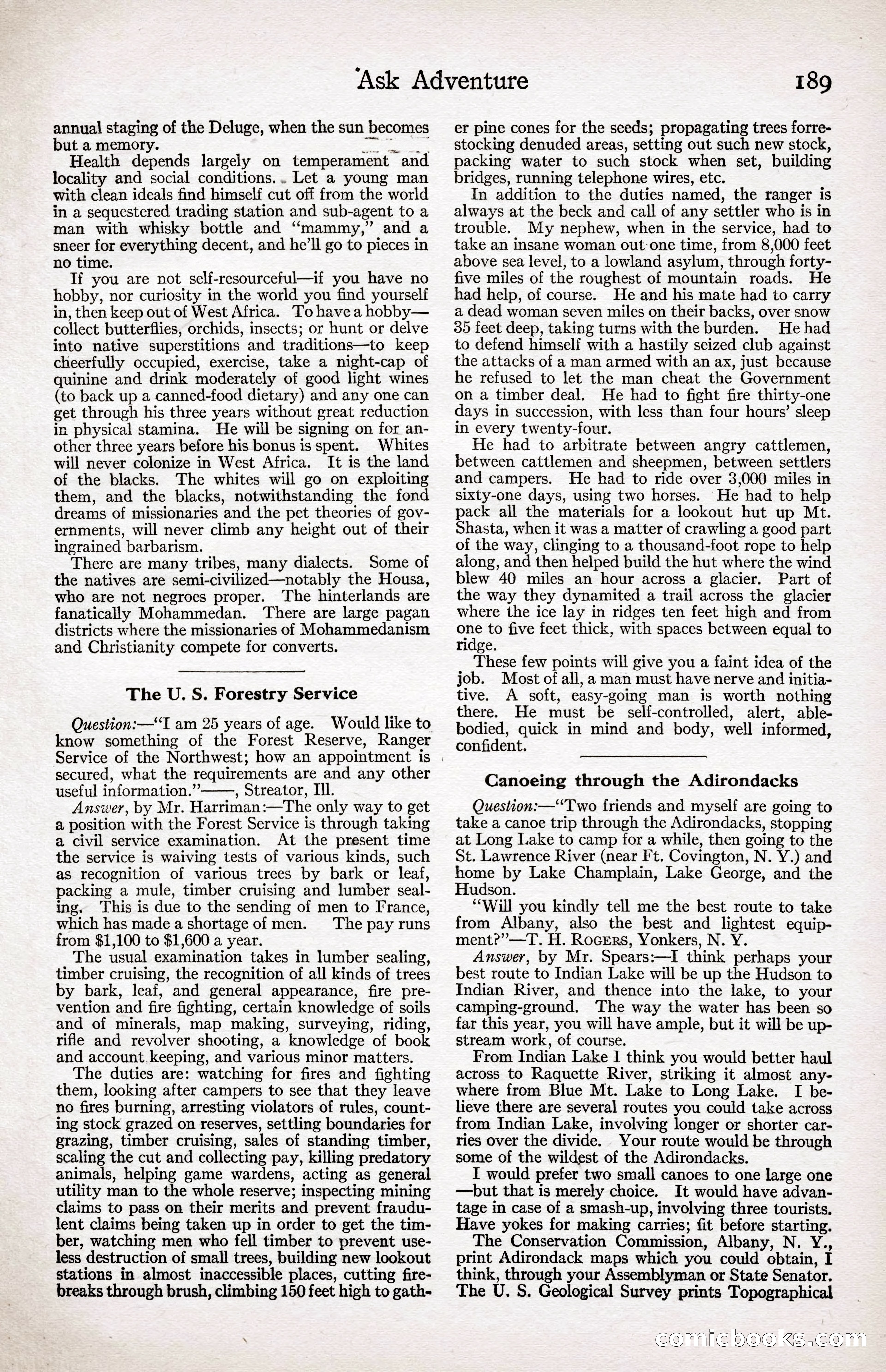
A restored page from Pulp Fiction, 1918. Page through the whole issue in the reader above.
📄 Transcribed text from this page (OCR, searchable)
Machine-transcribed from the original scan — historical spelling and the odd misread are preserved.
Ask Adventure annual staging of the Deluge, when the sun becomes but a memory. Megs Jer Health depends largely on temperament and locality and social conditions... Let a young man with clean ideals find himself cut off from the world in a sequestered trading station and sub-agent to a man with whisky bottle and ‘mammy,” and a sneer for everything decent, and he’ll go to pieces in no time. If you are not self-resourceful—if you have no hobby, nor curiosity in the world you find yourself in, then keep out of West Africa. To havea hobby— collect butterflies, orchids, insects; or hunt or delve into native superstitions and traditions—to keep cheerfully occupied, exercise, take a night-cap of quinine and drink moderately of good light wines (to back up a canned-food dietary) and any one can get through his three years without great reduction in physical stamina. He will be signing on for an- other three years before his bonus is spent. Whites will never colonize in West Africa. It is the land of the blacks. The whites will go on exploiting them, and the blacks, notwithstanding the fond dreams of missionaries and the pet theories of gov- ernments, will never climb any height out of their ingrained barbarism. There are many tribes, many dialects. Some of the natives are semi-civilized—notably the Housa, who are not negroes proper. The hinterlands are fanatically Mohammedan. There are large pagan districts where the missionaries of Mohammedanism and Christianity compete for converts. The U. S. Forestry Service Question: —“T am 25 years of age. know something of the Forest Reserve, Ranger Service of the Northwest; how an appointment is | secured, what the requirements are and any other useful information.” , otreator, Il. Answer, by Mr. Harriman:—The only way to get a position with the Forest Service is through taking a civil service examination. At the present time the service is waiving tests of various kinds, such as recognition of various trees by bark or leaf, packing a mule, timber cruising and lumber seal- ing. ‘This is due to the sending of men to France, which has made a shortage of men. The pay runs from $1,100 to $1,600 a year. The usual examination takes in lumber sealing, timber cruising, the recognition of all kinds of trees by bark, leaf, and general appearance, fire pre- vention and fire fighting, certain knowledge of soils and of minerals, map making, surveying, riding, rifle and revolver shooting, a knowledge of book and account.keeping, and various minor matters. The duties are: watching for fires and fighting them, looking after campers to see that they leave no fires burning, arresting violators of rules, count- ing stock grazed on reserves, settling boundaries for grazing, timber cruising, sales of standing timber, scaling the cut and collecting pay, killing predatory animals, helping game wardens, acting as general utility man to the whole reserve; inspecting mining claims to pass on their merits and prevent fraudu- lent claims being taken up in order to get the tim- ber, watching men who fell timber to prevent use- less destruction of small trees, building new lookout stations in almost inaccessible places, cutting fire- breaks through brush, climbing 150 feet high to gath- Would like to 189 er pine cones for the seeds; propagating trees forre- stocking denuded areas, setting out such new stock, packing water to such stock when set, building bridges, running telephone wires, etc. In addition to the duties named, the ranger is always at the beck and call of any settler who is in trouble. My nephew, when in the service, had to take an insane woman out one time, from 8,000 feet above sea level, to a lowland asylum, through forty- five miles of the roughest of mountain roads. He had help, of course. He and his mate had to carry a dead woman seven miles on their backs, over snow oo feet deep, taking turns with the burden. He had to defend himself with a hastily seized club against the attacks of a man armed with an ax, just because he refused to let the man cheat the Government on a timber deal. He had to fight fire thirty-one days in succession, with less than four hours’ sleep in every twenty-four. He had to arbitrate between angry cattlemen, between cattlemen and sheepmen, between settlers and campers. He had to ride over 3,000 miles in sixty-one days, using two horses. He had to help pack all the materials for a lookout hut up Mt. Shasta, when it was a matter of crawling a good part of the way, clinging to a thousand-foot rope to help along, and then helped build the hut where the wind blew 40 miles an hour across a glacier. Part of the way they dynamited a trail across the glacier where the ice lay in ridges ten feet high and from a to five feet thick, with spaces between equal to ridge. These few points will give you a faint idea of the job. Most of all, a man must have nerve and initia- tive. A soft, easy-going man is worth nothing there. He must be self-controlled, alert, able- bodied, quick in mind and body, well informed, confident. Canoeing through the Adirondacks Question: —“Two friends and myself are going to take a canoe trip through the Adirondacks, stopping at Long Lake to camp for a while, then going to the St. Lawrence River (near Ft. Covington, N. Y.) and home by Lake Champlain, Lake George, and the Hudson. “Will you kindly tell me the best route to take from Albany, also the best and lightest equip- ment?”—T. H. Rocrers, Yonkers, N. Y. Answer, by Mr. Spears:—I think perhaps your best route to Indian Lake will be up the Hudson to Indian River, and thence into the lake, to your camping-ground. ‘The way the water has been so far this year, you will have ample, but it will be up- stream work, of course. From Indian Lake I think you would better haul across to Raquette River, striking it almost any- where from Blue Mt. Lake to Long Lake. I be- lieve there are several routes you could take across from Indian Lake, involving longer or shorter car- ries over the divide. Your route would be through some of the wildest of the Adirondacks. I would prefer two small canoes to one large one —but that is merely choice. It would have advan- tage in case of a smash-up, involving three tourists. Have yokes for making carries; fit before starting. The Conservation Commission, Albany, N. Y., print Adirondack maps which you could obtain, I think, through your Assemblyman or State Senator. The U. S. Geological Survey prints Topographical GOmiiGcivoo S (C@