
Pulp Fiction, 1918 · page 19 of 194
Adventure Magazine Cover, April 3, 1918 — page 19: what you’re looking at
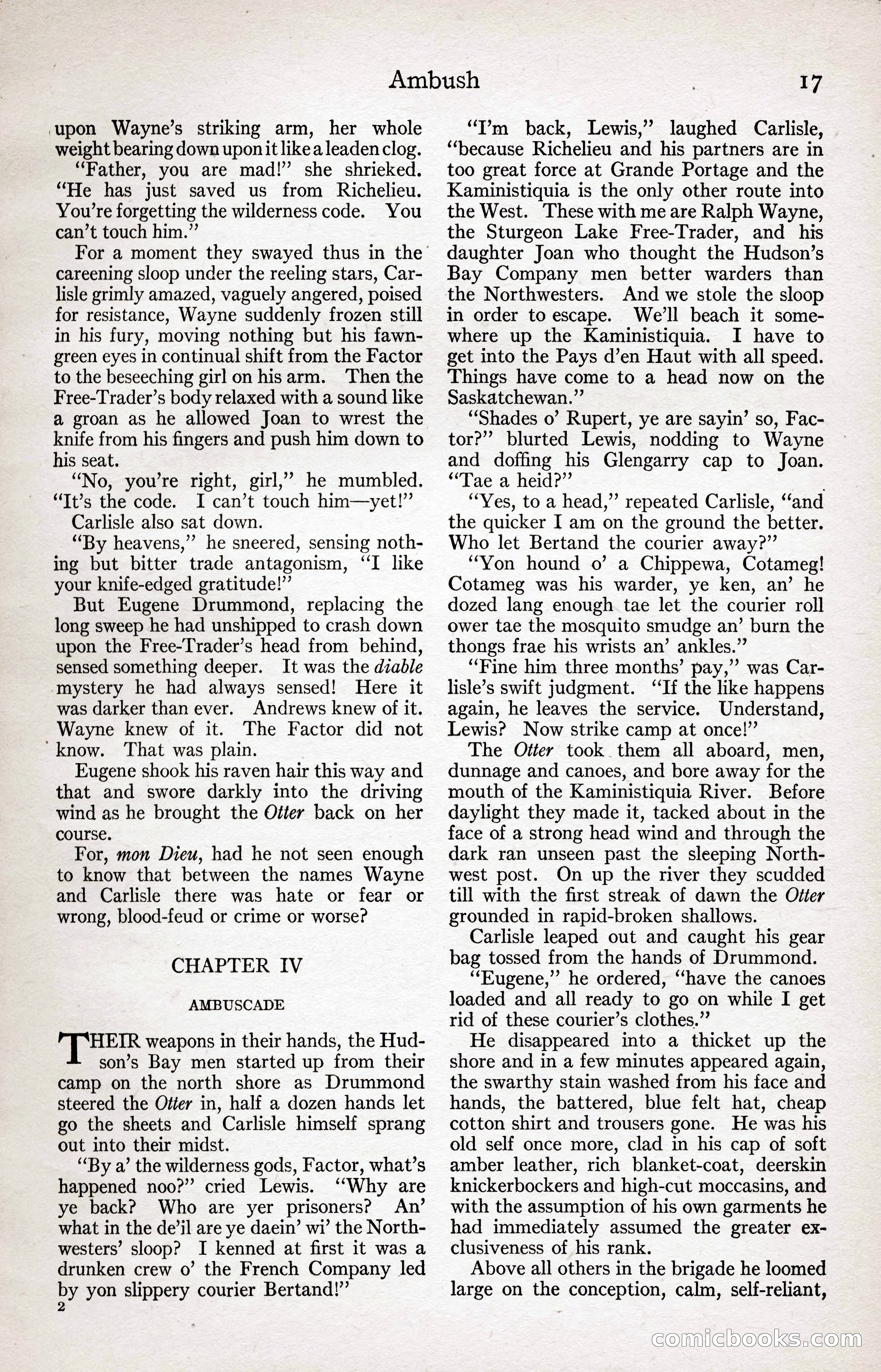
A restored page from Pulp Fiction, 1918. Page through the whole issue in the reader above.
📄 Transcribed text from this page (OCR, searchable)
Machine-transcribed from the original scan — historical spelling and the odd misread are preserved.
Ambush upon Wayne’s striking arm, her whole weight bearing down uponit likea leaden clog. “Father, you are mad!” she shrieked. “He has just saved us from Richelieu. You're forgetting the wilderness code. You can’t touch him.” For a moment they swayed thus in the’ careening sloop under the reeling stars, Car- lisle grimly amazed, vaguely angered, poised for resistance, Wayne suddenly frozen still in his fury, moving nothing but his fawn- green eyes in continual shift from the Factor to the beseeching girl on his arm. ‘Then the Free-Trader’s body relaxed with a sound like a groan as he allowed Joan to wrest the knife from his fingers and push him down to his seat. “No, you’re right, girl,’ he mumbled. “Tt’s the code. I can’t touch him—yet!”’ Carlisle also sat down. “By heavens,” he sneered, sensing noth- ing but bitter trade antagonism, “I like your knife-edged gratitude!” But Eugene Drummond, replacing the long sweep he had unshipped to crash down upon the Free-Trader’s head from behind, sensed something deeper. It was the dzable ‘mystery he had always sensed! Here it was darker than ever. Andrews knew of it. Wayne knew of it. The Factor did not know. That was plain. Eugene shook his raven hair this way and that and swore darkly into the driving wind as he brought the Otter back on her course. For, mon Dieu, had he not seen enough to know that between the names Wayne and Carlisle there was hate or fear or wrong, blood-feud or crime or worse? CHAPTER IV AMBUSCADE “PEER weapons in their hands, the Hud- son’s Bay men started up from their camp on the north shore as Drummond steered the Ofter in, half a dozen hands let go the sheets and Carlisle himself sprang out into their midst. “By a’ the wilderness gods, Factor, what’s happened noo?” cried Lewis. ‘‘Why are ye back? Who are yer prisoners? An’ what in the de’il are ye daein’ wi’ the North- westers’ sloop? I kenned at first it was a drunken crew o’ the French Company led 2 yon slippery courier Bertand!’’ 17 “Y’m back, Lewis,” laughed Carlisle, ‘because Richelieu and his partners are in too great force at Grande Portage and the Kaministiquia is the only other route into the West. These with me are Ralph Wayne, the Sturgeon Lake Free-Trader, and his daughter Joan who thought the Hudson’s Bay Company men better warders than the Northwesters. And we stole the sloop in order to escape. We'll beach it some- where up the Kaministiquia. I have to get into the Pays d’en Haut with all speed. Things have come to a head now on the Saskatchewan.” ‘Shades o’ Rupert, ye are sayin’ so, Fac- tor?” blurted Lewis, nodding to Wayne and doffing his Glengarry cap to Joan. ‘Tae a heid?” “Yes, to a head,’ repeated Carlisle, “‘and the quicker I am on the ground the better. Who let Bertand the courier away?” “Yon hound o’ a Chippewa, Cotameg! Cotameg was his warder, ye ken, an’ he dozed lang enough tae let the courier roll ower tae the mosquito smudge an’ burn the thongs frae his wrists an’ ankles.” “Fine him three months’ pay,” was Car- lisle’s swift judgment. ‘‘If the like happens again, he leaves the service. Understand, Lewis? Now strike camp at once!” The Otter took them all aboard, men, dunnage and canoes, and bore away for the mouth of the Kaministiquia River. Before daylight they made it, tacked about in the face of a strong head wind and through the dark ran unseen past the sleeping North- west post. On up the river they scudded till with the first streak of dawn the Otter grounded in rapid-broken shallows. Carlisle leaped out and caught his gear bag tossed from the hands of Drummond. “Eugene,” he ordered, ‘‘have the canoes loaded and all ready to go on while I get rid of these courier’s clothes.”’ He disappeared into a thicket up the shore and in a few minutes appeared again, the swarthy stain washed from his face and hands, the battered, blue felt hat, cheap cotton shirt and trousers gone. He was his old self once more, clad in his cap of soft amber leather, rich blanket-coat, deerskin knickerbockers and high-cut moccasins, and with the assumption of his own garments he had immediately assumed the greater ex- clusiveness of his rank. Above all others in the brigade he loomed large on the conception, calm, self-reliant, COnniclo@oo S (C@