
Pulp Fiction, 1918 · page 177 of 194
Adventure Magazine Cover, April 3, 1918 — page 177: what you’re looking at
A restored page from Pulp Fiction, 1918. Page through the whole issue in the reader above.
📄 Transcribed text from this page (OCR, searchable)
Machine-transcribed from the original scan — historical spelling and the odd misread are preserved.
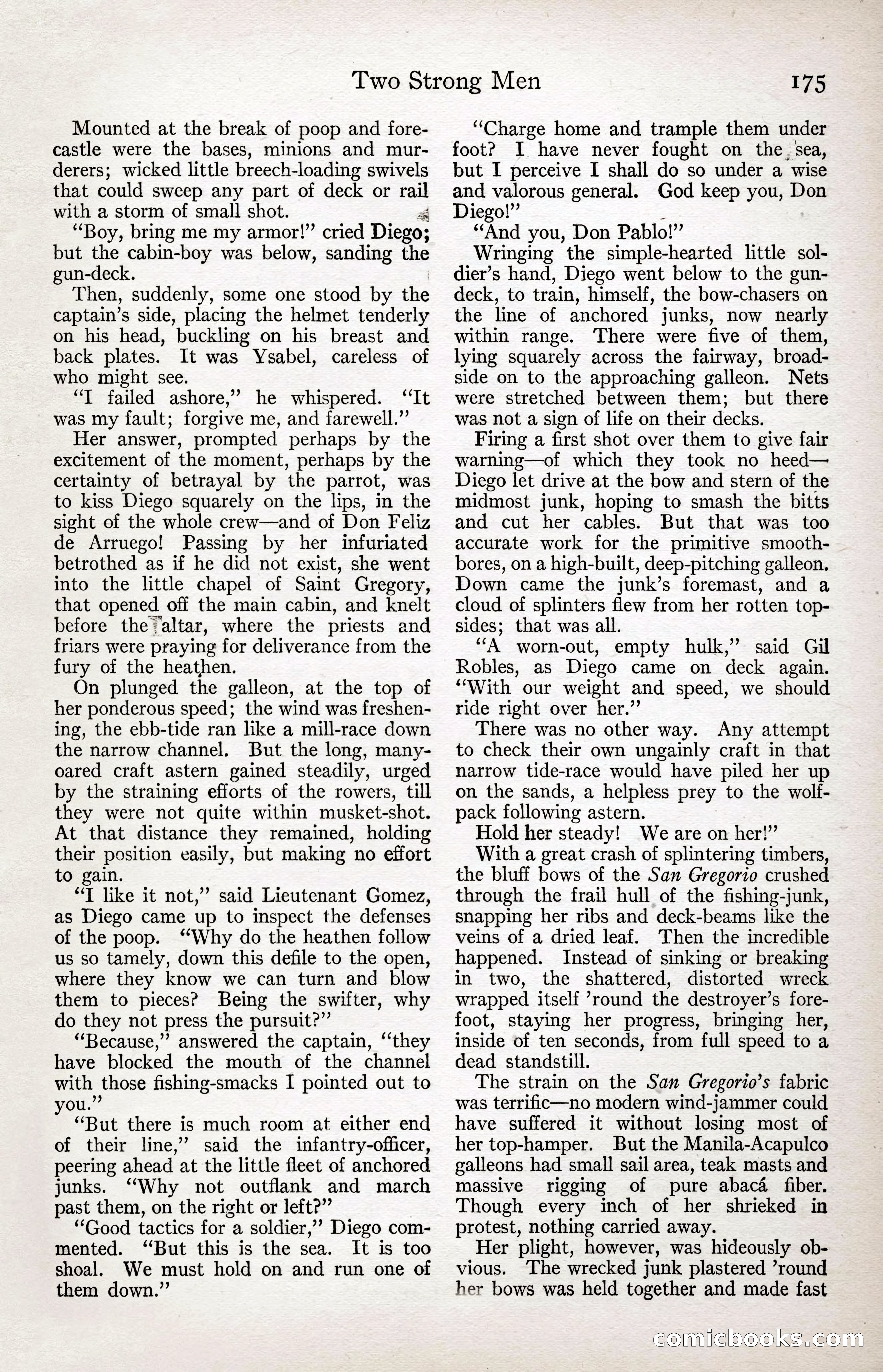
Two Strong Men Mounted at the break of poop and fore- castle were the bases, minions and mur- derers; wicked little breech-loading swivels that could sweep any part of deck or rail with a storm of small shot. a “Boy, bring me my armor!” cried Diego; but the cabin-boy was below, sanding the gun-deck. Then, suddenly, some one stood by the captain’s side, placing the helmet tenderly on his head, ‘buckling on his breast and back plates. It was Ysabel, careless of who might see. “YT failed ashore,” he whispered. ‘‘It was my fault; forgive me, and farewell.” Her answer, prompted perhaps by the excitement of the moment, perhaps by the certainty of betrayal by the parrot, was to kiss Diego squarely on the lips, in the sight of the whole crew—and of Don Feliz de Arruego! Passing by her infuriated betrothed as if he did not exist, she went into the little chapel of Saint Gregory, that opened off the main cabin, and knelt before the “altar, where the priests and friars were praying for deliverance from the fury of the heathen. On plunged the galleon, at the top of her ponderous speed; the wind was freshen- ing, the ebb-tide ran like a mill-race down the narrow channel. But the long, many- oared craft astern gained steadily, urged by the straining efforts of the rowers, till they were not quite within musket-shot. At that distance they remained, holding their position easily, but making no effort to gain. “T like it not,” said Lieutenant Gomez, as Diego came up to inspect the defenses of the poop. ‘“‘Why do the heathen follow us so tamely, down this defile to the open, where they know we can turn and blow them to pieces? Being the swifter, why do they not press the pursuit?” “Because,” answered the captain, “they have blocked the mouth of the channel with those fishing-smacks I pointed out to ou.” “But there is much room at either end of their line,” said the infantry-officer, peering ahead at the little fleet of anchored junks. “Why not outflank and march past them, on the right or left?” “Good tactics for a soldier,’”? Diego com- mented. “But this is the sea. It is too shoal. We must hold on and run one of them down.” 175 “Charge home and trample them under foot? I have never fought on the, sea, but I perceive I shall do so under a wise and valorous general. God keep you, Don Diego!” “And you, Don Pablo!” Wringing the simple-hearted little sol- dier’s hand, Diego went below to the gun- deck, to train, himself, the bow-chasers on the line of anchored junks, now nearly within range. There were five of them, lying squarely across the fairway, broad- side on to the approaching galleon. Nets were stretched between them; but there was not a sign of life on their decks. Firing a first shot over them to give fair warning—of which they took no heed— Diego let drive at the bow and stern of the midmost junk, hoping to smash the bitts and cut her cables. But that was too accurate work for the primitive smooth- bores, on a high-built, deep-pitching galleon. Down came the junk’s foremast, and a cloud of splinters flew from her rotten top- sides; that was all. “A worn-out, empty hulk,” said Gil Robles, as Diego came on deck again. “With our weight and speed, we should ride right over her.” There was no other way. Any attempt to check their own ungainly craft in that narrow tide-race would have piled her up on the sands, a helpless prey to the wolf- pack following astern. Hold her steady! We are on her!” With a great crash of splintering timbers, the bluff bows of the San Gregorio crushed through the frail hull of the fishing-junk, snapping her ribs and deck-beams like the veins of a dried leaf. Then the incredible happened. Instead of sinking or breaking in two, the shattered, distorted wreck wrapped itself ’round the destroyer’s fore- foot, staying her progress, bringing her, inside of ten seconds, from full speed to a dead standstill. The strain on the San Gregorio’s fabric was terrific—no modern wind-jammer could have suffered it without losing most of her top-hamper. But the Manila-Acapulco galleons had small sail area, teak masts and massive rigging of pure abaca fiber. Though every inch of her shrieked in protest, nothing carried away. Her plight, however, was hideously ob- vious. ‘The wrecked junk plastered ’round her bows was held together and made fast (EO) 0)(0)(6) ANG <SEGO