
Pulp Fiction, 1918 · page 175 of 194
Adventure Magazine Cover, April 3, 1918 — page 175: what you’re looking at
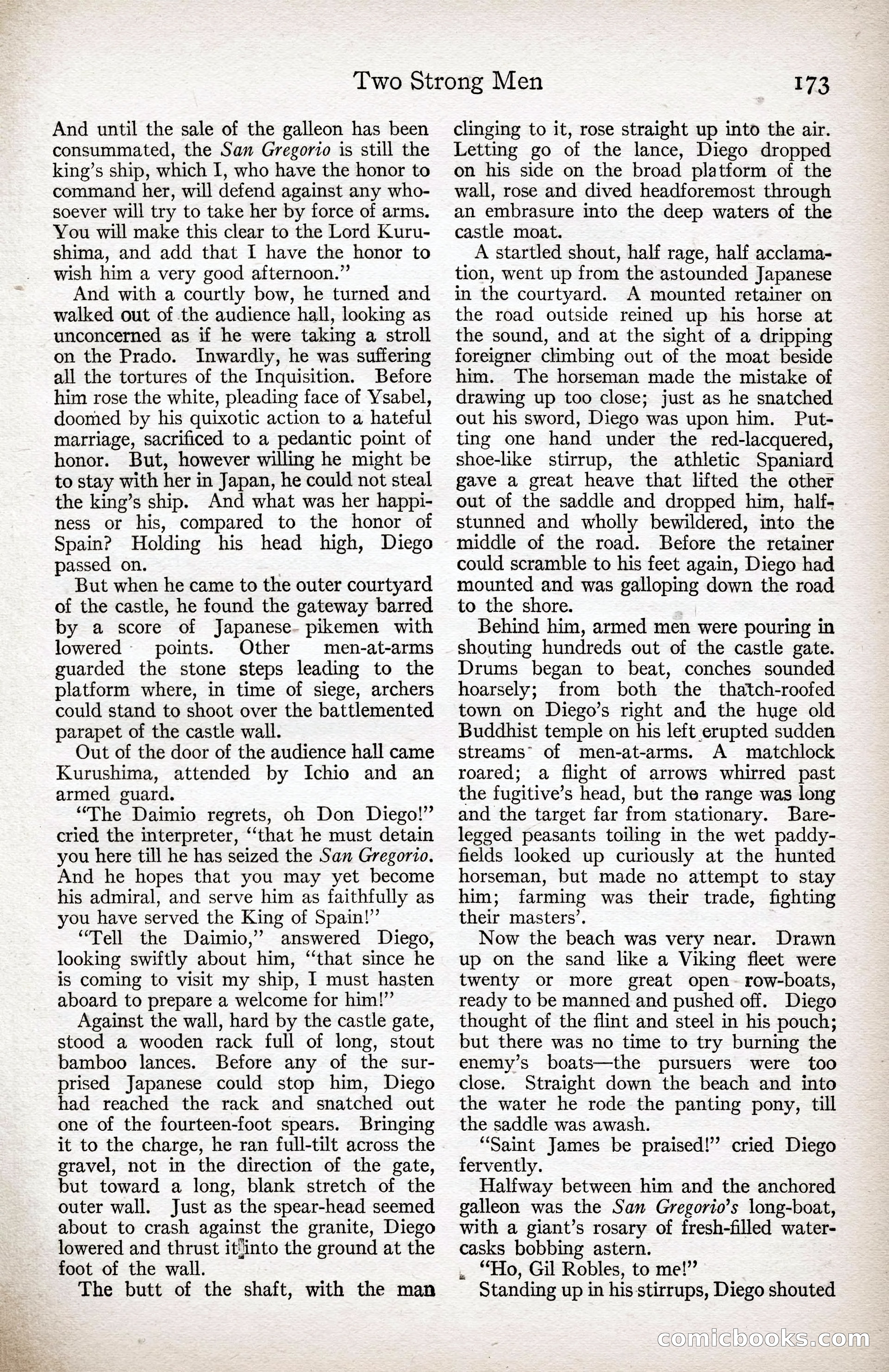
A restored page from Pulp Fiction, 1918. Page through the whole issue in the reader above.
📄 Transcribed text from this page (OCR, searchable)
Machine-transcribed from the original scan — historical spelling and the odd misread are preserved.
Two Strong Men And until the sale of the galleon has been consummated, the San Gregorio is still the king’s ship, which I, who have the honor to command her, will defend against any who- soever will try to take her by force of arms. You will make this clear to the Lord Kuru- shima, and add that I have the honor to wish him a very good afternoon.” And with a courtly bow, he turned and walked out of the audience hall, looking as unconcerned as if he were taking a stroll on the Prado. Inwardly, he was suffering all the tortures of the Inquisition. Before him rose the white, pleading face of Ysabel, doomed by his quixotic action to a hateful marriage, sacrificed to a pedantic point of honor. But, however willing he might be to stay with her in Japan, he could not steal the king’s ship. And what was her happi- ness or his, compared to the honor of Spain? Holding his head high, Diego passed on. But when he came to the outer courtyard of the castle, he found the gateway barred by a score of Japanese- pikemen with lowered points. Other men-at-arms guarded the stone steps leading to the platform where, in time of siege, archers could stand to shoot over the battlemented parapet of the castle wall. Out of the door of the audience hall came Kurushima, attended by Ichio and an armed guard. “The Daimio regrets, oh Don Diego!” cried the interpreter, ‘“‘that he must detain you here till he has seized the San Gregorio. And he hopes that you may yet become his admiral, and serve him as faithfully as you have served the King of Spain!” “Tell the Daimio,” answered Diego, looking swiftly about him, “that since he is coming to visit my ship, I must hasten aboard to prepare a welcome for him!”’ Against the wall, hard by the castle gate, stood a wooden rack full of long, stout bamboo lances. Before any of the sur- prised Japanese could stop him, Diego had reached the rack and snatched out one of the fourteen-foot spears. Bringing it to the charge, he ran full-tilt across the gravel, not in the direction of the gate, but toward a long, blank stretch of the outer wall. Just as the spear-head seemed about to crash against the granite, Diego lowered and thrust it/into the ground at the foot of the wall. The butt of the shaft, with the man 173 clinging to it, rose straight up into the air. Letting go of the lance, Diego dropped on his side on the broad platform of the wall, rose and dived headforemost through an embrasure into the deep waters of the castle moat. A startled shout, half rage, half acclama- tion, went up from the astounded Japanese in the courtyard. A mounted retainer on the road outside reined up his horse at the sound, and at the sight of a dripping foreigner chmbing out of the moat beside him. The horseman made the mistake of drawing up too close; just as he snatched out his sword, Diego was upon him. Put- ting one hand under the red-lacquered, shoe-like stirrup, the athletic Spaniard gave a great heave that lifted the other out of the saddle and dropped him, half- stunned and wholly bewildered, into the middle of the road. Before the retainer could scramble to his feet again, Diego had mounted and was galloping down the road to the shore. Behind him, armed men were pouring in shouting hundreds out of the castle gate. Drums began to beat, conches sounded hoarsely; from both the thatch-roofed town on Diego’s right and the huge old Buddhist temple on his left erupted sudden streams’ of men-at-arms. A matchlock roared; a flight of arrows whirred past the fugitive’s head, but the range was long and the target far from stationary. Bare- legged peasants toiling in the wet paddy- fields looked up curiously at the hunted horseman, but made no attempt to stay him; farming was their trade, fighting their masters’. Now the beach was very near. Drawn up on the sand like a Viking fleet were twenty or more great open- row-boats, ready to be manned and pushed off. Diego thought of the flint and steel in his pouch; but there was no time to try burning the enemy’s boats—the pursuers were too close. Straight down the beach and into the water he rode the panting pony, till the saddle was awash. “Saint James be praised!” cried Diego fervently. Halfway between him and the anchored galleon was the San Gregorio’s long-boat, with a giant’s rosary of fresh-filled water- casks bobbing astern. . “Ho, Gil Robles, to me!” Standing up in his stirrups, Diego shouted Gomicbooks:Go